Since my last article/video on Russia’s ‘turtle tanks’ the adapted vehicles have continued to be used on several fronts but on Monday, 17 June Ukrainian forces captured their first turtle tank intact.
Known by numerous names by both sides including ‘Blyatmobiles’ (Блятьмобиль) and ‘assault garages’ (штурмовые гаражи), ‘Tsar Mangals’ (Царь мангал) or simply ‘sheds’ (сарай) the tanks are characterised by them being equipped with large counter-FPV shells made from readily available sheet metal (and other non-standard materials) and are sometimes equipped with electronic warfare jammers to provide additional protection against drones and sometimes with mine clearing devices such a mine rollers or ploughs. They appear to have been developed to provide improvised breaching vehicles capable of penetrating Ukrainian minefields, withstand drone attacks and in some cases deliver troops to an objective.
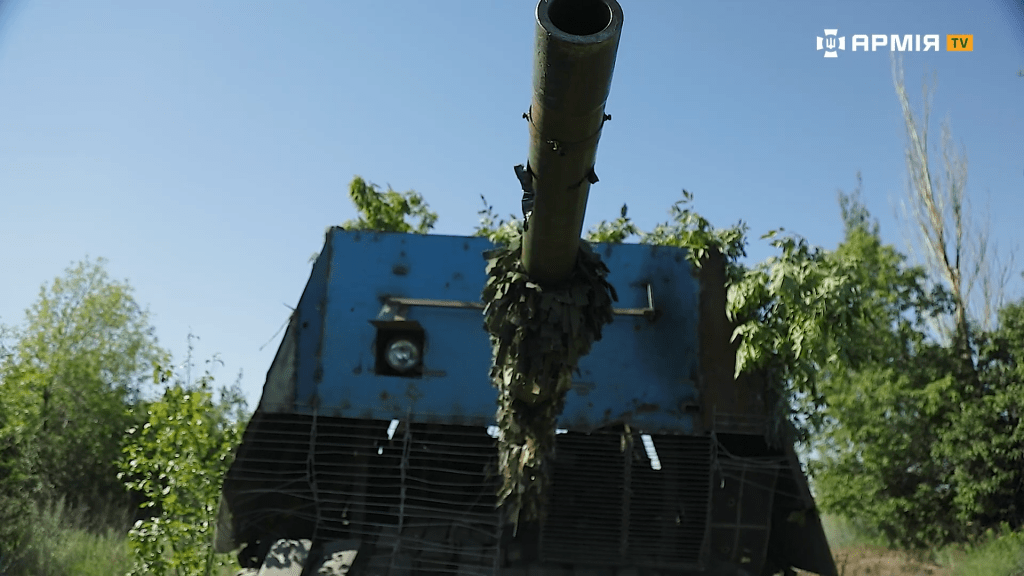
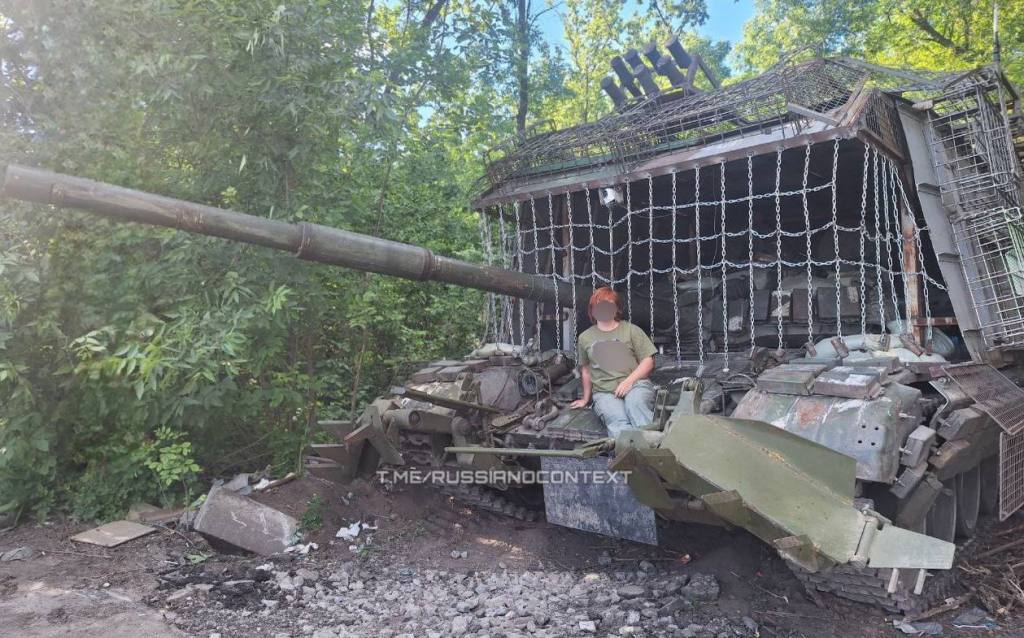
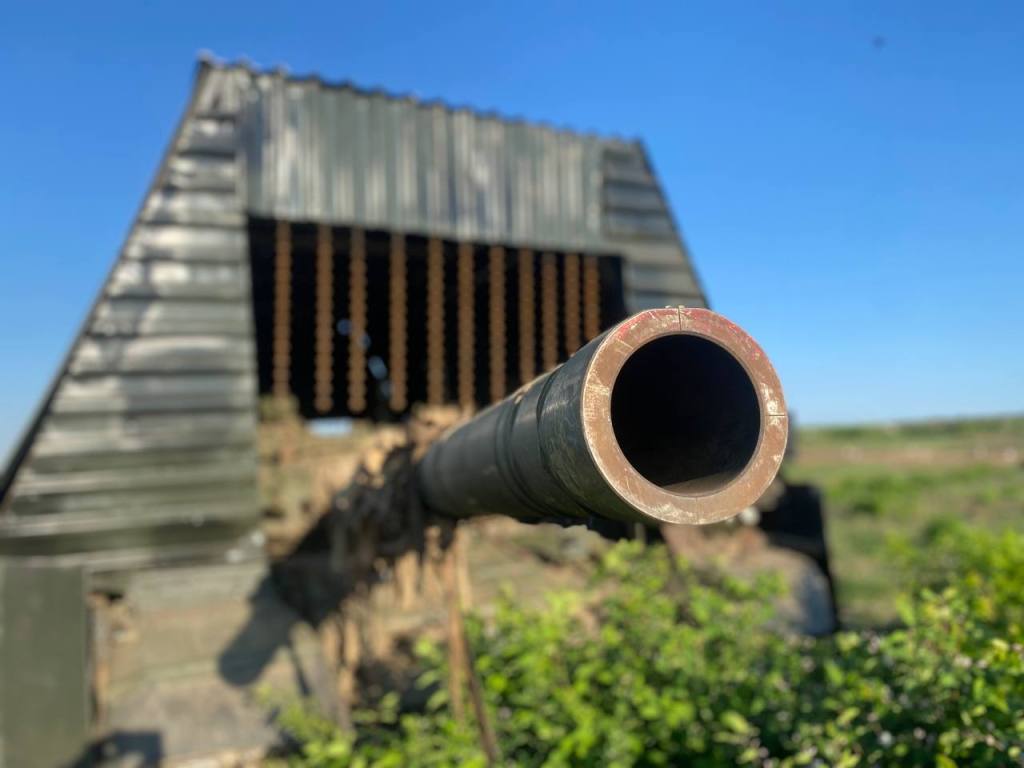
Front of the Turtle Tank captured in the field (via ArmyInform)
From posts on Ukrainian social media the tank was reportedly captured by troops from the 22nd Separate Mechanised Brigade but the vehicle was first encountered near Klishchiivka by soldiers of the 244th battalion of the 112th Territorial Defense Brigade that had been seconded to the 5th Assault Brigade.
The turtle tank allegedly became lost in the Klishchiivka area and saw an M113 APC belonging to the 2nd Battalion of the 5th Assault Brigade and began following it. When the M113 crew spotted the enemy tank it attempted to hide. The tank, however, continued to follow and on reaching the M113 a member of the turtle tank’s crew said to be the driver got out to ask for directions. He was captured by medics of the 244th Battalion. From the footage available it appears that the following morning troops of the 22nd Separate Mechanised Brigade approached the tank and captured an undisclosed number of Russian troops who were travelling in the rear of the turtle tank’s counter-FPV shell. Despite numerous sources and accounts the timeline of the tank’s capture remains somewhat unclear.
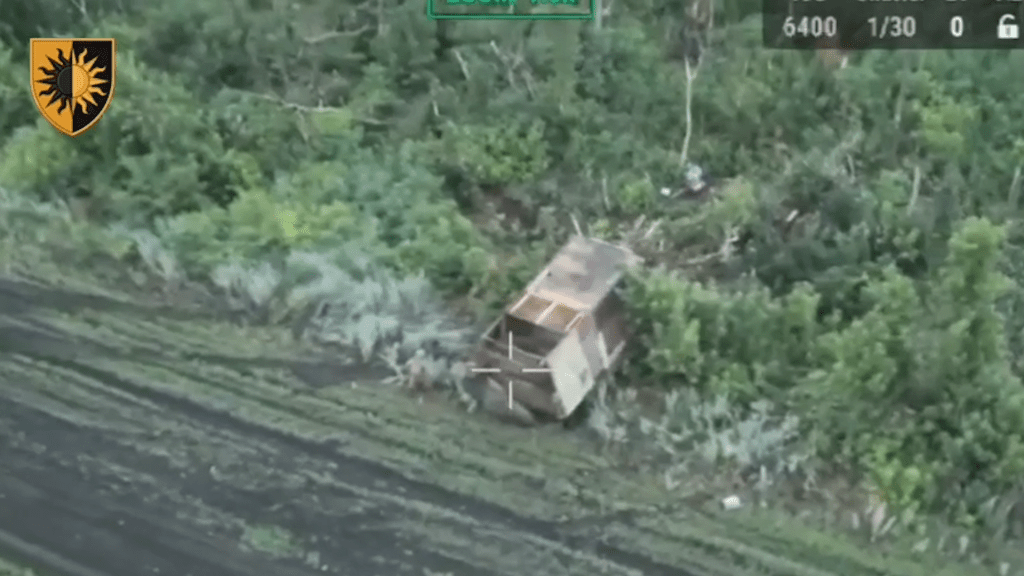
The immobilised Turtle Tank captured in the field (via 22nd Separate Mechanised Brigade)
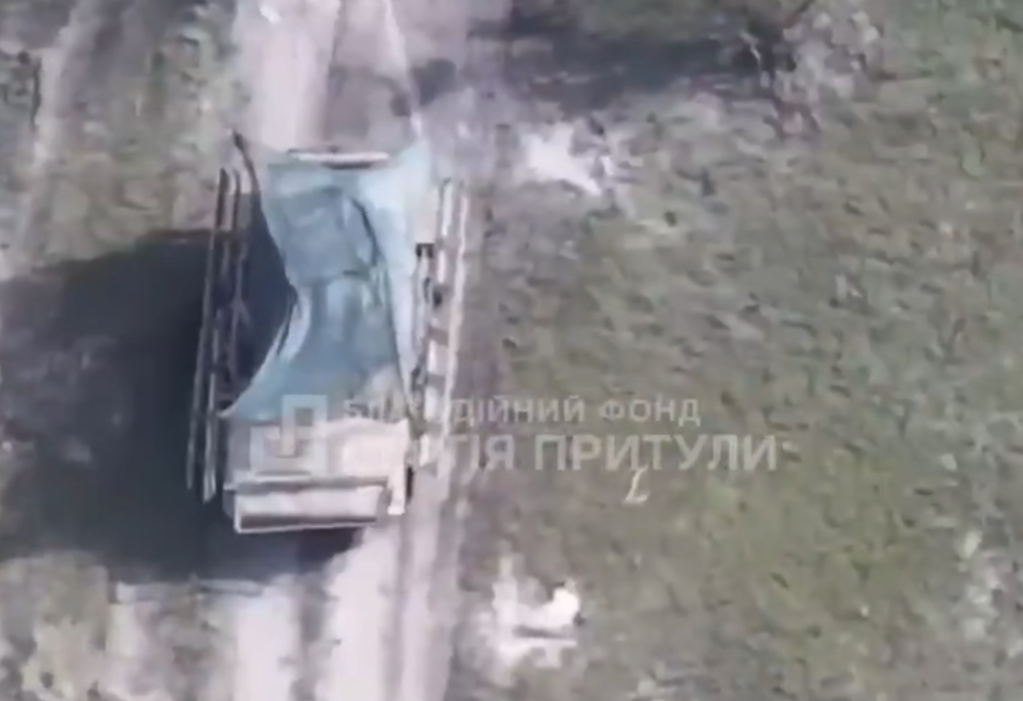
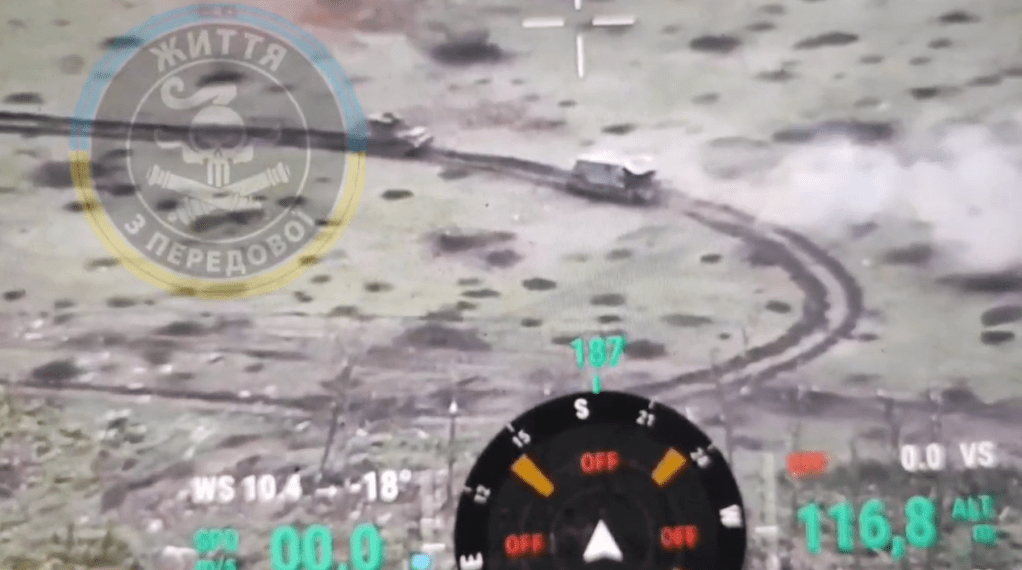
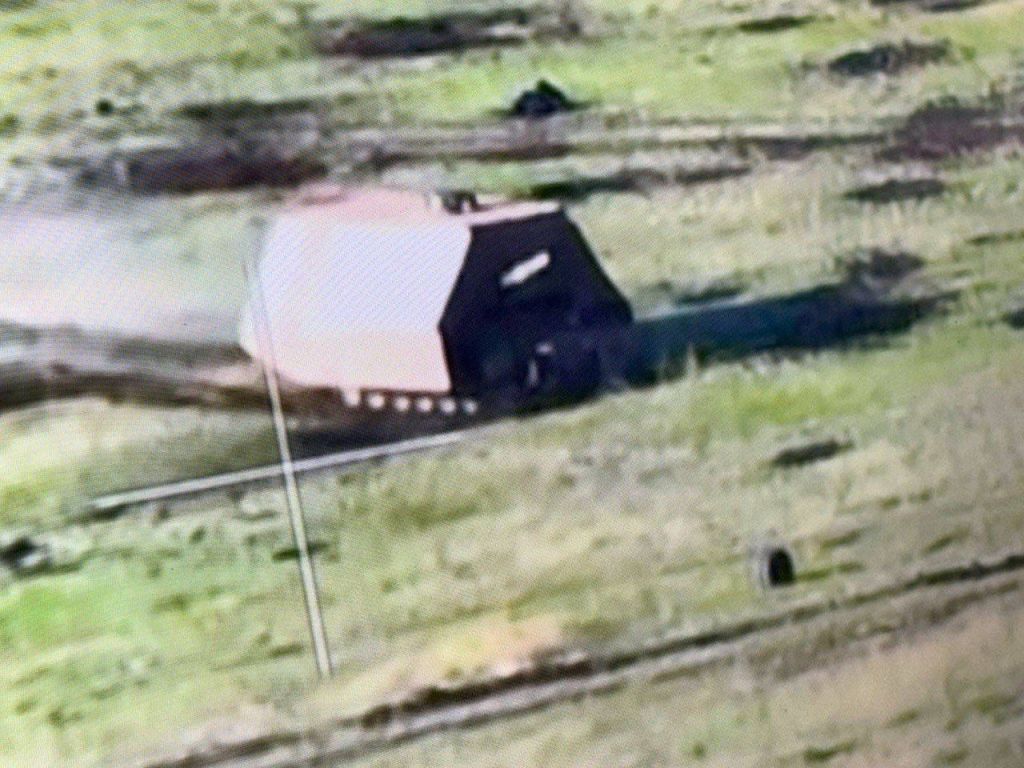
Subsequently released footage from a 22nd Mechanised Brigade drone appears to show the Turtle Tank being damaged by a drone dropped munition before it was captured. The post with the video claimed that the turtle tank’s crew became disorientated after the drone attack and mistakenly drove towards Ukrainian lines. Lt. Colonel Serhiy Misyura, of ArmyInform, also noted that the vehicle was struck by an FPV. Lt.Col. Misyura claims that the drone dropped munition detonated next to one of the tank’s road wheels and immobilised it. After it was captured Ukrainian troops were able to get the tank moving again and drive it to the rear.
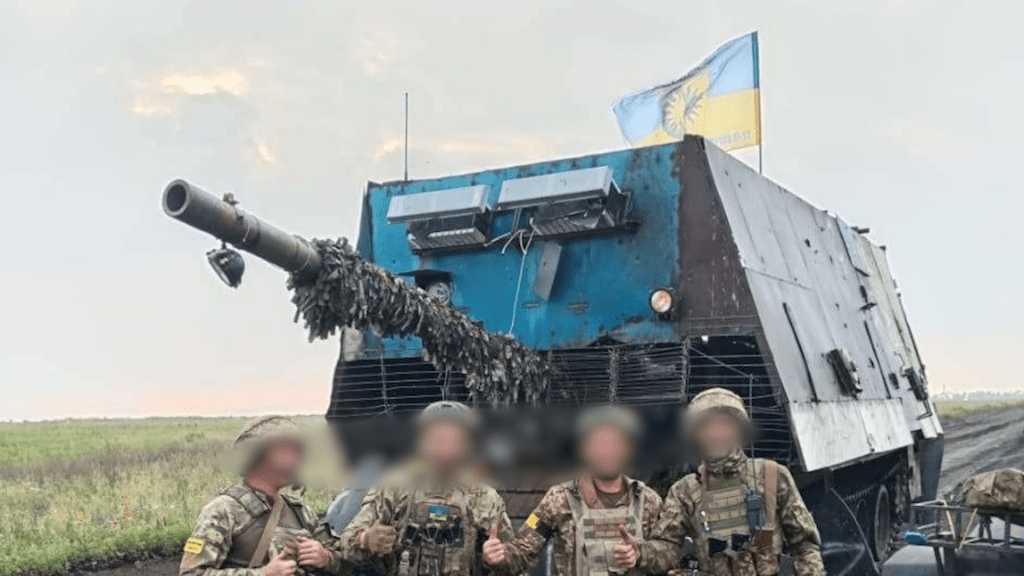
Drone footage then shows the capture of the tank’s crew and the vehicle moving off towards the Ukrainian rear. Teoyaomiquu shared a short clip filmed by a member of the 93rd Mechanized Brigade which showed the captured tank passing by, the 22nd Mechanised Brigade’s flag can be seen flying from the top of the tank. In a photograph of the tank and some of the men who captured it the same flag can be seen. Another piece of footage showing the tank close up also appeared online on the 18th June. The video shows the front, rear and left side of the tank’s counter-FPV shell.
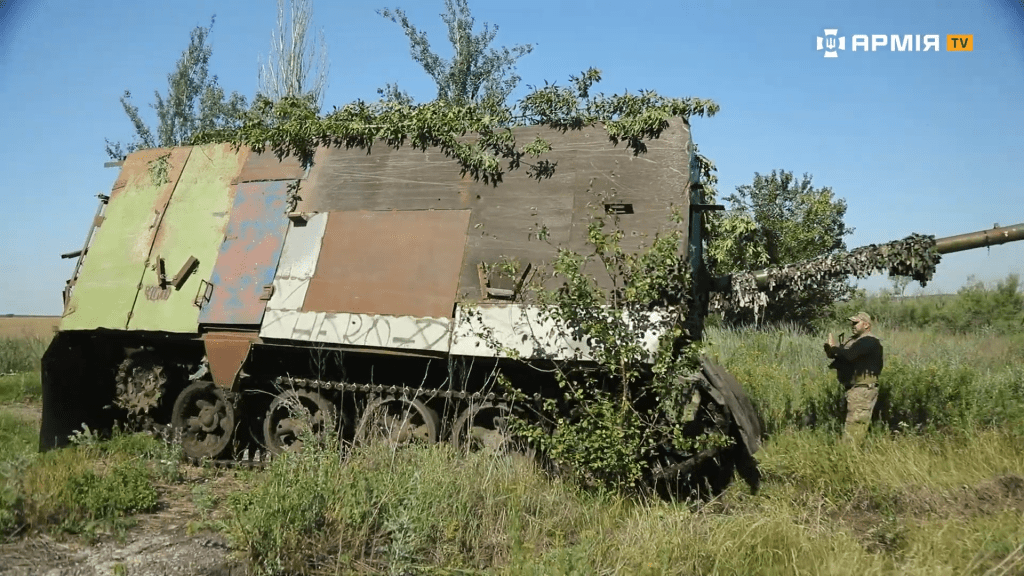
Right side of the captured Turtle Tank (via ArmyInform)
On the 19th June, the 112th Territorial Defense Brigade shared a short video showing the confused captured tank driver sat in the rear of an M113. On the 20th June, ArmyInform, the Ukrainian Armed Forces’ news outlet published a video on their YouTube channel giving us an up close look at the captured tank in detail during which Lt. Colonel Misyura describes it as a ‘marvel of modern Russian engineering’.
The Ukrainian Army were quick to capitalise on the propaganda value of finally capturing one of the Tsar Mangal (Tsar’s Barbaque) / assault sheds in tact, at the time of publication the video has over 650,000 views on YouTube alone.
Examining The Turtle
Since late April we have seen many variations on the ‘turtle tank’ theme, this example is certainly one of the least refined. Firstly, the tank does not appear to have been equipped with mine clearing kit as some of the other tanks have. However, it has been outfitted with what appear to be some sort of EW jammer to counter drones. Additionally, we can clearly see several UDSh smoke generators, held in a pair of brackets on either side of the shell. These have sometimes been misidentified as standard TM-62 anti-tank mines but the UDSh is a smoke generator which mimics the mine’s shape for training purposes. In this case they have been repurposed to enable the tank to create a mobile smoke screen. According to CAT-UXO the UDSh can be initiated electronically or manually and once ignited discharges smoke for 8-10 minutes. In the ArmyInform video it is also noted that the Kontakt ERA blocks seen on the tank’s glacis are empty.
Ukrainian troops pose in fron of the captured Turtle Tank (via social media)
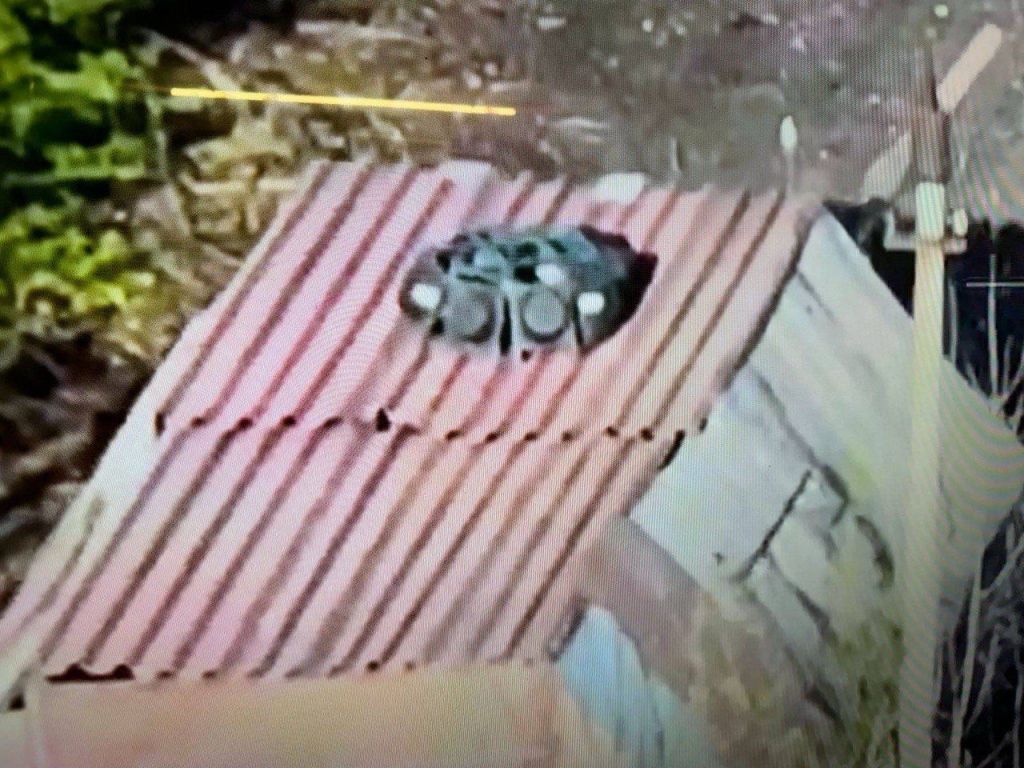
The tank itself is a T-62M and according to Ukrainian sources the turret is fixed in place and the tank carried no ammunition for its main gun, making it largely defenceless in isolation from supporting elements. The counter-FPV shell is crudely assembled made up of a mish-mash of materials including metal sheeting which ranges from rusted bare metal to various worn paint colours, wire fencing and metal caging. There also appears to be rubber matting attached front and rear to help keep dust down. The top of the shell over the tank’s engine deck appears incomplete and may have been damaged. In the ArmyInform video which shows the area in-detail it is clear that the counter-FPV shell’s support struts were welded directly to the top of the hull and a number of large and small shrapnel holes in the shell are visible.
Top of the captured Turtle Tank (via ArmyInform)
It appears that between when the vehicle was captured and when the ArmyInform video was filmed the Ukrainian have removed the assemblies, which may have been EW jammers, on the front of the tank. Its unclear how long the adapted tank has been in service but their is evidence of past repairs and there are numerous spray painted slogans on its panels including ‘god is with us’, ‘Hero-Z’ and ‘154 RUS’ (a possible joke reference to Russian vehicle registration plates). If this is the case it might hint at the origins of the Russian crew. ‘154’ is a registration code for the Novosibirsk Oblast which is the home of the 41st Combined Arms Army. In one clip of the tank it also has what appears to be a stolen ‘1941’ sign (possibly from a Great Patriotic War memorial) attached to the rear of its shell.
Support Us: If you enjoyed this video and article please consider supporting our work here. We have some great perks available for Patreon Supporters – including early access to custom stickers and early access to videos! Thank you for your support!
For several weeks now we’ve tracked the interesting phenomena of Russia’s tanks equipped counter-FPV shells, known by many names – Tsar’s BBQs, assault sheds, Blyatmobiles or Turtle Tanks. These vehicles began to appear in April around Krasnohorivka but since then have spread to numerous other sectors. Most recently they have played a role in the Russian offensive towards Kharkiv.
They combine a number of features including the large characteristic sheet metal shells, electronic warfare systems to jam drone control frequencies to protect against first person view (FPV) suicide drones. They also often feature devices such as mine plough and rollers to enable them to act as breaching vehicles.
Since other last video there have been even more interesting variations on the ‘turtle tank’ concept and also a fair amount of imagery showing them being successfully engaged. Which raises the question: has the tide turned on the Turtle Tanks?
On the 8 May photos of a Russian T-72B3 being fitted with a counter-FPV shell were posted. OSINT account Naalsionoted that while the tank had tactical markings denoting the 68th Guards Tank Regiment, 150th Motorised Rifle Division, 8th Guards Combined Arms Army, Southern Military District, the original Telegram post said that the work was carried out by the 104th Separate Tank Battalion of the 7th Guards Airborne Assault Division. In the photos we can see the assembly of a frame projecting from the tank’s sides with slightly angled sheet metal being welded to the frame.
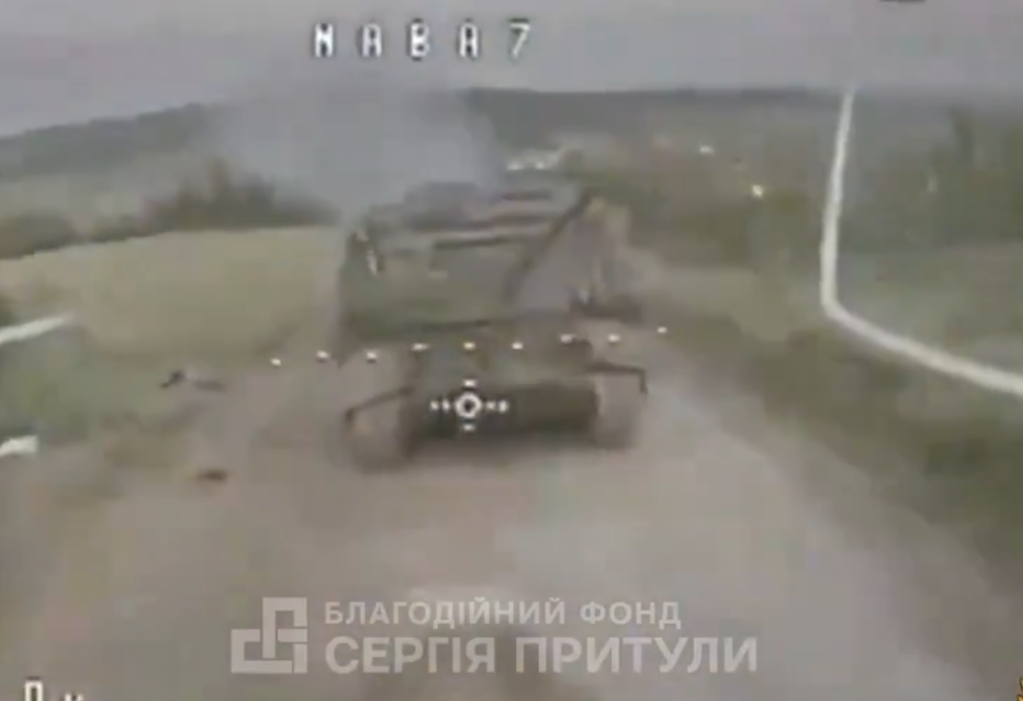
Ukraine’s Presidential Brigade shared some FPV footage of what may be another ‘Turtle Tank’ near Vuhledar. The resolution of the footage is low but the vehicle appears to have an EW module on top of its counter-FPV shell. Its unclear if the shell is solid s heet metal or if its is a mesh screen which covers the top part of the vehicle and has been shrouded in camouflage netting.
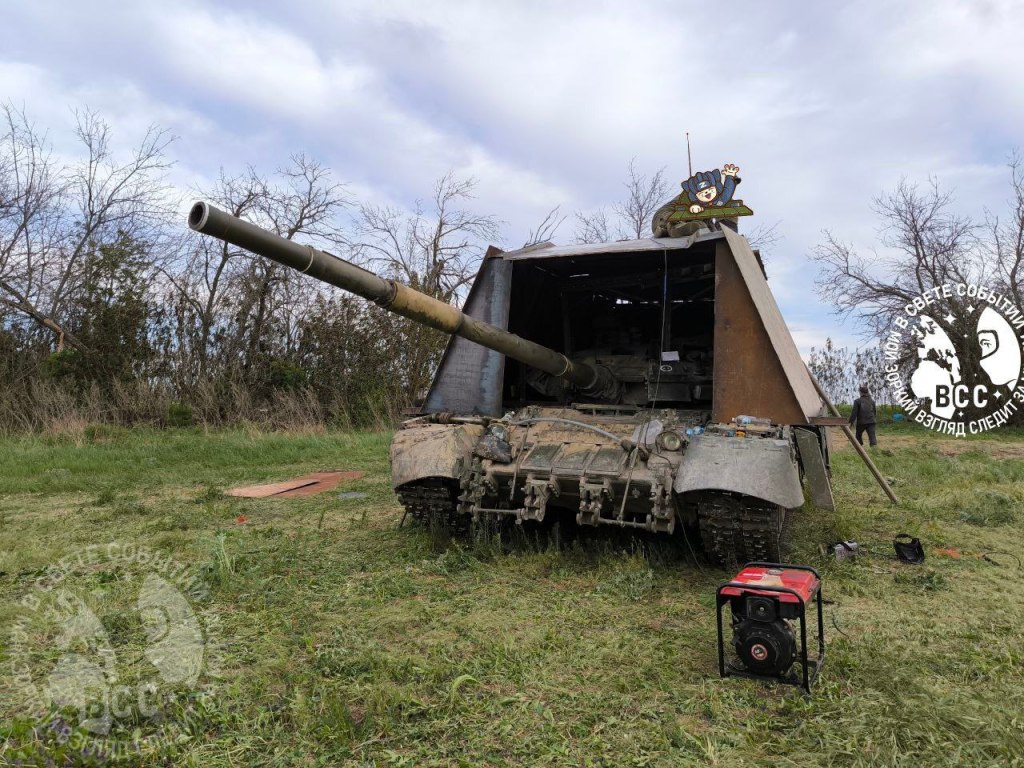
On 13 May, photographs of a pair of tanks fitted with shells were shared, with at least some of the work seemingly being completed in the field with a welder hooked up to a generator. The first vehicle has a visible framework and the sheet metal used to have surface rust. A possible second tank has a less angled shell and horizontally orientated metal sheeting. Markings visible on the first tank may suggest it tank belongs to the 3rd Motor Rifle Division’s 752nd Motor Rifle Regiment.
Also on the 13 May, the 3rd Assault Brigade claimed that the 3rd along with the 66th Mechanized, and 77th Airmobile Brigades had engaged Russian forces on the Kharkiv front and struck a ‘turtle tank’ with FPVs.
Footage of a recovered damaged ‘turtle tank’, which may be the tank which was immobilised during the initial assaults on the Kharkiv front, shows the tank’s shell badly damaged and its left-side track lost, however, its KMT-6 mine plough is still present.
The clearest imagery of of a knocked out ‘turtle tank’ which has appeared so far also emerged on 13 May. Three images taken by an observation drone show a T-62 which shares a numerous construction characteristics with the earlier ‘porcupine turtle’ seen on 5 May. It has similar protective grills made from cages which completely cover the outer metal sheets of the counter-FPV shell. However, its rear is not enclosed by sheet metal but a combination of sheets and grating.
The tank doesn’t have any visible electronic warfare equipment but is fitted with what appears to be a BTU-55 dozer blade mounting point (H/T – Ross) which is no longer present and not visible in the available imagery (although what appears to be a KMT-6 mine plough can be seen on the ground behind the tank). The tank clearly has signs of fire damage along its side and rear and the front portion of its shell as been blown inwards and warped, cause unclear though it may have been an artillery strike, ATGM hit or an FPV. Intriguingly, inside the shell appears to be an earlier pre-existing ‘cope cage’ shelter on the turret which does not not a part of the outer shell structure.
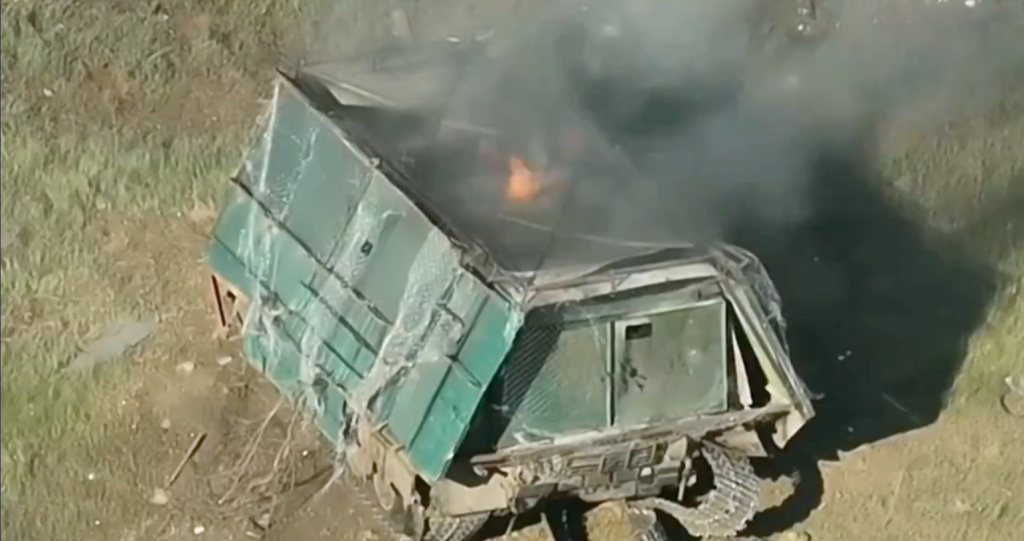
Further examples of tanks equipped with counter-FPV shells, which both sides increasingly refer to as ‘сарай’ or sheds, have been shared. Drone footage of a Russian T-72B3 equipped with a ‘shed’ was shared early on 14 May showing the vehicle on fire, with smoke billowing from its roof, and under attack by FPVs. The footage has reportedly been geo-located to Novovodyanoe, in the Luhansk region. Again the shell is made up of sheet metal with a rear hatch and an additional mesh roof screen. The tank has a broken track and one shot from the footage appears to show the vehicle surrounded by TM-62 anti-tank mines suggesting the vehicle entered a mine field. The vehicle does not appear to be fitted with a mine plough or roller.
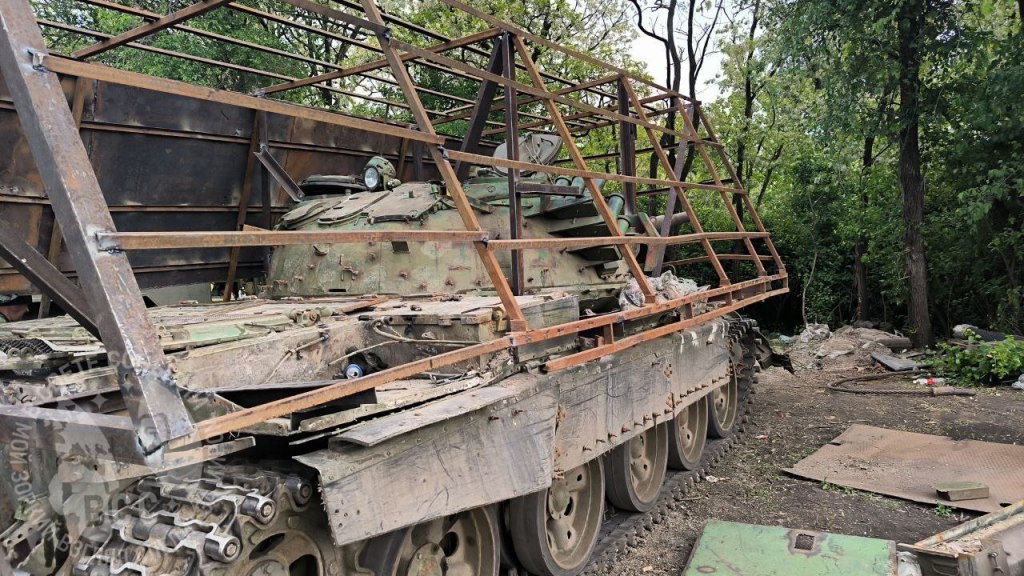
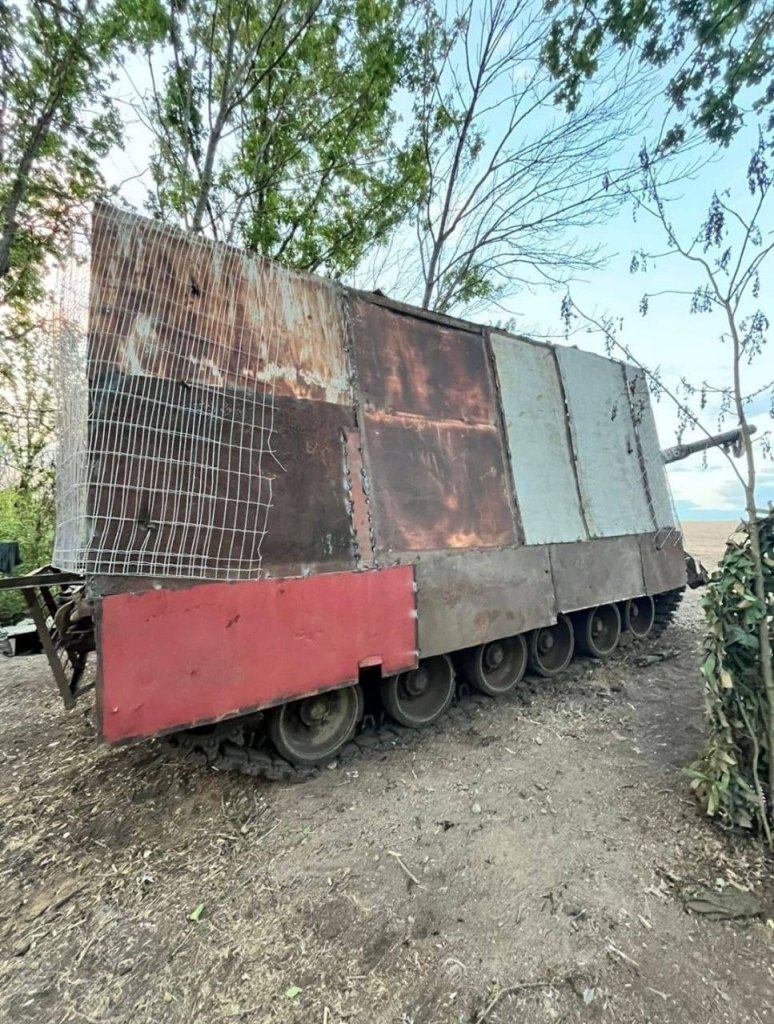
Additionally imagery of another T-62-based ‘turtle tank’ were also shared, date and location unknown, but the now standard construction of a rough internal framework made from box metal and then sheet metal welded onto the frame. From the photos it appears it may be fitted with a mine plough. Only one side of the shell has been completed but there is also a small ladder welded onto the frame at the rear for access to the engine deck. Intriguingly, we can also see that the frame itself has been welded to the tank’s turret with two angled struts meaning that the tanks turret cannot be traversed at all.
On the 14 May, footage of another knocked out ‘turtle tank’ emerged showing a burning tank near Andriivka in Donestsk. The tank appears to have been part of an armoured assault which may have been halted by artillery fire. The tank appears to be a T-62 fitted with KMT-6 mine plough. The vehicle is on fire with a significant portion of its shell blown off on its right side. The video also shows an FPV drone striking the tank from the rear. A further video appears to show an FPV able to enter the rear of the shell. The Ukrainian Ministry of Defense attributed the destruction of the tank to ‘Javelins and FPV drones’ deployed by the 93rd Mechanised Brigade.
On the evening of 14 May, the 79th Air Assault Brigade shared video of another Russian attack in Novomykhailivka, in Donetsk. This showed several intriguing vehicles including a hybrid-turtle which had a layer of tyres under some cage armour and a camouflage net. [Additional footage here] Another brief shot showed a tank, with no visible main gun, moving across open ground. It is equipped with a KMT-7 mine roller and a counter-FPV shell/shed which is open fronted with no additional protection such as a chain curtain or wire cages. It appears the assault was met with both artillery and FPVs.
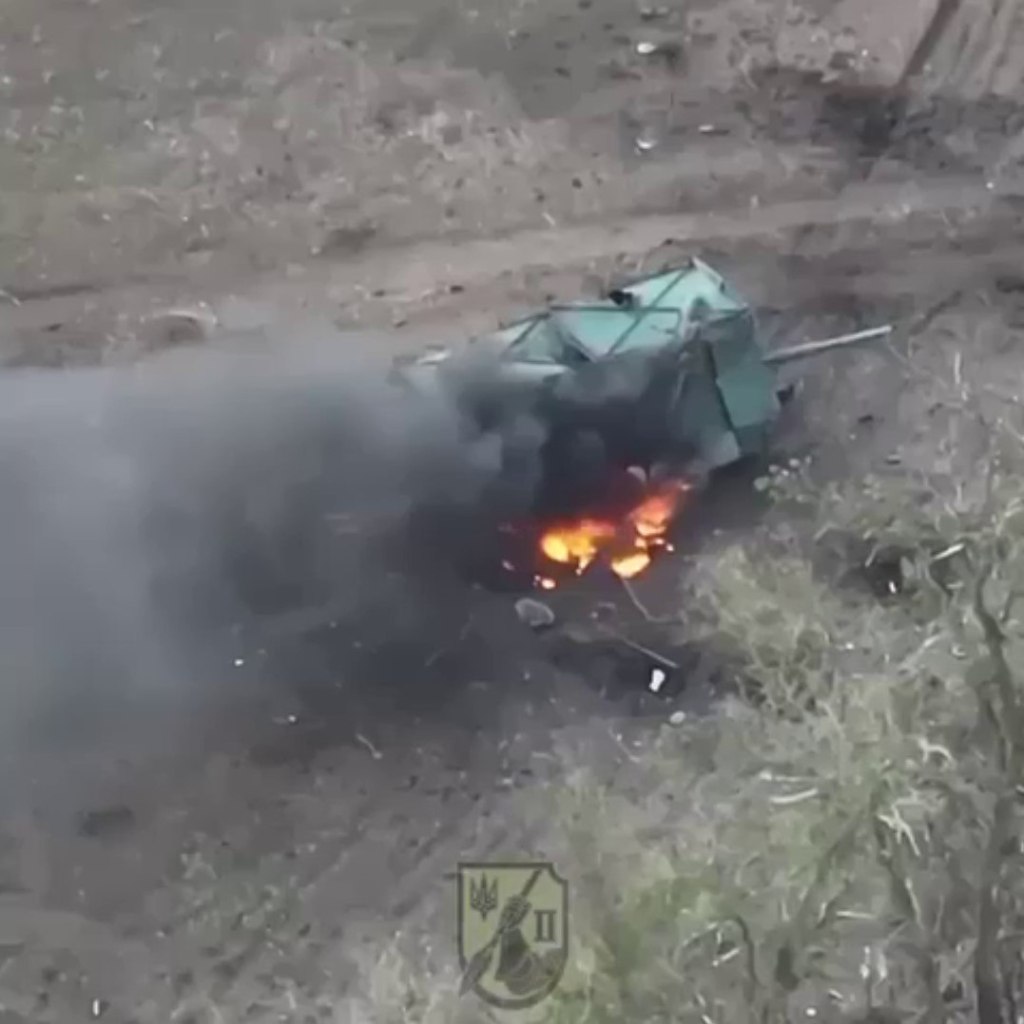
On the 15th, observation drone footage was shared of a badly damaged, burning ‘turtle tank’ which was destroyed by the Ukrainian 72nd brigade during a Russian attack in the Vuhledar sector. The date of the engagement is unconfirmed but the video shows the vehicle being destroyed in a spectacular explosion, likely due to a cook-off of ammunition.
On the 15 May another image of a converted T-72 in Donetsk emerged. Visible in the photo is a sheet metal counter-FPV shelter equipped with a layer of outer wire cages. A KMT-6 mine plough is fitted and a chain curtain protects the turret while providing decent visibility for the tank’s frontal arc. Additionally a commercial surveillance camera has been attached to the roof of the shell. An АЕК-902 smoke discharger is attached to the top of the shell and ERA blocks have been attached to the skirt and then enclosed partially by a wire screen.
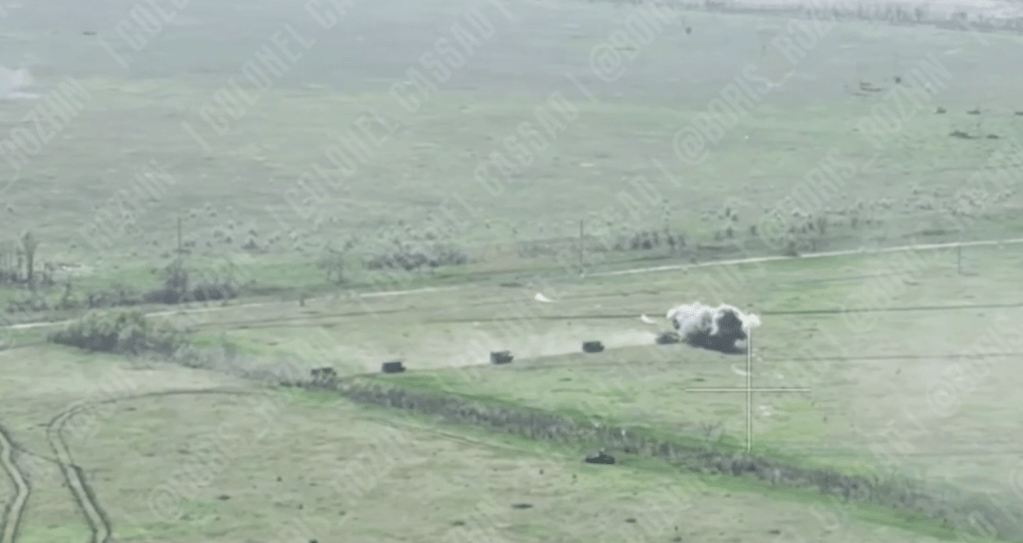
On the 16 May, Russian military vlogger Large Caliber Trouble shared a series of videos which featured armoured vehicles fitted with counter-FPV shells. The first video showed an armoured assault with three vehicles with shells/sheds and one tank without. The footage, from an observation drone, is too low resolution to fully make out the configuration of the Turtles but its clear that the lead vehicle is equipped with a set of mine rollers. The assault column is bracketed by Ukrainian artillery fire and the lead tank is damaged and forced to turn back. While the second moves up and deploys smoke from an AEK-902 launcher the lead tank appears to take a direct hit to its rear, possibly from an FPV drone.
One of the tanks is called the ‘scorpion’ and is tasked with “clearing mines and identifying enemy points”. In a video showing the vehicle in action it is clear that the design is substantially different to previous ‘turtle tanks’ with no visible main gun, a fully enclosed front and an overhanding sheet metal rear awning. The vehicle is also equipped with a KMT-7 mine roller. In another post he described the vehicle as “a captured tank with a cut-off turret” that used “different building materials for [the] armor”. He claims it was “hit by 8 anti-tank guns and countless artillery shells.”
As always with these breakdowns we have to remember that we don’t have the full picture and the available imagery represents a fraction of what is happening on the frontline. As mentioned in the previous article/video the ‘turtle tanks’ are just as susceptible (if not more) to conventional means of knocking out tanks: mines, artillery and anti-tank guided missiles. It remains to be seen if a new trend is emerging that suggests that Ukraine is now increasingly capable of successfully countering the Russian assault sheds or if indeed the Turtle Tank will adapt again.
Updates
Update – 19/05/24:
On 18 May, the drone unit with the 3rd Assault Brigade shared further video of the ‘turtle tank’ that was first seen on 8 May. Filmed at the same time they stated that they came across an immobilised and abandoned ‘turtle tank’ and made several sorties to damage the vehicles engine and main gun.
Also on the 18 May, FPV camera footage from the 93rd Mechanised Brigade’s SIGNUM unit showed the ‘turtle tank’ first seen in footage shared on 14 May, near Andriivka in Donestsk. The first FPV can be seen to dive and strike the upper, right side of the shell. Another comes in low targetting the tank’s wheels while a third attacks the open hatch at the rear.
On the 19 May, several photos of hybrid-Turtles were shared by the Russian Ugolok_Sitha telegram channel showing T-62Ms with either a mine roller or a plough as well as camouflaged cope cages or Turtle-style counter-FPV shells made from gratings rather than solid sheet metal which have then been camouflaged with netting.
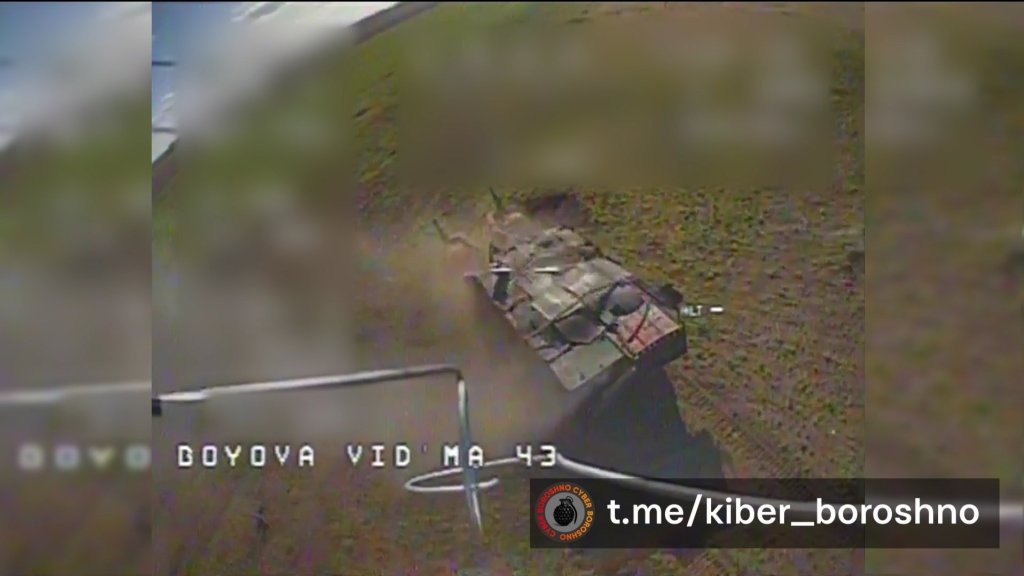
It emerged on 19 May that the ‘Scorpion’ showcased by Large Caliber Trouble three days earlier had apparently been successfully engaged. CyberBoroshnoshared a short clip showing the vehicle being struck by FPV drones and set alight. CyberBoroshno suggested the vehicle was an ‘atypical MT-LB’ but it is likely the tank, which had had its gun removed, was a T-62M.
The ‘Scorpion’ Turtle Tank about to be hit by an FPV (via social media)
On the evening of the 19 May, the 81st Airmobile Brigade shared drone footage of a pair of MT-LBs, both equipped with counter-FPV shells and both destroyed. The first MT-LB appears to have had its corrugated metal shell panels blown off and is burnt out. The second vehicle’s shell design is different with sheet metal panels and a cage frontage. The footage is said to have been filmed near the village. Belogorivka, Lugansk
Update – 20/05/24:
On 20 May, a Ukrainian telegram channel shared a video of another ‘Turtule Tank’, again with no visible main gun but with the usual trapezoidal sheet metal shell. The vehicle has a set of KMT-7 mine rollers and appears to strike two mines while moving at speed. A crew member is then seen running from the tank on foot as another explosion, possibly from an FPV, is seen on the left side of the tank. It is claimed the video was filmed on 18 May, near Novomykhailivka.
Also on the 20 May, the ADAM Tactical Group, shared a video of an FPV striking the rear of a moving vehicle which appears to have a counter-FPV shell. The low resolution of the footage makes it difficult to identify the vehicle. The construction of the vehicle’s shell is similar to that of the T-72B3 seen on the 14 May which had a pine green painted shell and supporting cross pieces visible on the shell’s top plates.
Update – 22/05/24:
On 21 May, CyberBoroshnoshared footage of a Russian ‘turtle tank’ damaged Marinka in the Donetsk region. The vehicle has seemingly already been disabled and the rear of the shell damaged. The shell has a secondary layer of bages on top of the sheet metal shell. The shell appears to have a considerable number of Kontakt-1 ERA bricks on the rear of its shell.
A Turtle Tank engaged by the ‘Rubizh’ Brigade (via social media)
Also on the 21 May, the 2nd battalion of the 4th Rapid Reaction Brigade “Rubizh” destroyed a turtle tank in Makeevka, Lugansk. The video shows the tank with heavy damage to its shell, with a fire on its right side. The very brief clip shows what may be a Bonus or 155 SMART round detonating above the tank while its stationary, alternatively it may be a close range engagement of the tank with an infantry anti-tank weapon.
Update – 23/05/24:
A video of an abandoned T-62BV enclosed in a hybrid ‘shell’ made from mesh being struck by FPVs was shared on the 23 May. Additionally, a telegram channel shared what was claimed to be a conversation between Russian combatants discussing the possibility of using rubber matting on ‘turtle tanks’. This post included a photograph of a very rustic looking ‘turtle tank’ which featured a mix of metal sheeting and fence wire enclosing the rear opening.
Photo of a rustic ‘turtle tank’ shared on 23 May, featuring a mix of steel sheeting and wire (via social media)
Also on the 23 May further footage of a ‘Turtle Tank’, first seen on 6 May, was shared showing the tank burnt out and completely destroyed after it was previously seen immobilised.
Update – 28/5/24:
On the 27 May, Ukraine’s 71st Jaeger Brigade shared further drone footage of a classic Turtle Tank with a low profile, well built counter-FPV shell. The Ukrainian Armed Forces press centre first shared video of this engagement on the 25 May, dating the footage to at least before the 25 May. The post did not state the location of the engagement, just that it was successfully engaged by FPVs. Two of which entered the rear of the shell and detonated near the turret ring. The tank appears to be equipped with mine rollers, fitting the Turtle Tanks’ conventional role as breachers.
Some recent footage of a Russian 'turtle tank' being destroyed by FPV drones of Ukraine's 71st Jaeger Brigade.
— Matthew Moss | Historical Firearms (@historicfirearm) May 28, 2024
Footage published in late May, with date and location unconfirmed, shows a BMP-2 fitted with a counter FPV shell being damaged by a munition being dropped by a drone. The vehicle already seems to have been mobility killed.
An interesting hybrid-Turtle was seen in footage shared by the Apachi FPV Strike Group on 27 May. It shows a tank with what appears to be a net over a frame work protecting the turret and two layers of spaced armour on its sides (see images below).
Also on 27 May, a single photograph of a T-72 being equipped with cage turret protection and horizontal slat protection on its sides was shared. It’s unclear what the vehicles finished form will by but other similar configurations have been covered with camouflage netting to make targetting more difficult for FPVs [Example].
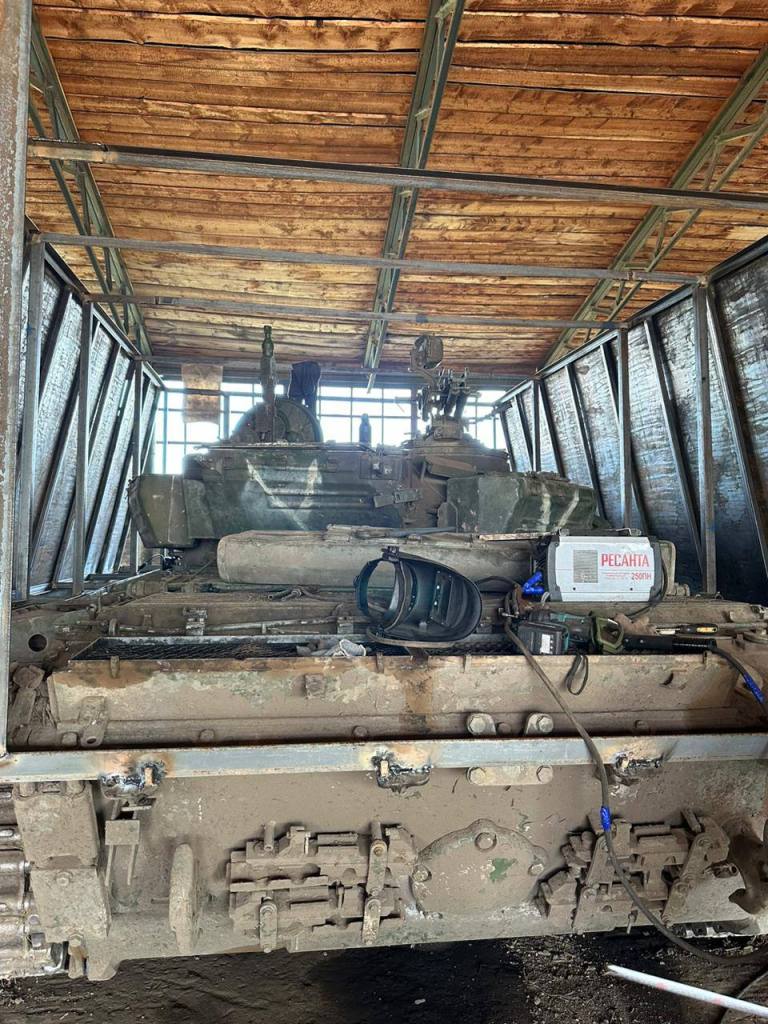
Russia's Zvezda published a short video of Russian repair crews welding a mine plough on a #TurtleTank which is based on a damaged T-72 with its turret removed. There is a 2nd Turtle is in the background.
— Matthew Moss | Historical Firearms (@historicfirearm) May 28, 2024
On 28 May, Russia’s Zvezda Newspublished a short video of Russian repair crews welding a set of mine ploughs on a Turtle Tank (or as the report calls them Tsar-Mangal / Tsar’s barbecue). The report notes that the T-72 featured was damaged so its turret was removed and a counter-FPV shell added to create a APC capable of carrying troops. In the footage a second Turtle Tank can be seen in the background. The report did not state the units location.
A still from footage showing a transporter, carrying a Turtle Tank, which was involved in an accident in Belogrod (via social media)
On the evening of the 28 May, footage of a road traffic accident near Korocha, in the Belgorod region, showed several vehicles involved in a crash including a Russian tank transporter carrying a Turtle Tank (see above). The KamAZ tank transporter can be seen jackknifed and on fire. The tank can be seen fitted with mine ploughs and a trapezoidal counter-FPV shell, with a open front and an enclosed rear.
Support Us: If you enjoyed this video and article please consider supporting our work here. We have some great perks available for Patreon Supporters – including early access to custom stickers and early access to videos! Thank you for your support!
In a recent article/video we looked at the proliferation of Russia’s unusual ‘Turtle Tanks’ which are protected by ad hoc, locally fabricated counter-FPV shells. Since then we’ve gotten a good look at several more Turtle Tanks and our first look at the driver’s point of view.
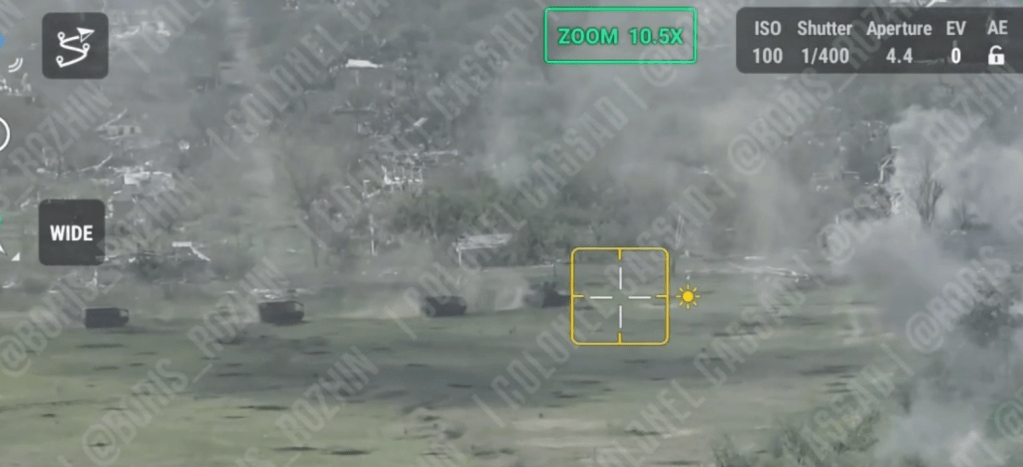
Footage, filmed on 27 April, of another Russian armoured assault into Krasnohorivka shows a column of four infantry fighting vehicles with what appear t o be counter-FPV shelters following a tank with a ‘cope cage’
On the 29 April, a Ukrainian Telegram channel posted a short video of a ‘Turtle Tank’ attack in the Bakhmut direction, noting that [machine translated]: “the equipment is stupidly scalded with metal, from 5 units it was possible to destroy a tank and an armored personnel carrier. A lot of FPV was spent on one tank. Everyone laughs at their construction of barns, but in fact they work like hell.” The tank appears to have a box like shelter with a sloped forward roof over its gun and glacis. As seen in earlier videos the tank is leading a column of armoured vehicles during the assault, clearing a path for them. It appears to detonate a mine with its mine plough and retreats.
At the start of May a pair of T-62s with hybrid counter-FPV shelters were seen in photos taken by a UAV, location unconfirmed. These images illustrate the blurring of the lines between ‘cope cage’ equipped tanks and the ‘turtle tanks’. Like the earlier turtle tanks they’re fitted with EW sets & KMT-6 mine ploughs but do not have shells made entirely from sheet metal. Instead, they appear to have used chainlink and gratings, one piece of which appears to have Kontakt (explosive reactive armour (ERA) mounted. One of the vehicles appears to have been used to transport supplies. One T-62 has broken tracks, the other top damage.
A hybrid combining elements of the Turtle Tank with that of earlier ‘cope cages’ (via social media)
Around the same time the Ukrainian 79th Air Assault Brigade shared video of Russian attacks near Novomykhailivka, in Donetsk, the footage included a brief clip of a ‘turtle tank’ with a small forward opening, camouflage over its shell frame and no sign of a mine plough or roller fitted. On 2 May, the 33rd Mechanized Brigade shared footage from thermal camera-equipped FPV drones showed a Russian tank being used to transport troops, the profile of the counter-FPV shelter is visible but the low definition of the thermal footage makes it difficult to analyse its construction. The vehicle, however, appears to be equipped with a mine plough and possibly an EW module.
Also on 2 May, Ukrainian drone fundraiser Teoyaomiquushared a video of a Russian assault near Ivanivske which shows a pair of Russian armoured vehicles with counter-FPV shells, one of which deploys a smoke screen. The 1st Assault Battalion of the 5th Separate Assault Brigade also shared footage from the Russian assault showing the shell-equipped vehicles.
On the 5 May a short video was posted by a Russian combatant which showed an entirely enclosed MT-LB with steel plates surrounding the top of the vehicle and its wheels. It also has an additional mesh roof cover to add additional top protection. Two cutouts in the side and one in the front for the driver also have mesh covers to give some visibility. On the same day video of a destroyed BTR-MDM which had been encased in a counter-FPV shelter was shared, showing the rear of the vehicle enclosed.
An evolved Turtle Tank with added cages on its superstructure (via social media)
Perhaps the most striking evolution of the ‘Turtle Tank’ appeared on 5 May, a tank completely enclosed except for a small gap at the front. Protective grills made from cages completely cover the outer metal sheets of the counter-FPV shell. One Russian telegram channel likened it to a rolling ‘poultry farm’. The vehicle also has a KMT-7 mine roller. Additional video of the porcupine-like tank gives us the first look at what it is like driving one of these ‘turtle tanks’, with his hatch open the driver has an almost clear view ahead (apart from the solid awning above him and the partial grill cage protection to his front) but no view to the left or right front quarters of the tank.
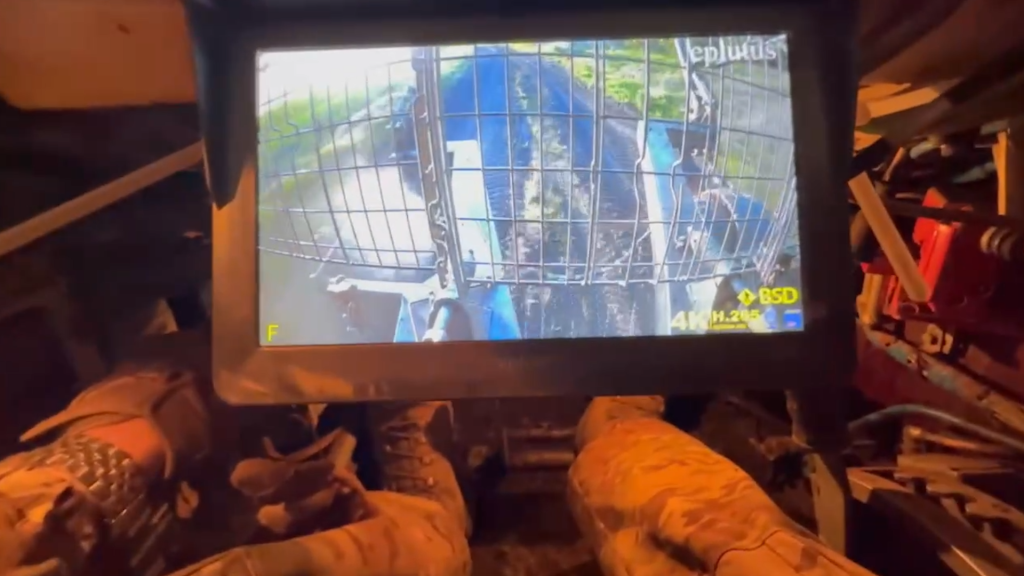
A Turtle Tank driver using a camera feed to steer (via social media)
Several days later footage from inside what appears to be the same tank shows the driver steering by video monitor. The readout on the monitor suggests the video’s resolution is 4K H.265 but the field of view appears limited, with the camera seemingly positioned on the shell’s awning looking down between the KMT-7’s two rollers. The system used is from Russian automotive accessory company Eplutus and appears to be one of their rear view camera monitors.
Another piece of UAV footage shows another ‘turtle tank’ with a much boxier shell. It again has all of the major features seen in earlier examples: a sheet metal shell which encloses most of the top part of tank, a set of mine rollers and a EW jammer module on the roof. Some sources suggest the footage was filmed near Bilohorivka, in Luhansk. It’s unclear when the footage was filmed but the vehicle appears stationary with access grates to the tank’s rear deck left open.
The 7 May saw evidence of the proliferation of t he ‘turtle tank’ concept with Russian social media sharing photographs of a ‘Turtle Tank’ fabricated by the Russian 40th Naval Infantry Brigade, these indicate that the concept is continuing to proliferated, perhaps without any central influence. The tank is encased in a counter-FPV shelter made up of three large metal sheets, a poorly fabricated angled roof which slopes at the rear with a flat top and a wire mesh slopping front piece. Additionally on the floor there appears to be a chair curtain similar to those seen on other ‘turtle tanks’. The rear has an extended deck and appears to be enclosed. A skirt of Kontakt-1 ERA has been roughly added around the skirt. As with other Turtle Tanks the ‘V Turtle’ is equipped with what appears to be an RP-377 electronic warfare jammer. It also has a KMT-6 mine plough fitted. A large white V has been painted on the sides of the shell and Russian flag rings added to the barrel.
A Turtle Tank built by the 40th Naval Infantry Brigade (via social media)
On 10 May, footage of an FPV drone attacking an immobilised ‘turtle tank’ emerged. The tank is again enclosed by a counter-FPV shell and has a mine plough. The feed from the drone also suffers from some interference as it approaches the vehicle suggesting that an EW module may be present nearby, perhaps aboard the tank. However, it appears that a mine has damaged the tank’s tracks and the vehicle has been abandoned allowing an FPV to attack via an open rear hatch. The footage was reportedly filmed during the first day of the new Russian offensive towards Kharkiv. This again shows that not only is the concept proliferating but also that the ‘turtle tanks’ are still vulnerable to conventional anti-tank weapons like mines.
Also on the 10 May, the Russian military channel, Large Caliber Trouble, shared a photo of the porcupine turtle tank which had been damaged by FPV strikes showing the cage bars bent and some holes in the counter-FPV shell. The post claims that the tank was “attacked by 40 kamikazes, [but] thanks to electronic warfare, most of them fell and only 8 FPVs were able to cause damage.” The condition of the vehicle after the engagement is unknown. The suggestion that a large number of FPVs attacked the tank supports the earlier Ukrainian comments about ‘a lot of FPV [being] spent on one tank.’
A ‘turtle tank’, possibly a T-80, seen on the eastern front on the first day of the Russian Kharkiv offensive (via social media)
A key question is how can the Turtle Tanks be defeated? Basically just like any other tank can be: anti-tank guided missiles with tandem warheads, dense mines belts, direct hits by artillery, use of multiple FPV drones to damage and breach the shell with additional drones to exploit gaps made.
We will probably see further proliferation of the ‘turtle tanks’ in coming weeks but with time the Ukrainians will probably find ways to engage these protected tanks more effectively, as is so common in war there will probably be a continued evolution of measure and counter-measure.
Update – 13/5/24:
On the 8 May photos of a Russian T-72B3 being fitted with a counter-FPV shell were posted. OSINT account Naalsionoted that while the tank had tactical markings denoting the 68th Guards Tank Regiment, 150th Motorised Rifle Division, 8th Guards Combined Arms Army, Southern Military District, the original Telegram post said that the work was carried out by the 104th Separate Tank Battalion of the 7th Guards Airborne Assault Division. In the photos we can see the assembly of a frame projecting from the tank’s sides with slightly angled sheet metal being welded to the sides.
Ukraine’s Presidential Brigade shared some FPV footage of what may be another ‘Turtle Tank’ near Vuhledar. The resolution of the footage is low but the vehicle appears to have an EW module on top of its counter-FPV shell. Its unclear if the shell is solid sheet metal or if its is a mesh screen which covers the top part of the vehicle and has been shrouded in camouflage netting.
On 13 May, photographs of a T-80U with shell were shared with at least some of the work seemingly being completed in the field with a welder hooked up to a generator. The outer framework of the shell is visible and the sheet metal used seems to be well rusted. Markings visible may suggest the tank belongs to the 3rd Motor Rifle Division’s 752nd Motor Rifle Regiment.
Also on the 13 May, the 3rd Assault Brigade claimed that the 3rd along with the 66th Mechanized, and 77th Airmobile Brigades had engaged Russian forces on the Kharkiv front and struck a ‘turtle tank’ with FPVs.
Footage of what may be the ‘turtle tank’ which was immobilised during the initial assaults on the Kharkiv front shows the shell badly damaged and its left-side track lost its KMT-6 mine plough is still present however.
The clearest imagery of of a knocked out ‘turtle tank’ which has appeared so far also emerged on 13 May. Three images taken by an observation drone show a T-62 which shares a numerous construction characteristics with the earlier ‘porcupine turtle’ seen on 5 May. It has similar protective grills made from cages completely cover the outer metal sheets of the counter-FPV shell. However, its rear is not enclosed by sheet metal but a combination of sheets and grating.
The tank doesn’t have any visible electronic warfare equipment but is fitted with what appears to be a BTU-55 dozer blade mounting point (H/T – Ross) which is no longer present and not visible in the available imagery (although what appears to be a KMT-6 mine plough can be seen on the ground behind the tank). The tank is clearly has signs of fire damage along its side and rear and the front portion of its shell as been blown inwards and warped, cause unclear though it may have been an artillery strike, ATGM hit or an FPV. Intriguingly, inside the shell appears to be an earlier pre-existing ‘cope cage’ shelter on the turret which does not not a part of the outer shell structure.
Update – 14/5/24:
Further examples of tanks equipped with counter-FPV shells, which both sides increasingly refer to as ‘сарай’ or sheds. Drone footage of a Russian T-72B3 equipped with a ‘shed’ was shared early on 14 May showing the vehicle on fire, with smoke billowing from its roof, and under attack by FPVs. The footage has reportedly been geo-located to Novovodyanoe, in the Luhansk region. Again the shell is made up of sheet metal with a rear hatch and an additional mesh roof screen. The tank has a broken track and one shot from the footage appears to show the vehicle surrounded by TM-62 anti-tank mines suggesting the vehicle entered a mine field. The vehicle does not appear to be fitted with a mine plough or roller.
Additionally imagery of another T-62-based ‘turtle tank’ were also shared, date and location unknown, but the now standard construction of a rough internal framework made from box metal and then sheet metal welded onto the frame. From the photos it appears it may be fitted with a mine plough. Only one side of the shell has been completed but there is also a small ladder welded onto the frame at the rear for access to the engine deck. Intriguingly, we can also see that the frame itself has been welded to the tank’s turret with two angled struts meaning that the tanks turret cannot be traversed at all.
Update – 15/5/24:
On the 14 May, footage of another knocked out ‘turtle tank’ emerged showing a burning tank near Andriivka in Donestsk. The tank appears to have been part of an armoured assault which may have been halted by artillery fire. The tank appears to be a T-62 fitted with KMT-6 mine plough. The vehicle is on fire with a significant portion of its shell blown off on its right side. The video also shows an FPV drone striking the tank from the rear.
On the evening of 14 May, the 79th Air Assault Brigade shared video of another Russian attack in Novomykhailivka, in Donetsk. This showed several intriguing vehicles including a hybrid-turtle which had a layer of tyres under some cage armour and a camouflage net. [Additional footage here] Another brief shot showed a tank, with no visible main gun, moving across open ground. It is equipped with a KMT-7 mine roller and a counter-FPV shell/shed which is open fronted with no additional protection such as a chain curtain or wire cages. It appears the assault was met with both artillery and FPVs.
On the 15th observation drone footage was shared of a badly damaged, burning ‘turtle tank’ which was destroyed by the Ukrainian 72nd brigade during a Russian attack in the Vuhledar sector. The date of the engagement is unconfirmed but the video shows the vehicle being destroyed in a spectacular explosion, likely due to a cook-off of ammunition.
On the 15 May another image of a converted T-72 in Donetsk emerged. Visible in the photo is a sheet metal counter-FPV shelter equipped with a layer of outer wire cages. A KMT-6 mine plough is fitted and a chain curtain protects the turret while providing decent visibility for the tank’s frontal arc. Additionally a commercial surveillence camera has been attatched to the roof of the shell. An АЕК-902 smoke discharger is attached to the top of the shell and ERA blocks have been attached to the skirt and then enclosed partially by a wire screen.
Support Us: If you enjoyed this video and article please consider supporting our work here. We have some great perks available for Patreon Supporters – including early access to custom stickers and early access to videos! Thank you for your support!
Ukrainian social media describes the vehicles as ‘turtle tanks’ (танку черепашці) or the ‘Blyatmobile’ while on Russian telegram channels the tanks are often referred to as ‘Tsar Mangal’ (Царь мангал) or Tsar’s BBQ/grill or some refer to them as ‘assault garages’ (штурмовых гаражей). To give it a more academic name it could be described as a counter-FPV shelter or shell. Generally speaking at the moment Ukraine is short on anti-tank guided missiles and artillery which would traditionally be used to combat armoured vehicles, over the past year Ukraine has held the advantage in FPV drone production and has come to rely on them when targeting Russian armour. It appears that these shelters have been fabricated in an effort to mitigate Ukraine’s use of FPVs offering an additional layer of physical protection, often alongside electronic warfare systems.
A day or so after I shared my initial video on the Turtle Tank more imagery of what was either another Turtle Tank or the first one rebuilt appeared online. The vehicle’s shell had a slightly different profile and notably mounted on top was an electronic warfare device to counter drones. Here’s a still from a UAV feed showing the vehicle:
A still from a UAV feed showing the ‘Mk2’ on the move (via social media)
Subsequently, on the 17 April, we got a better look at the Mk2 Turtle Tank. Unlike the first vehicle it appears to be constructed from corrugated sheet metal and is fully enclosed, preventing any traverse of the tank’s turret. It has been speculated that Russian engineers took a damaged tank which could not move its turret and built a breacher vehicle which could be used to lead assault columns. Like the first Turtle Tank, this iteration also has a KMT-6 mine plough fitted.
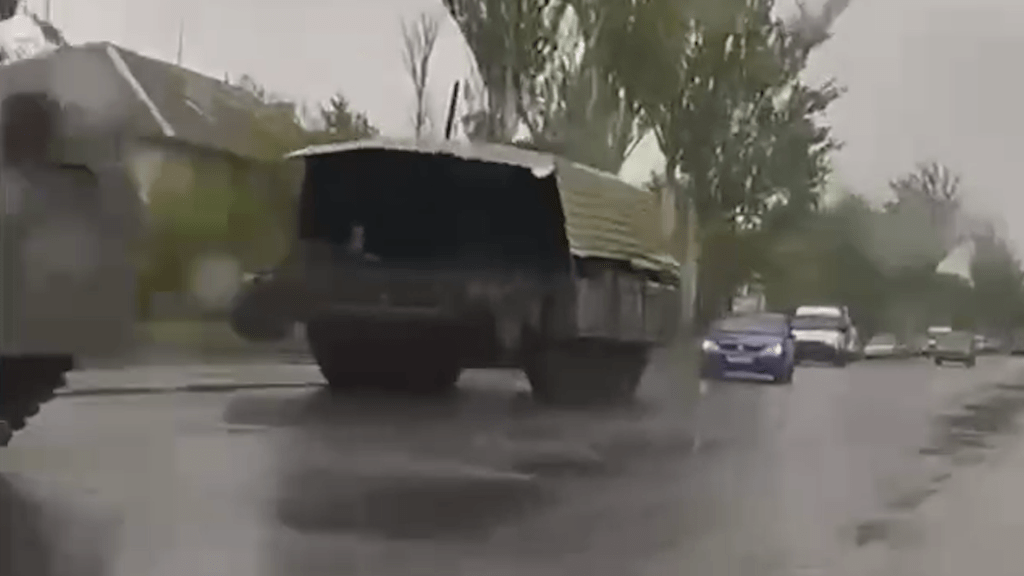
With a fully enclosed shell it is unclear if the Mk2 is being used for transporting troops or if its enclosed to protect its electronic warfare (EW) kit or perhaps both. What is clear is that it is being used as a mine clearance vehicle ahead of armoured assault columns. The shell would in theory give all around protection against drone attack. The footage of the vehicle, said to have been filmed on around 15 April, shows the vehicle on the move, it survives several near misses from artillery and it also shows the vehicle making a wrong turn probably due to is severely restricted visibility.
A side profile shot of the initial Turtle Tank (via social media)
On the 19 April, a Russian telegram channel shared a video showing several photographs of the construction of the initial Turtle Tank showing its inner framework. A week later on 25 April, Russian news outlet Izvestiashared footage of one of the tanks, again fitted with a mine plough, in action leading a column of vehicles in the Krasnohorivka sector. [The first footage of the operation appeared on Telegram on 24 April.] The vehicle is immobilised by what appears to be a mine blast with Russian sources suggesting it became stuck. Another video filmed by another drone shows the rear angle of the columns advance.
Izvestia’s report suggests that the tank was locally known as ‘Ferdinand’. Further footage shows the salvaging of ‘Ferdinand’ with another tank successfully towing it away. Here is another video showing another overwatch angle of salvage operation. Closer drone footage of the stricken tank shows that the red corrugated sheet metal shell has been covered in a camouflage net and there is also what appears to be an electronic warfare device mounted on the roof. The sides of the vehicle’s shell are less sloped and the front of the shell appears less enclosed than the second iteration of the tank.
In additional footage a new iteration of the improvised counter-FPV shelters appears with a ‘Turtle BMP’ [or BMP-Mangals / ‘Царь-Мангал’] seen in operation inside Krasnohorivka. What appears to be earlier footage shows both ‘Ferdinand’ and the ‘Turtle BMP’ moving by road in the Petrovs’kyi district. The Turtle BMP appears to be fitted with a mine plough.
A still from footage of a Turtle BMP on the move on the outskirts of Donetsk (via social media)
Also on the 25 April, two photographs of fabrication of another Turtle Tank were shared these show a frame of six supporting arches onto which steel plates have been welded, on top of this a mash screen has been attached adding another layer of spaced protection.
A short video of yet another variant shows a sheet metal shell with an enclosed rear that has a door and steps perhaps to allow passengers to debus. The front of the shell is much more open and there is no sign of any electronic warfare devices mounted on the shell. It’s unclear when or where the footage was filmed.
Another example of a Turtle Tank, no mine plough fitted (via social media)
Intriguingly, the concept of a counter-FPV shelter made from sheet metal appears to be proliferating with several images of another vehicle reportedly originating from the Chasiv Yar area to the north of Krasnohorivka where the first vehicles were seen. The shell appears to be made from corrugated metal sheets and unlike some of the earlier examples has been painted with a camouflage pattern. Unlike some of the other Turtle tanks this one does not appear to have a mine plough fitted and it has a curtain of chains to protect openings at the front and rear of the shell.
A Turtle Tank reportedly operating near Chasiv Yar (via social media)
From the available imagery it appears that the majority of the vehicles outfitted with a counter-FPV shell are also equipped with mine ploughs, further supporting the theory that they are being used a breacher vehicles. Some, however, appear to be optimised for transporting infantry.
It’s unclear if all of the Turtle Tanks are operated by the 5th Motorized Rifle Brigade but [as of 25 April] there may be early signs that the counter-FPV shelter concept may be proliferating to other sectors, and other units. While the vehicles may appear ridiculous they are proving at least somewhat effective in mitigating the threat of Ukrainian FPV drones though their shells offer little protection against anything else.
Update – 29/4/24:
Footage, filmed on 27 April, of another Russian armoured assault into Krasnohorivka shows a column of 4 infantry fighting vehicles with what appear to be counter-FPV shelters following a tank with a ‘cope cage’
A Ukrainian Telegram channel posted a short video of a ‘Turtle Tank’ attack in the “Bakhmut direction” noting that [machine translated] “the equipment is stupidly scalded with metal, from 5 units it was possible to destroy a tank and an armored personnel carrier. A lot of FPV was spent on one tank. Everyone laughs at their construction of barns, but in fact they work like hell.”
The tank appears to have a box like shelter with a sloped forward roof over its gun and glacis.
Update – 1/5/24:
Not quite ‘turtle tanks’: a pair of T-62s with hybrid counter-FPV shelters were seen in photos taken by a UAV, location unconfirmed. Like previous turtle tanks they’re fitted with EW sets & KMT-6 mine ploughs. But do not have shells made from corrugated sheet metal. Instead they have used chainlink and gratings (one piece of which appears to have Kontakt ERA mounted). One of the vehicles appears to have been used to transport supplies. One T-62 has broken tracks, the other top damage.
T-62s with hybrid counter-FPV shelters. Like other turtle tanks they're fitted with EW sets & KMT-6 mine ploughs. 1 appears to be being used to transport supplies. 1 has broken tracks. Not corrugated sheets but chainlink and grating (also with Kontakt ERA mounted on some). https://t.co/0Ds6kmdoZB
— Matthew Moss | Historical Firearms (@historicfirearm) May 1, 2024
Update – 7/5/24: A ‘Turtle Tank’ fabricated by the Russian 40th Marine Brigade shows that the concept is continuing to proliferated, perhaps without any central influence.
I am pleased to inform you that they are at it again.
This beauty was apparently assembled by the 40th Guards Marine Brigade.
— Matthew Moss | Historical Firearms (@historicfirearm) May 8, 2024
Support Us: If you enjoyed this video and article please consider supporting our work here. We have some great perks available for Patreon Supporters – including early access to custom stickers and early access to videos! Thank you for your support!
The so-called ‘cope cage’ has been a thing since before Russia’s invasion of Ukraine in February 2022. With the proliferation of top attack munitions, drone dropped munitions and subsequently first person view (FPV) kamikaze munitions ways of protecting valuable armoured fighting vehicles were sought. This evolved as cages over the top of tanks’ turrets and later with some vehicles being near-fully enclosed by wire cages, sometimes with hanging chains.
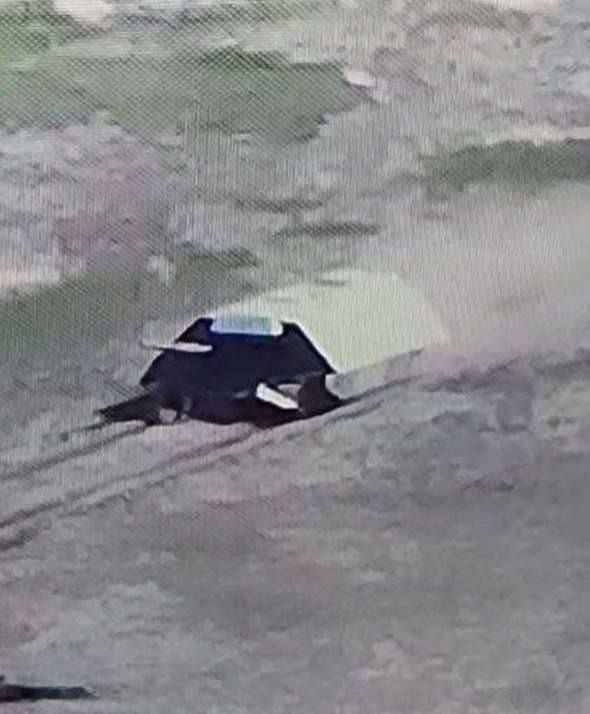
A still from a Ukrainian overwatch drone feed showing the tank (via social media)
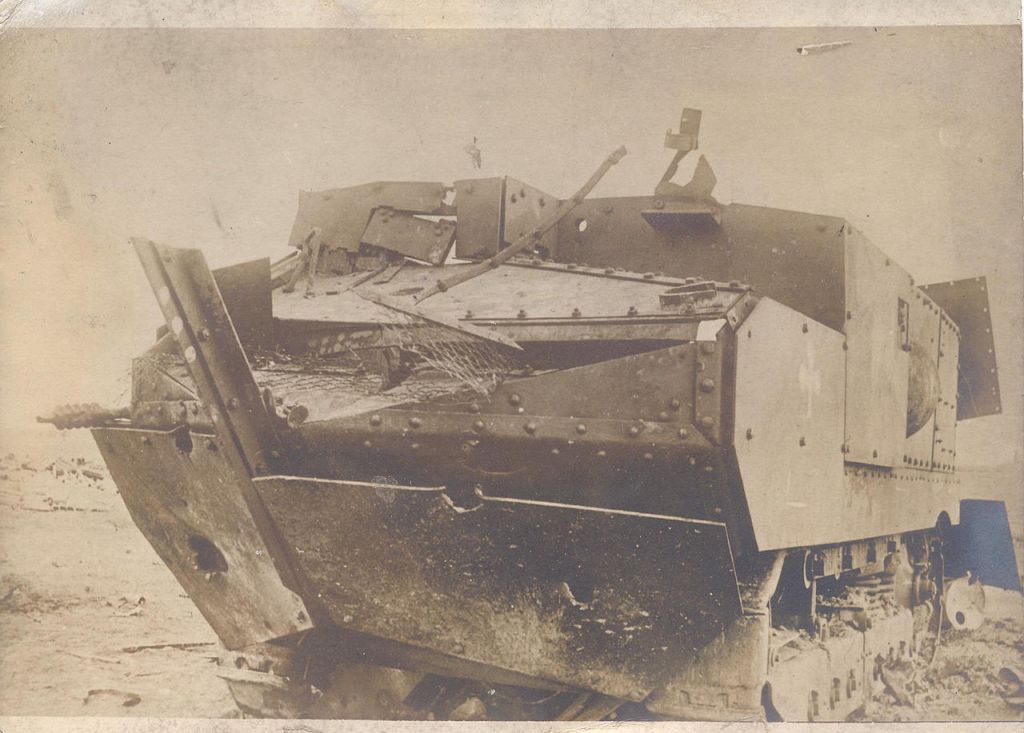
In early April Russian ‘engineers’ took the ‘cope cage’ to its next level, completely enclosing an entire tank in sheet metal. While this might look ridiculous the practice is a time-honoured one with the concept of spaced armour developing as early as the First World War, when the French augmented the Schneider CA1 with some forward armour panels. Spaced armour is intended to reduce the penetrating power of kinetic and explosive penetrators.
Damage to the outer, spaced, armour plates of a French CA1 tank (source)
At least one Russian tank, a T-72, has been seen near totally enclosed by sheet metal rather than a cage. Various imagery shows a tank encased in a trapezoidal steel structure, giving the vehicle the look of a shed on tracks. Ukrainian social media has seen the tank described as the ‘turtle tank’ (танку черепашці) or the ‘Blyatmobile’ while on Russian telegram channels the tanks is often referred to as ‘Tsar Mangal’ (Царь мангал) or Tsar’s BBQ/grill. The odd vehicle was first spotted during a recent attack on Ukrainian positions around Krasnohorivka, in Donetsk. It was seen in video posted on 8 April, from a Ukrainian overwatch drone, leading an attacking column of Russian armoured fighting vehicles delivering troops forward. It has been hypothesised that the sheet metal structure was built to protect troops riding on the tank’s hull. Notably the tank is also fitted with a KMT-6 mine plough.
A still from a video of the tank posted on a Russian telegram channel (via dobryi_russkyi)
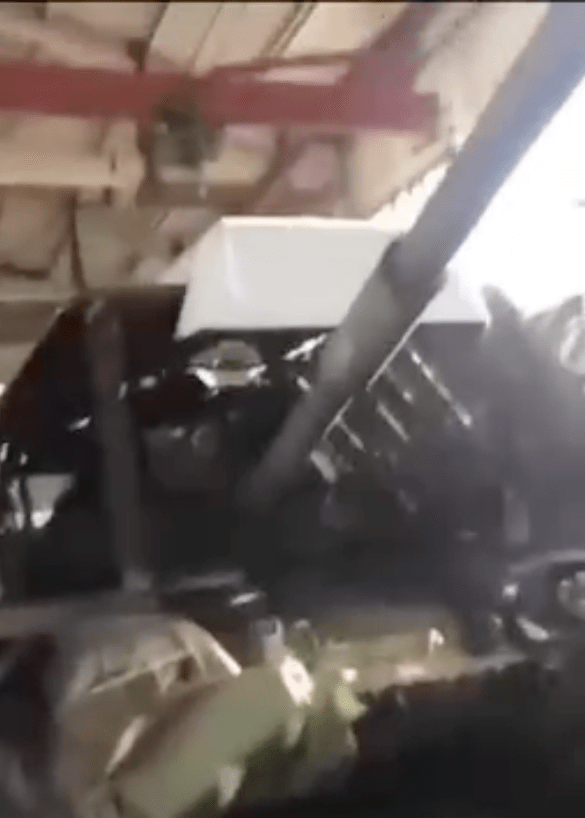
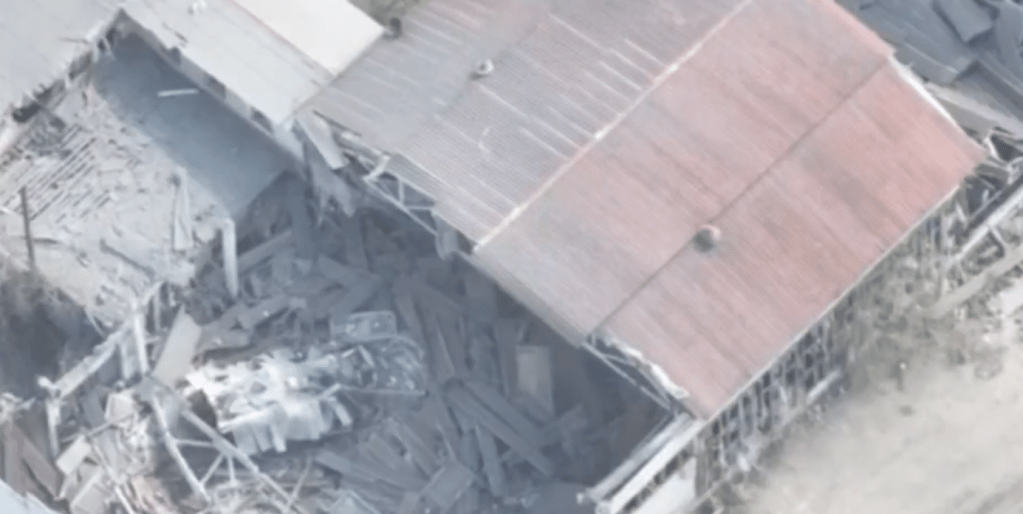
While the turtle tank survived the operation during which it was first seen several days later it appears to have been destroyed by a Ukrainian artillery strike. Ukrainian overwatch and reconnaissance drones tracked the tank back to its base and the location was reportedly cross-referenced by a Ukrainian OSINT and geo-location team Cyber Boroshno, against open source video of it inside a warehouse posted by Russian sources.
In the video we can better see the construction of the tank’s shell. It appears there are 4 corner support columns holding up a frame work onto which the shell as been welded. At the front of the shell there is a white painted piece of shaped metal that looks it could be from the roof of a commercial panel van adds some aerodynamic finesse. It appears there may be an internal box with sheet metal of the sides of the shell providing a second layer at the rear on the tank’s engine deck. Perhaps a space for infantry dismounts.
The drone footage shared on 9 April showed the aftermath of the strike on the Russian armoured unit’s base with the battle damage assessment footage appearing to show the turtle tank in the wreckage of the building.
Ukrainian ISR UAV footage claimed to be of the turtle tank after an artillery strike (via CyberBoroshno)
The armour shell constructed by Russian engineers likely offered some protection against FPV drones but at the cost of the crew’s ability to observe its surroundings, the ability to traverse its gun and likely its mobility.
The turtle tank may look ridiculous but it is a prime example of in-field adaptation and evolution of concepts around how to protect vehicles. The cope cage, which first emerged in Syria, have become more and more mainstream with both Russia and Ukraine employing them, who knows perhaps the armour shell of the turtle tank may indicate a future direction of development which might eventually become less ad-hoc and ludicrous looking.
Update 16/04/24:
Russian ‘engineers’ in the Krasnohorivka area appear to have either rebuilt or built another ‘turtle tank’ with a slightly different profile and an electronic warfare device mounted on top to counter drones. Stills from a UAV feed:
Update 17/04/24: A better look at the Turtle Tank Mk2. It appears to be constructed from corrugated sheet metal and is fully enclosed, preventing any traverse of the tank’s turret. It has been speculated that Russian engineers took a damaged tank which could not move its turret and built a breacher vehicle. This later was iteration of the Turtle Tank also has a mine plough like the first.
It’s unclear if the Mk2 is a construction on another tank or the shell rebuilt on the same vehicle following damage. With a fully enclosed shell it seems unlikely that the vehicle is being used for transporting troops instead it appears to be enclosed to protect its EW kit and act as a mine clearance vehicle ahead of armoured columns. The shell would in theory give all around protection against drone attack. The footage of the vehicle, said to have been filmed on around 15 April, shows the vehicle on the move, it survive several near misses from artillery it also shows the vehicle making a wrong turn probably due to is severely restricted visibility.
A better look at the Turtle Tank Mk2. It is full enclosed, no turret movement. Electronic warfare set mounted on roof. Shell is made from standard corrugated metal. It's also mounted with a mine plough, & may be the same tank with shell rebuilt. Role seems to be as a breacher. pic.twitter.com/CjszFkecPM
— Matthew Moss | Historical Firearms (@historicfirearm) April 17, 2024
Support Us: If you enjoyed this video and article please consider supporting our work here. We have some great perks available for Patreon Supporters – including early access to custom stickers and early access to videos! Thank you for your support!








 The Armourers Bench