A few weeks ago my good friend (and podcast co-host!) Robbie McGuire gifted me a cool little comic. Now I’m not a comic guy but this one is definitely in my wheelhouse. Robbie gave me a copy of ‘Super Soldiers of the SAS’, which was printed as a part of the ‘Battle Action Force’ series of comics that published in the mid-1980s.
From what I can tell from a little research ‘Super Soldiers of the SAS’ wasn’t part of the normal run of the Battle Action Force comics and isn’t dated, it seems to have been an additional side publication giving more of a look at the SAS and its history.
Front cover of ‘Super Soldiers of the SAS’ (Photo: Matthew Moss)
The Battle Action Force comics were launched in the summer of 1983 and was a partnership between IPC’s long running ‘Battle’ comic (launched in 1975) and UK toy company Palitoy to advertise and tie in with Palitoy’s new Action Force. The Action Force toys were themselves a smaller 3¾” spin off from the larger Action Man figures. Palitoy launched the Action Force toys in 1982 and these included ‘SAS Trooper’ and ‘SAS Frogman’ and overtime a whole SAS team was sold.
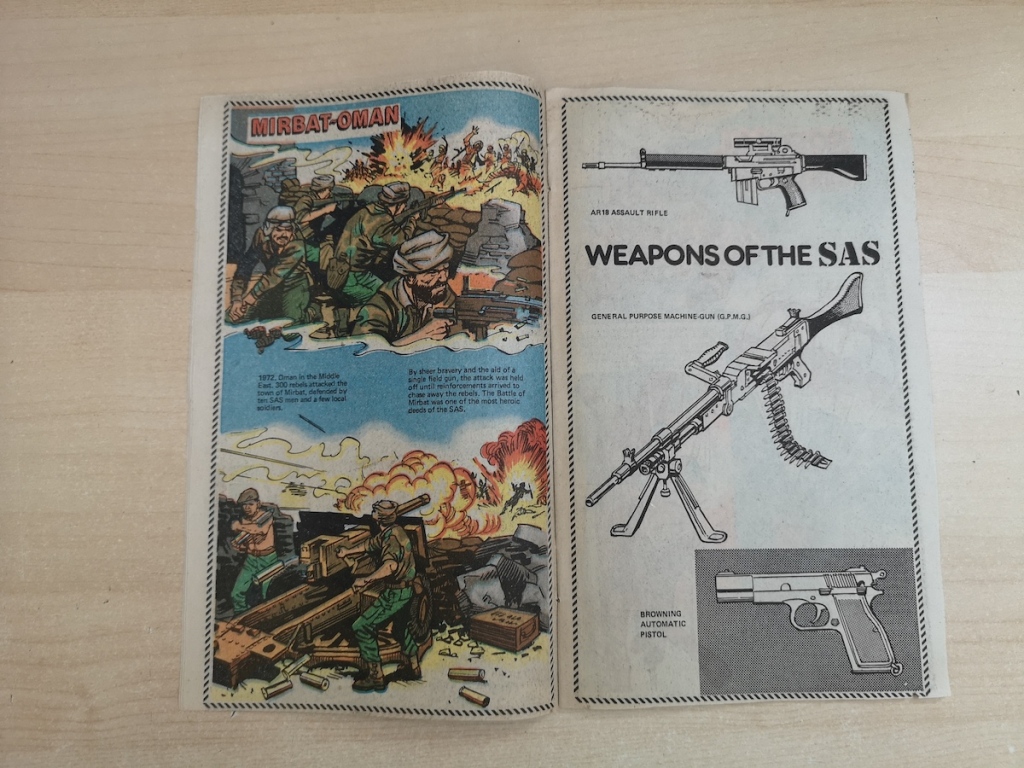
‘Super Soldiers of the SAS’ came at the height of SAS mania in the wake of the Iranian Embassy Siege (1980) and the Falklands War (1982). The comic is brilliantly illustrated and gives a brief history of the SAS and their role. With illustrations of the Iranian Embassy Siege, Malaya, the Falklands War and operations in Oman. There’s some nice mentions of known SAS personnel including Sgt Gordon Turnbull who was awarded the Military Medal in 1957 and Captain Gavin Hamilton who was killed during the Falklands War and awarded the Military Cross.
There’s a section on ‘weapons of the SAS’ featuring an AR-18, an L7 GPMG, MP5 and Browning Hi-Power the comic then outlines some of the SAS’s special skills and other equipment including Pink Panther Land Rovers and stun grenades. Then right at the very back is a two page section n the SBS, who were never featured in the Action Force toy range but is a great inclusion here picturing them infiltrating ashore from a canoe equipped with a suppressed Sterling Mk6.
All in all a cool little comic and I can definitely see how it would have captured a little boy’s imagination back in the mid-1980s.
Support Us: If you enjoyed this video and article please consider supporting our work here. We have some great perks available for Patreon Supporters – including early access to custom stickers and early access to videos! Thank you for your support!
Bibliography:
The History of Action Force, Bloodforthebaron.com, (source)
Looking back at Battle Action Force, Downthetubes.net, (source)
On the 5th May 1980, the world was spectacularly introduced to the Special Air Service and their Browning Hi-Power’s with extended magazines.
22 SAS formed the Counter-Revolutionary Warfare Wing in the 1970s, after the 1972 Munich Massacre, and quickly took a lead in developing counter-terrorism tactics. They gained worldwide notoriety in 1980, during Operation Nimrod, the assault ended the Iranian Embassy Siege. It was during Nimrod that the SAS’ CRW squadron was seen in action for the first time.
I began to notice the extended Hi-Power magazines while examining photographs from the operation for another upcoming video. As I looked closely I began to notice more and more holstered Browning Hi-Powers with extended magazines. The Hi-Power’s standard double-stack, single-feed magazine holds 13 rounds, decent for the period, however, SAS troopers evidently saw the benefit of having more ammunition ready to go on their secondary weapon.
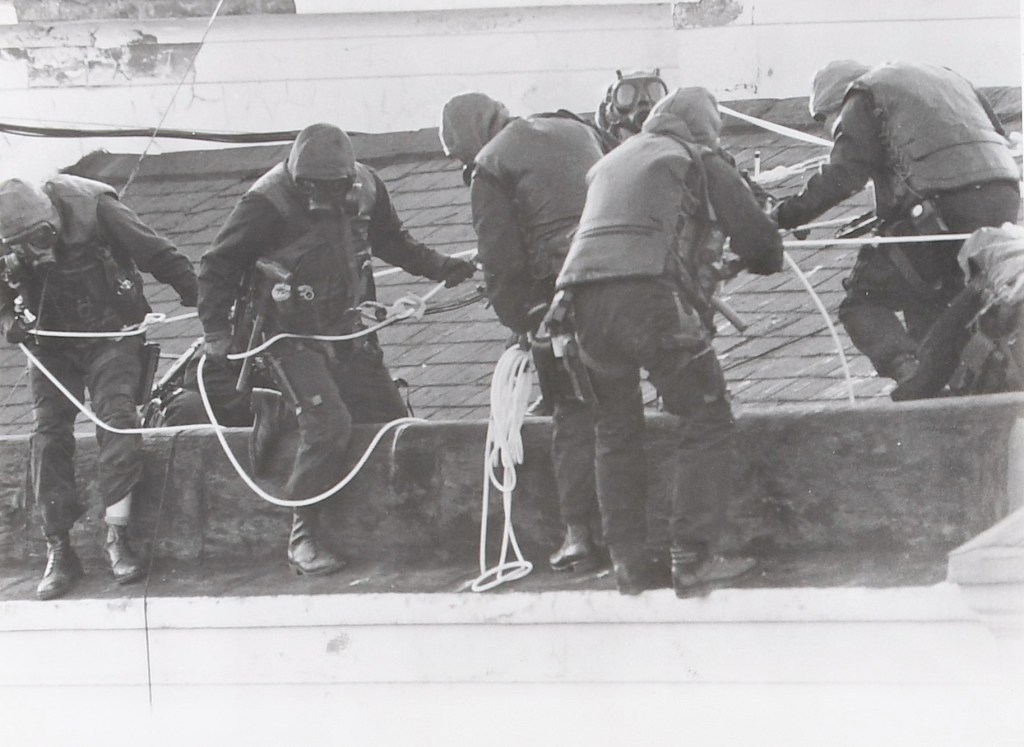
Members of B Squadron’s Red Team prepare to rappel and breach the rear of the embassy (via Woolley & Wallis)
The best photographs are of part of Red Team as they breach the rear balcony of the embassy. In the first photograph a four man team prepare to rappel/abseil down the rear of the embassy to enter via the balcony. You can see the trooper with his back to the camera about to rappel has a Hi-Power with an extended magazine. Subsequent photographs of the four man team on the rear balcony show that several of the troopers have extended magazines. In another photograph Rusty Firmin and a breech team with Blue Team enter the rear of the embassy at the ground floor. On his right leg Firmin is carrying a Browning Hi-Power with an extended magazine.
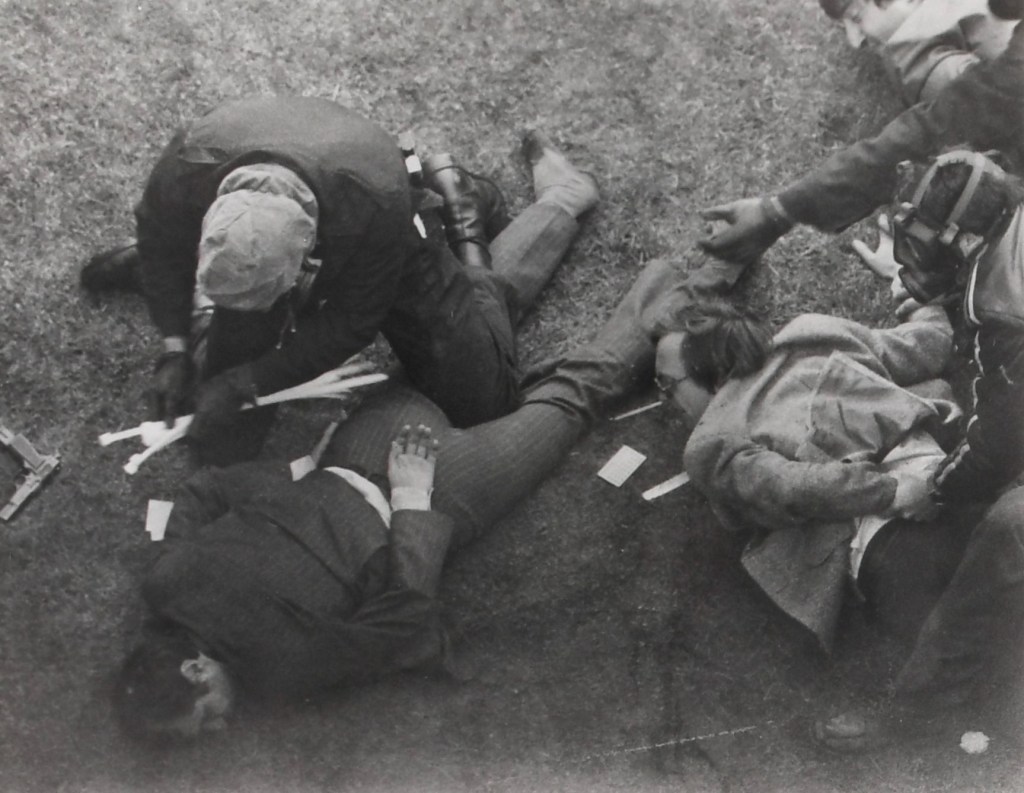
The last photograph shows members of the SAS in the garden behind the embassy securing the hostages so they can be safely identified. As one of the troopers is zip-tying a man he has laid his Hi-Power on the grass next to him.
SAS troopers secure hostages for IDing, note the pistol and extended magazine on the left (via Woolley & Wallis)
The British Army adopted the Hi-Power in 1954, it remained in service through to 2013. It was the SAS’ primary sidearm until the SIG Sauer P226 gained favour in the early 1990s. As seen in the photographs from the Iranian Embassy Siege the CRW squadron carrier their Hi-Powers in custom-made leather drop leg holsters which were made by Len Dixon and Paul Evers.
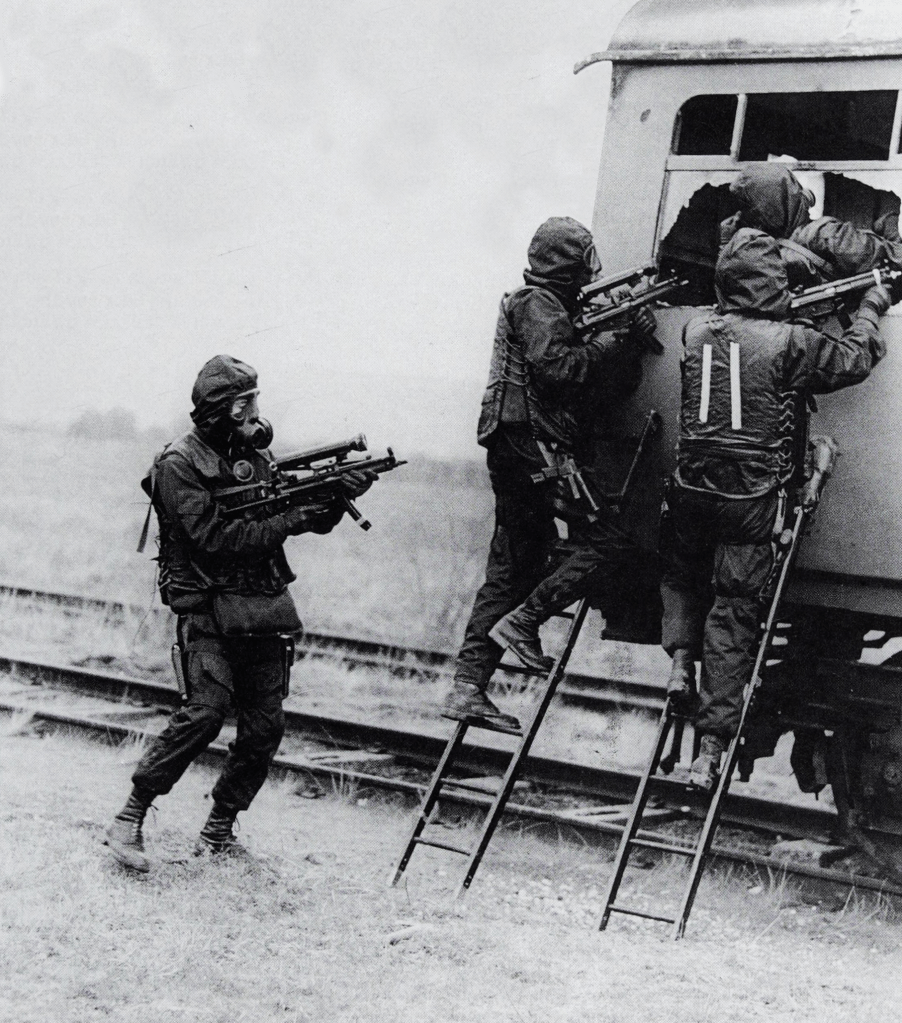
The extended magazines can be seen in photographs dating from throughout the 1980s. Theundated photograph below shows an SAS team during training to assault a train carriage, the trooper in the centre has a Hi-Power with an extended magazine. A photograph of Princess Diana during a visit to Hereford in 1983, features an SAS trooper with an extended magazine visible. This undated photograph, probably from the mid-1980s, of a trooper kicking in a door during training also features one of the magazines. A similar training photograph shows a 4-man team stacking up for an entry – the lead trooper has a Hi-Power loaded with an extended magazine.
SAS team during training to assault a train carriage, note the extended magazine in the central trooper’s Hi-Power and the DIY vertical front grip on the right
Initially, I was unsure who manufactured the extended magazines used by the SAS as very little has previously been written about them and the resolution of the available imagery makes identifying them difficult. A look through contemporary issues of Soldier of Fortune magazine shows a quite few variations were available. With manufacturers like Mec-Gar, SILE and Pachmayr all producing variations though they may also have been offered by FN themselves. However, according to a member of the SAS active in the 1970s and early 1980s the magazines were made in-house by the Regiment’s armourers. They apparently worked well. Judging from the imagery available the magazines probably held between 20 and 25 rounds, with the lower end of the scale more likely.
I spoke to Robert Lancaster, another member of the SAS who served in the 1980s, who explained:
“I nearly always used a 20 round mag unless I was doing door entry, when you had a slung Remington [870] and the 5 [MP5], in that case I used the standard mag in case the mag got caught on the shotty!”
A wrist magazine holder seen in a 1984 British Army film about the SAS (British Army/SSVC via IWM)
One other notable thing to point out are the wrist magazine holders used by some members of the assault teams. This is essentially a ready-to-go magazine attached to the operator’s pistol arm. This would in theory allow the operator to execute a faster reload, the idea being that taking the fresh magazine from the wrist, nearer to the pistol, rather than from the holster pouches on the thigh .
We get a good look at one of these in the British Army’s 1984 video about the SAS. We can see the magazine holder on the operator’s left wrist. Later in the film a trooper climbing through a window can also be clearly seen equipped with a Browning Hi-Power loaded with an extended magazine. The tradition continued with extended magazines also being regularly used with the later SIG P226s.
Special thanks to British SAS Photos on Instagram for their help and to Robert Lancaster for answering my questions.We’ll have more articles/videos looking at SAS weapon set ups from this period in the future so stay tuned.
Support Us: If you enjoyed this video and article please consider supporting our work here. We have some great perks available for Patreon Supporters – including early access to custom stickers and early access to videos! Thank you for your support!
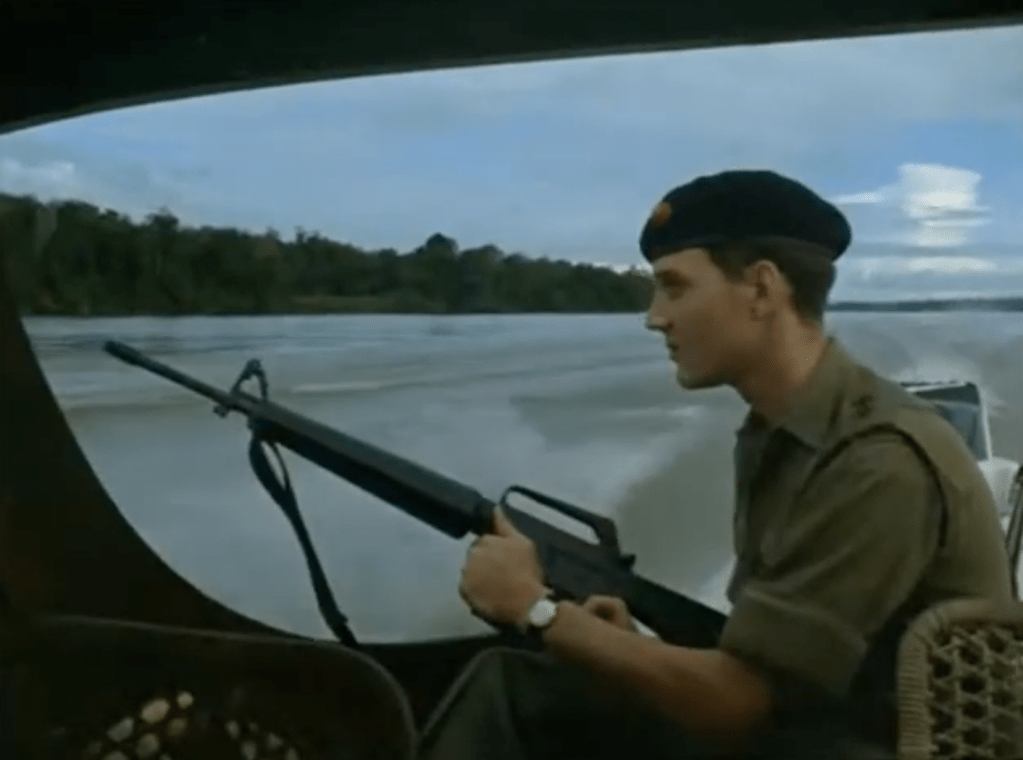
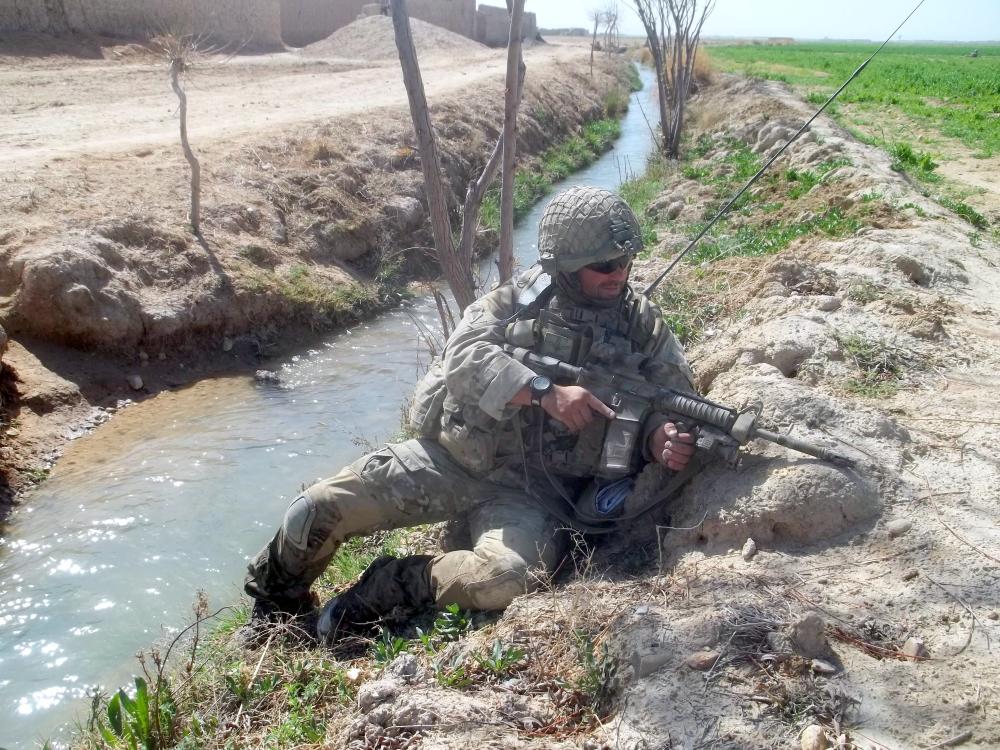
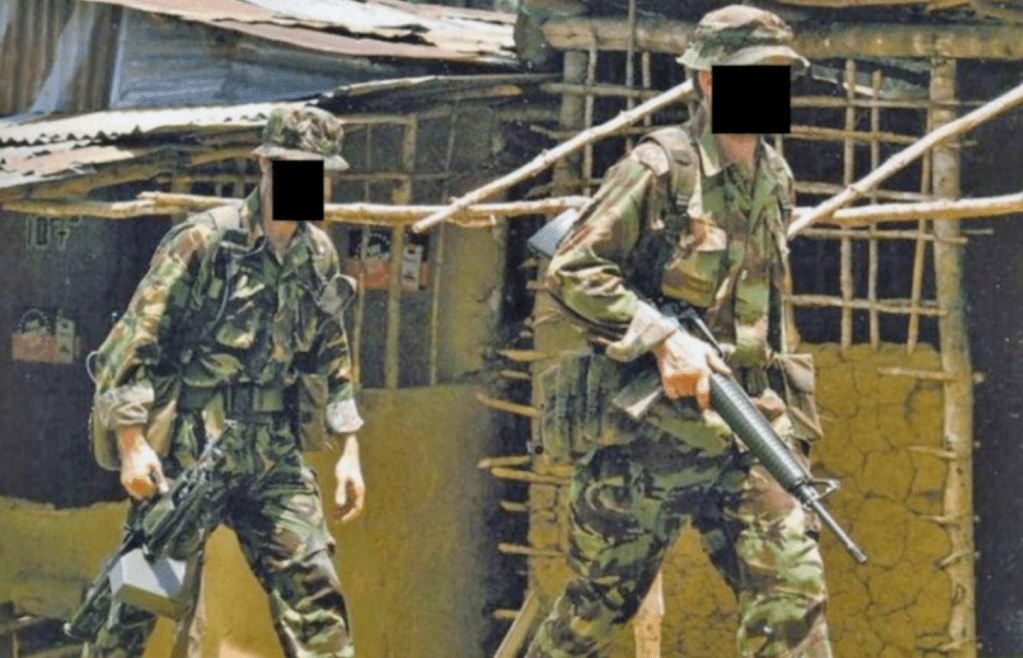
Last year I had the pleasure of giving a talk at the Cody Firearms Museum’s Arsenals of History Symposium. I’ve been working with my friend Jonathan Ferguson of the Royal Armouries on a research paper looking at British use of the AR-15 platform. My focus for the project has been the user experience, I’ve spoken to over 25 veterans from across the British military who have experience using the AR-15/M16 platform on operations. Chronologically their experiences span nearly 60 years and this somewhat informal presentation gives a brief overview of some of the operations where the rifles have been used from the Indonesian Confrontation right through to the present day.
Some of the photos featured in the presentation
If you’re a member or former member of the British armed forces with experience with the AR-15/M16 platform I would love to hear from you, please reach out via armourersbench@gmail.com. Your help and insights would be invaluable.
Once the project is completed I’ll put together a more in-depth video discussing the history of the UK’s use of AR-15/M16-pattern rifles.
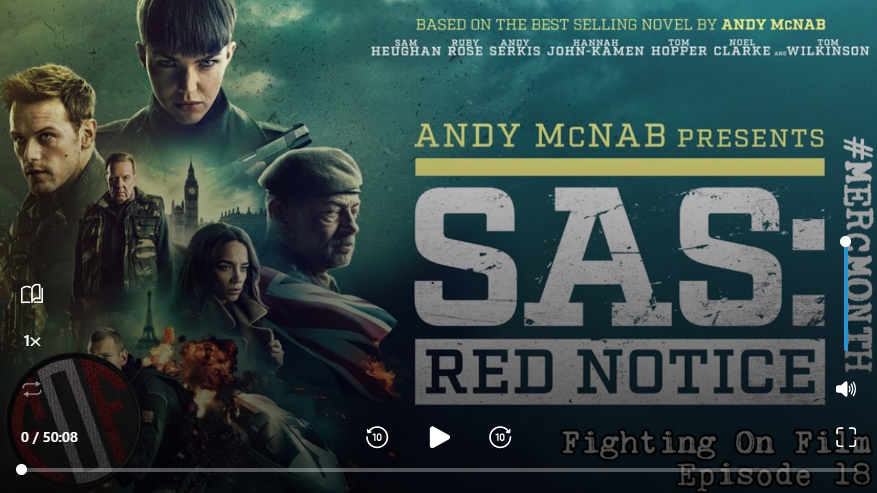
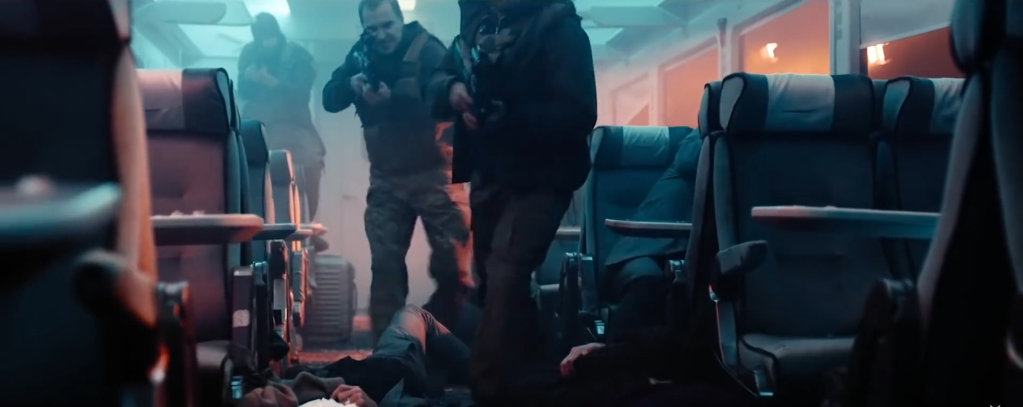
Merc Month continues with SAS: Red Notice as brand new film about mercenaries who highjack the ‘Eurostream’ train. Based on a book by SAS veteran Andy McNab it stars Sam Heughan, Ruby Rose and Andy Serkis. We watched it so you don’t have to, be warned there is some exasperated swearing. This was a bit of an unplanned added bonus for Merc Month.
Join us as we take a special look at not one but two films – both looking at the ill-fated SAS mission – Bravo Two Zero. Gulf War films are rare and with the 30th Anniversary of the war upon us we thought it was a good time to take a look at ‘The One That Got Away’ (1996) and ‘Bravo Two Zero’ (1999).






 The Armourers Bench