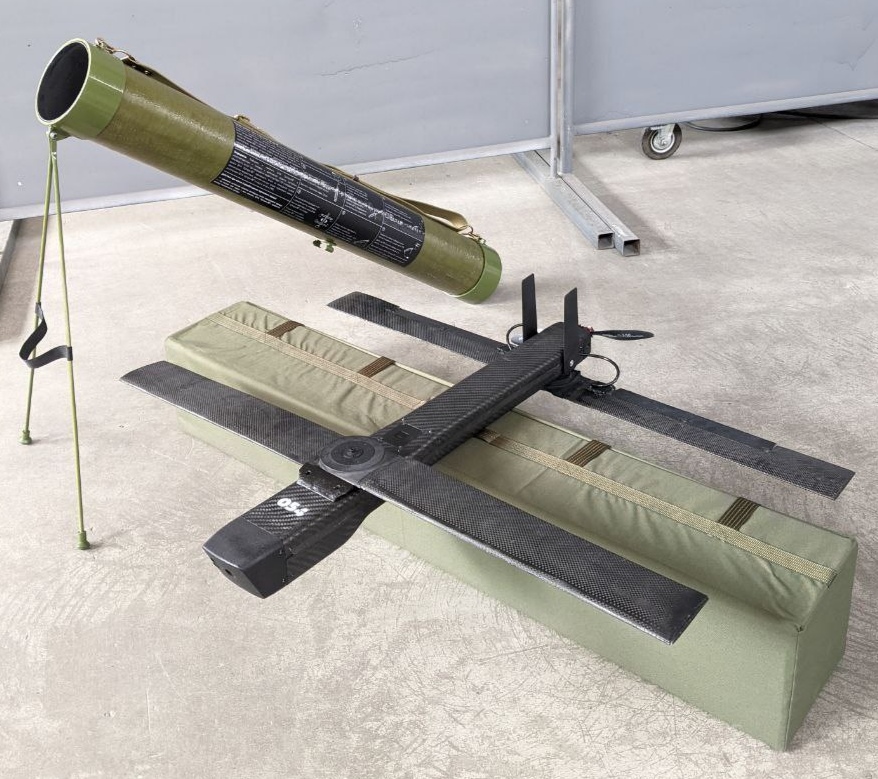
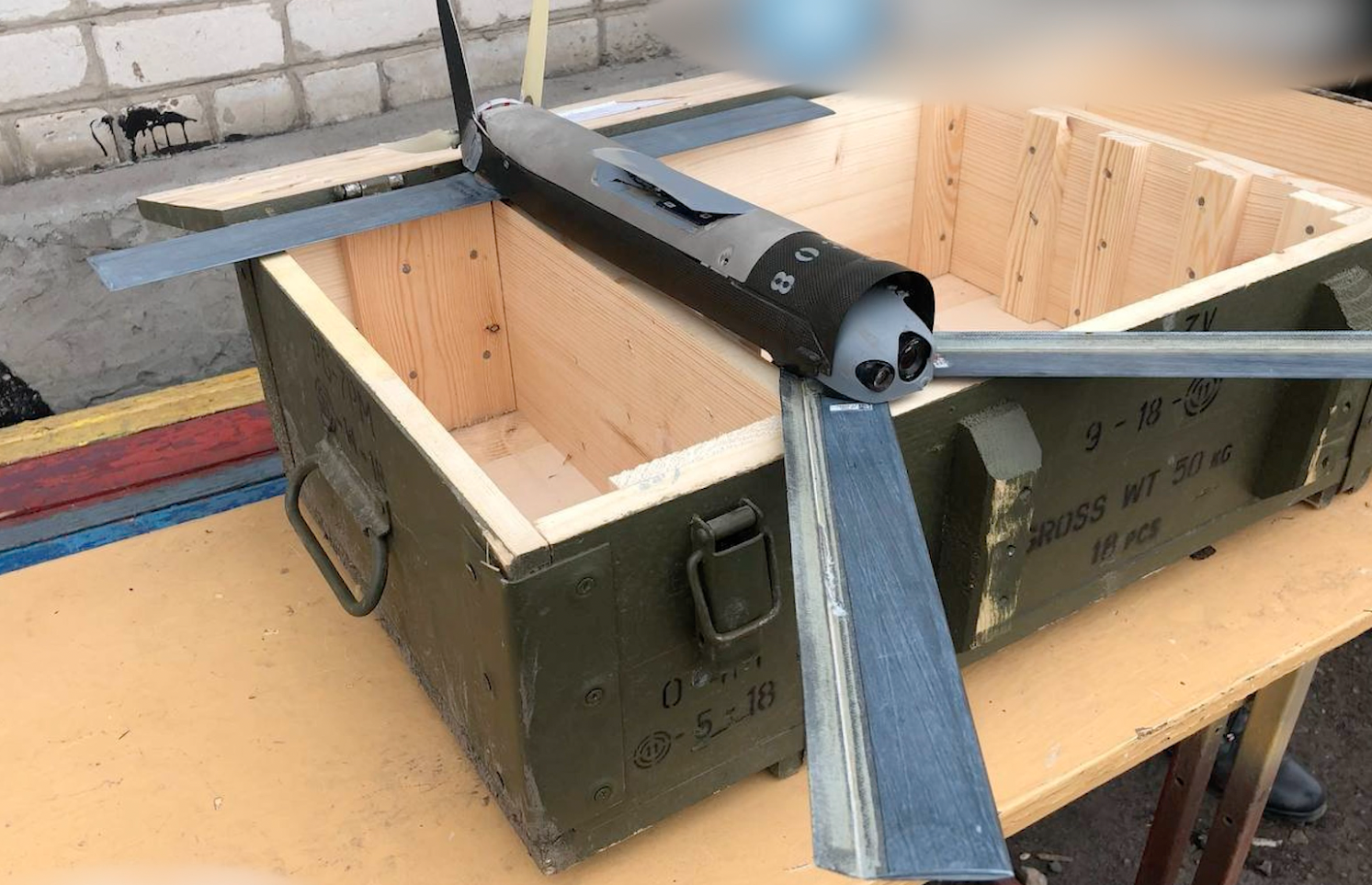
Reports from Russian media outlets announced on 18 September, that Android Technics/Technology, a Russian technology company, had developed an analogue of AeroVironment’s Switchblade 300 loitering munition. Imagery and footage of the BAS-80 was shared by Russian state news outlet RIA.
Android Technology’s Managing Director, Evgeny Dudorov, told RIA that they had provided a ‘couple’ of the loitering munitions to a volunteer unit, the Tsar’s Wolves, which reportedly provides military-technical assistance to Separatist units. Dudorov hopes that the unit will “find the best ways” to use the new kamikaze drone. Back in April, the development of the BAS-80 was first reported when Android Technology stated that the munitions would be mounted on the Marker armed unmanned ground vehicle.
BAS-80 (via RIA)
Russia has had considerable success in the field with its larger, heavier Lancet loitering munitions developed by ZALA Aero Group which is a part of Kalashnikov Concern. The most advanced variants of Lancet boast a 11lb/5kg payload. The Ukrainian’s, however, have demonstrated an edge when utilising smaller FPV kamikaze drones. These FPV drones appear to be favoured over the Switchblade 300.
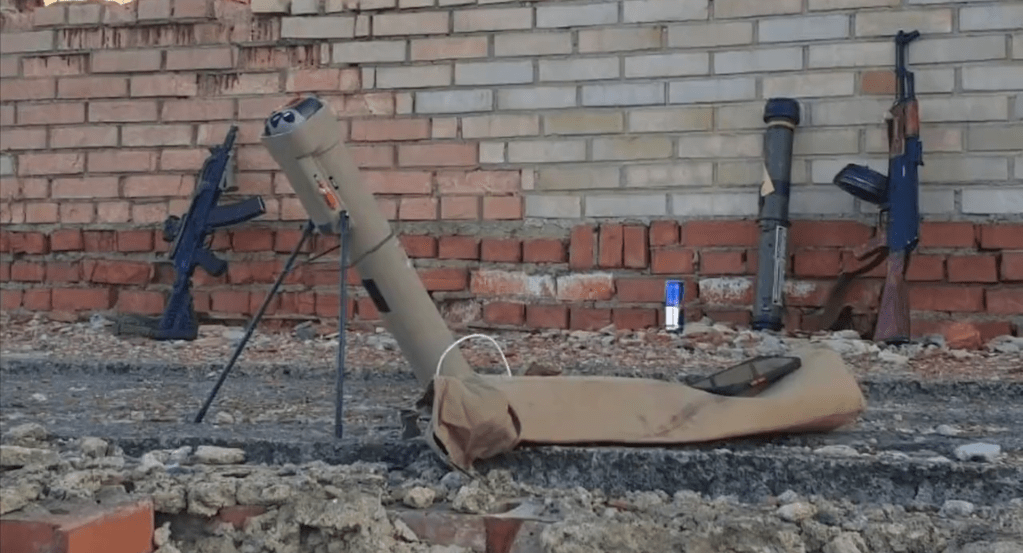
The BAS-80 bares more than a passing resemblance to the US-manufactured Switchblade which the US has provided to Ukraine in moderate numbers since March 2022. Utilising the same folding wing configuration and man-portable tube-launch system.
Russian news sites this morning are awash with stories about this new Switchblade-clone developed by НПО "Андроидная техника" which is reportedly undergoing limited testing currently.
— Historical Firearms | Matthew Moss (@historicfirearm) September 18, 2023
Dudorov stated that the BAS-80 is made from carbon fiber, weighs in at 3.7lb/1.7kg and has a maximum flight speed of up to 80mph/130kph. He also claimed that it can travel up to 18.6 miles/30km and carries a 1.1lb/500g payload – which may suggest that its intended for anti-personnel and anti-materiel use, like the Switchblade. This would made the BAS-80 0.6lb/300g lighter than the Switchblade 300 and have 12.5 miles/20km more range. Photographs of the munition show that it uses a pusher propeller configuration and has three forward-facing optical lens for guidance.
A Switchblade 300 in the field in Ukraine, 2022 (via social media)
It remains unclear if the Russian munition was developed using technology found in captured Switchblade 300s. Other analogues of the Switchblade have been developed by both China and Iran. China unveiled the FH-901 loitering munition in September 2022 and Iran introduced the Meraj-521 in October 2022. Both systems appear to be externally different in size and shape to that of the BAS-80, with the Chinese munition larger (more analogous with the Switchblade 600) and the Iranian drones launching from a rectangular box. The BAS-80 launches from a cylindrical tube more akin to the Switchblade.
The BAS-80’s guidance systems, software and internals remain unknown and from Russian reports it is still some way from mass production with development to be finalised following trials in the field.
Support Us: If you enjoyed this video and article please consider supporting our work here. We have some great perks available for Patreon Supporters – including early access to custom stickers and early access to videos! Thank you for your support!
So far during the fighting we’ve seen everything from M14s to Brimstone missiles transferred to Ukraine. One weapon which was hailed as a game changer when it was announced was the Switchblade loitering munition. While not game changers we have begun to see evidence of their use in the field and they are definitely an interesting new weapon.
Switchblades are a loitering munition capable of being launched and then remaining on station to be tasked to destroy a ground target once the target has been identified. Back in March it was announced that as part of the US’ military aid to Ukraine Switchblades made by AeroVironment.
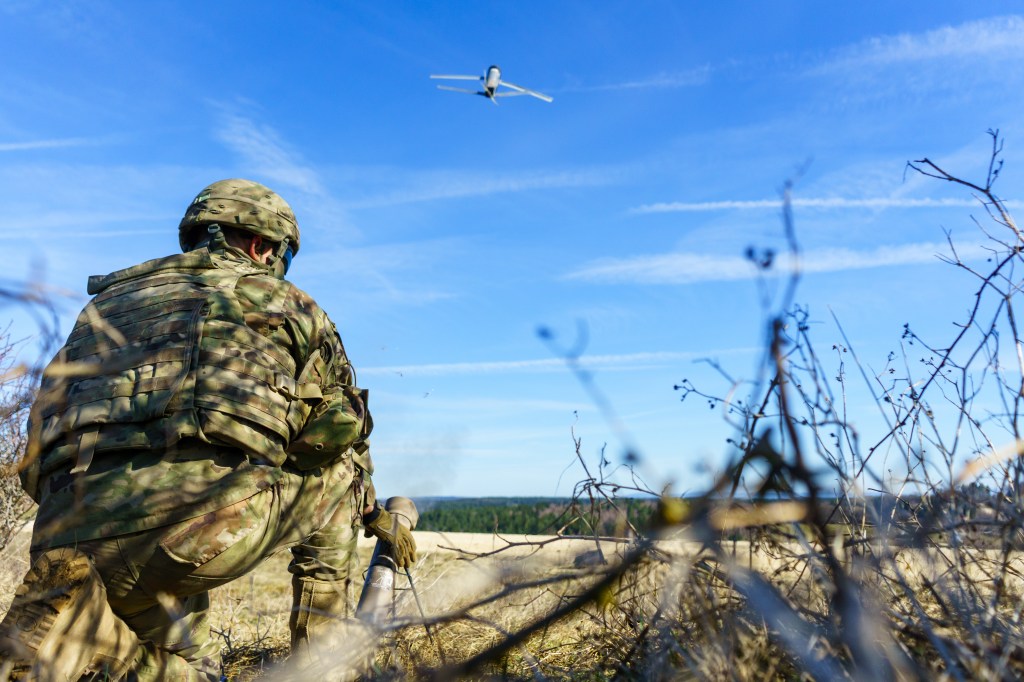
Pvt. 1st Class Brandon Norton launches a Lethal Miniature Aerial Missile System (LMAMS) for aerial support during a Robotic Complex Breach Concept assessment and demonstration, at Grafenwoehr, Germany, April 6, 2018. (U.S. Army photo by Sgt. Gregory T. Summers)
The system was originally developed for use in Afghanistan with the first US Department of Defense contract awarded in 2011. These have been designated the Lethal Miniature Aerial Missile System (LMAMS). AeroVironment currently offers two models, the Switchblade 300 and the larger Switchblade 600.
On the 16th March the US announced it would provide Ukraine with “100 Tactical Unmanned Aerial Systems”.[1] It was widely theorised that these would in fact be Switchblade loitering munitions.
So what is a Switchblade?
It is a tube-launched, rapidly deployable munition which can strike beyond-line-of-sight targets with precision at a range of up to 10km. The system is small enough to be man-packed weighing 5.5lbs (or 2.5kg).
It can also be launched from a multiple launch system which can be vehicle mounted. Once launched its wings deploy and its electrically-powered propeller spins up, it can remain in the air for 15 minutes. It has a maximum altitude of 5,000 feet and cruises at around 60 miles per hour (but can dash at speeds up to 100mph).[4] AeroVironment claim the system can be set up and launched in under 2 minutes.
Its payload is described as ‘modular’ by AeroVironment, who also mention it carries a ‘Northrop Grumman advanced munition’, which some sources suggest is roughly equivalent to a 40mm grenade – said to be capable of knocking out light armoured vehicles. The warhead has a highly directional fragmentation charge which is triggered by a sensor that detonates it as a specific distance from the target in mid-air.
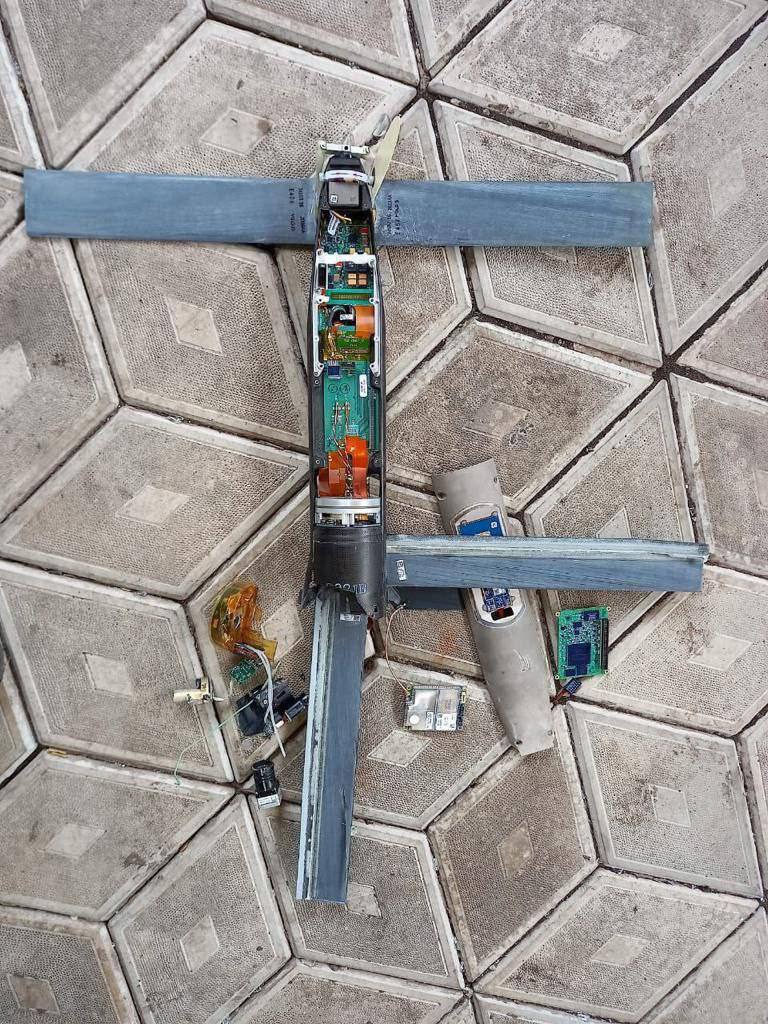
Remains of a Switchblade 300 following detonation of its warhead (via social media)
The system is controlled manually or autonomously and uses a dedicated ruggedized laptop with a built-in mission planner (which is also pre-loaded with a simulator). The Switchblade is equipped with electro-optical and infra-red cameras which provide the operator with real-time video and can be directed by fly-by-radio frequency signal. Once launched Switchblade is not recoverable and does have a wave-off and redirection capability.
On 1 April, a fresh military assistance package was announced which expressly named ‘Switchblade Tactical Unmanned Aerial Systems’ but did not indicate a quantity.[2] These were believed to have been ordered direct from the manufacturer under the Ukraine Security Assistance Initiative (USAI) which allows procurement of systems and capabilities from industry rather than delivering equipment Department of Defense stocks.
On 7 April the US Department of Defense’s fact sheet on aid supplied to Ukraine referred to ‘hundreds of Switchblade Tactical Unmanned Aerial Systems’[11], a week later the wording had changed to a more specific ‘Over 700 Switchblade Tactical Unmanned Aerial Systems’.[12]
An intact, undetonated but damaged Switchblade 300 captured by Russian forces (via social media)
On the 6 May AeroVironment were awarded a contract modification worth nearly $18 million for “Switchblade hardware production” for a Foreign Military Sale to Ukraine. This contract is estimated to be completed by 4 May, 2023.[3] The US Department of Defense announced on 10 May that it would supply a total of 700 Switchblade systems, but did not state the split between 300s and the newer, more capable Switchblade 600s.[10]
We’ve yet to see evidence of Switchblade 600 use in Ukraine, likely because the system has only been produced in pre-production runs and substantial orders for the munition have not been made yet. The 600s capabilities are regularly compared to those of an Anti-Tank Guided Missile. With a 40km (25 mile) range and a 20 minute loiter time they offer considerable capability and much longer range than ATGM like Javelin or Stugna P. For now only 300s have been visually confirmed in use in Ukraine. But the larger 600s have the potential to have significant impact on the battlefield.
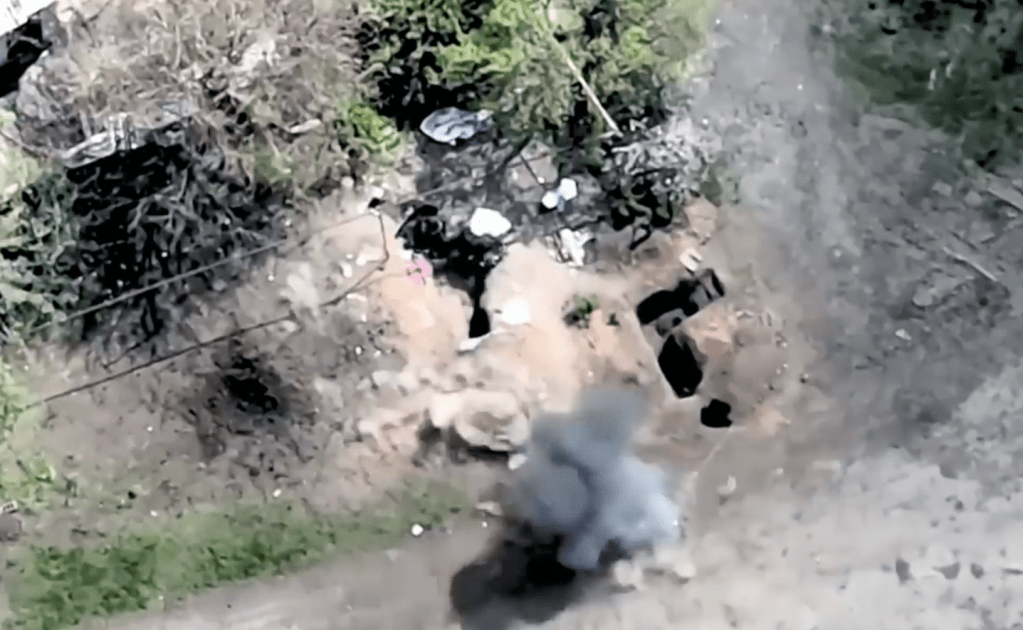
On the 6 May the Ukrainian 53rd Separate Mechanized Brigade shared a clip showing a Russian machine gun position being struck by a Switchblade, we can see the characteristic mid-air blast and fragmentation pattern.[5]
On the 24 May the SSO, a Ukrainian special forces unit, shared a video of a Switchblade 300 strike against a Russian tank crew which had dismounted and were sat on the vehicle’s hull. Memes are one thing the war in Ukraine isn’t short of and the video features the Star Wars theme and concludes with a Curb Your Enthusiasm credit reel meme.[9]
A Switchblade 300 in the field in Ukraine (via social media)
On the 25 May a pretty comprehensive video showing the launch and targeting of a Switchblade, said to be on the eastern front was shared.[6] The video shows the launch tube and control laptop. A largely intact Switchblade 300 was recovered by Russian troops on 26 May, with photos of the munition shared online.[8] This is potentially an example of the munition running out of loitering time or one which has potentially taken damage from ground fire.
On 1 June footage of another Switchblade 300 launch was released but no indication of if it struck its target. The video is said to have originated from the Kharkiv region.[7] On the 6 June a further photo of a Switchblade 300 appeared. The photo shows the remnant of the Munition – given the front portion of the Switchblade is missing it appears that it fired its payload. Around the 12 June further photos of an expended Switchblade 300 were shared online with very little of the fuselage remaining.
Footage released by the Ukrainian Armed Forces of a Switchblade 300 strike against a machine gun position
On 15 June, a short clip of another fired Switchblade gives us a close up look at the electronics inside the weapon and at the propeller at the rear which powers it. Again given the damage and the fact the front portion of the munition is missing it would indicate that the Switchblade detonated its payload.
On the same day more footage of what might be the same expended Switchblade 300 appeared in a Russian news report. The report allegedly shows the location where the Switchblade detonated, somewhere near Avdiivka in Donetsk. The nature of the Switchblade 300’s forward firing payload it is suited to softer targets like infantry in the open or in the case of at least one video claimed to be from a Switchblade attack against dismounted vehicle crews.
Some have criticised the Switchblade 300 for its apparent lack of punch but they were never designed to take on Russian armour, they were designed as a focused munition intended to take out soft targets with the minimum collateral damage. In Ukraine the use of commercial drones has rapidly proliferated, many of these are delivering grenade-based gravity bombs onto enemy positions and assets. It could be argued that these systems, rather than a sophisticated loitering munition like the Switchblade 300, are arguably more cost effective, efficient, more versatile and easier to use. The larger, more capable loitering munitions, such as the Switchblade 600s, will likely see the concept come into its own and have the potential to have a more significant impact on the battlefield.
If you enjoyed this video and article please consider supporting our work here. We have some great perks available for Patreon Supporters – including custom stickers and early access to videos! Thank you for your support!

 The Armourers Bench