3D Printed Anti-Personnel Mines

In this article/video we’ll examine an an interesting and very simple 3D printed anti-personnel mine developed by the Ukrainians. The mines are similar in purpose and size to the Russian PFM-1, the so-called ‘Butterfly’ mines. However, their shape and form factor is similar to that of the larger PMN-4, but they are significantly simpler.

3D printed mine found in the field (via social media)

The 3D printed mine’s explosive filling is said to be around 30g, with an overall weight of 55g. The mine is made up of a two-part outer shell printed in PLA, or another similar plastic. The two pieces screw together and a layer of plastic explosive is in the bottom half of the shell along with a percussion initiator of some sort. The top half of the mine has a small  metal Philips-head screw protruding down through the top, this acts as a striker for the initiator. There is a tube protruding up from the lower half of the mine, printed as part of the body, which likely guides the screw and holds the initiator.

The mine appears to work along the principle of when stepped on the outer shell breaks and compacts allowing the screw to strike the initiator, detonating the mine.
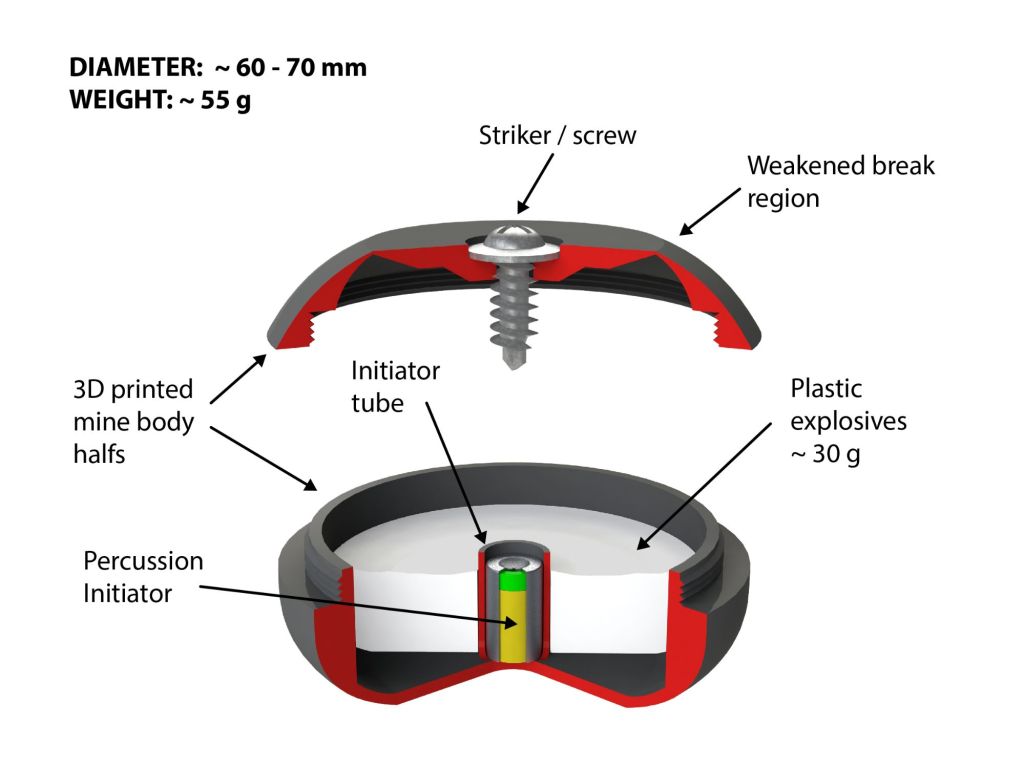
An illustration of the mine’s layout and components (Alexis Midy/Midy Infographie)

The design is extremely simple and cost effective to produce, requiring only the simplest 3D printer, a screw and an initiator and explosive.

The first sighting of the mines I’ve been able to find was in a telegram post by a Russian sapper. In the post, on 6 October, he shared several photos of the mines found in the field and warned that Ukrainian drones are dropping them in the Kursk and Belgorod regions. Another photo of one of the mines was shared by another Russian combatant on 8 October.

A Russian telegram channel, enginner25, shared post showing multiple images of the mines and a video showing the internals.
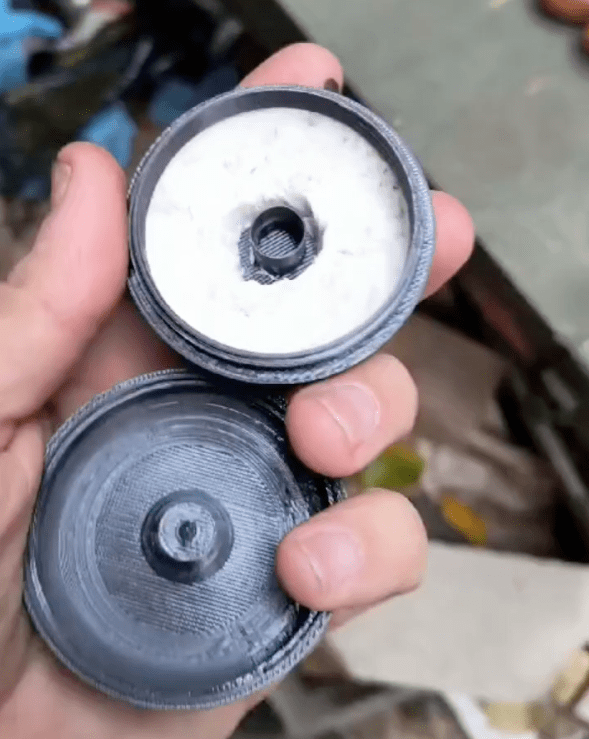
3D printed mine opened to show explosive filling (via social media)

In another photo we can see that the mines are apparently dropped from plastic tubes suspended below drones. The photo only shows the top of the tube but it’s clear that a number of tubes are carrying a significant number of mines. The release mechanism for the lids of the carrier tubes appears to use something like 3mm Visco fuze, commonly used with fireworks, or igniter cord. Once initiated the fuze/cord burns away and releases the mines with the drone scattering them as it flies over an area.

The design of the mine is extremely simple but appears to be potentially quite effective, relying on the brittleness of the 3D printed shell to work. The mines seem to have been engineered to be quickly produced at scale rather than to make them undetectable to Russian sappers. However, if a non-metallic striker replaced the screw the mines would be even more difficult to detect.
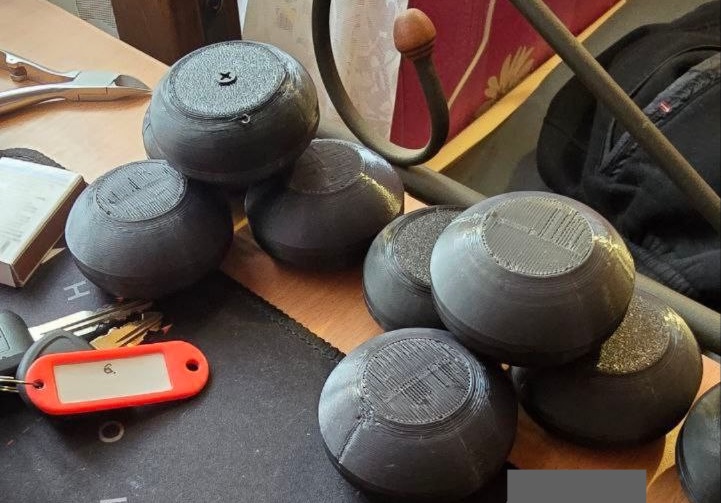
Assorted 3D printed mines (via social media)

While not the first 3D printed explosive device to emerge from the fighting in Ukraine, this mine is certainly one of the smallest and simplest. How widespread their deployment is, is still unclear but they seem they would be a useful part of Ukraine’s drone-deployed mine interdiction efforts behind Russian lines.

Thank you to Roy for drawing my attention to these mines.

Update 22/12/24: A new Russian video showing the internals of the mine and giving a better look at the percussion initiator (source).

Update 5/7/25: A Ukrainian video showing the testing of a 3D printed mine.


Support Us: If you enjoyed this video and article please consider supporting our work here. We have some great perks available for Patreon Supporters – including early access to custom stickers and early access to videos! You can also find us on the History of Weapons & War app. Thank you for your support!
Improvised Bazooka Mine

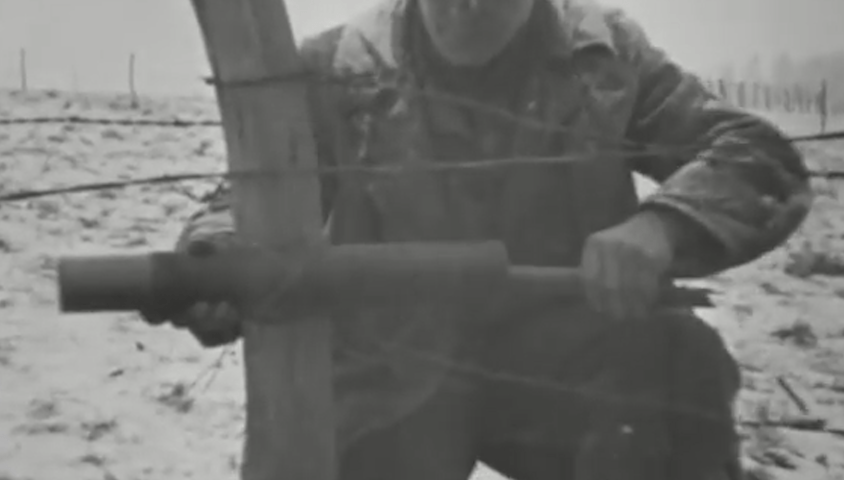
I recently came across an interesting segment in a January 1945 US Army Combat Bulletin newsreel. It showed men of B Company of the 238th Combat Engineers setting up improvised anti-tank mines in Belgium. The mines were fashioned from Bazooka rockets!

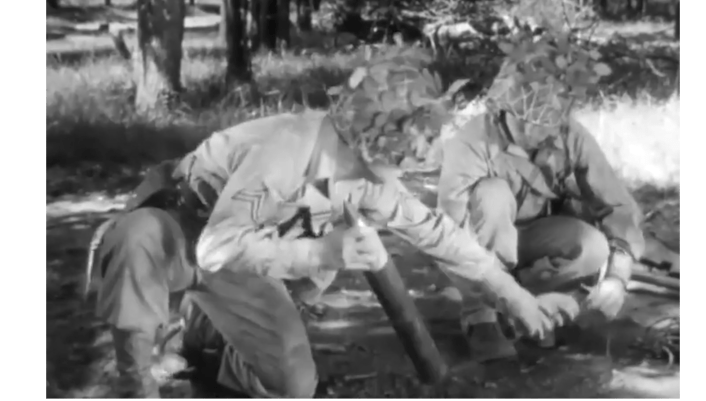
A still from Combat Bulletin #39 showing an engineer from the 238th Combat Engineer Battalion setting up an improvised off route rocket mine on a fence post (US Army)

This is a relatively little-known application for the Bazooka’s rockets but a really interesting field expediency. The footage shows engineers cutting the cardboard tubes the Bazooka’s rockets were carried in, down and attaching them to a fence post. Essentially setting up an off-route mine or IED. The engineers run a wire back to cover for remote detonation with some batteries. 

Diagram showing how the rocket could be buried (1944 US Army field manual)

While these seems quite ad hoc it was a secondary use for the Rocket Launcher’s ammunition which was laid down in the Bazooka’s 1944 basic field manual. It doesn’t appear in the 1943 technical manual for the M1A1 launcher at all but the 1944 manual explains that 

“In addition to its use as a projectile when fired from the launcher, the rocket may be prepared for firing electrically and used as an improvised anti-tank mine.”

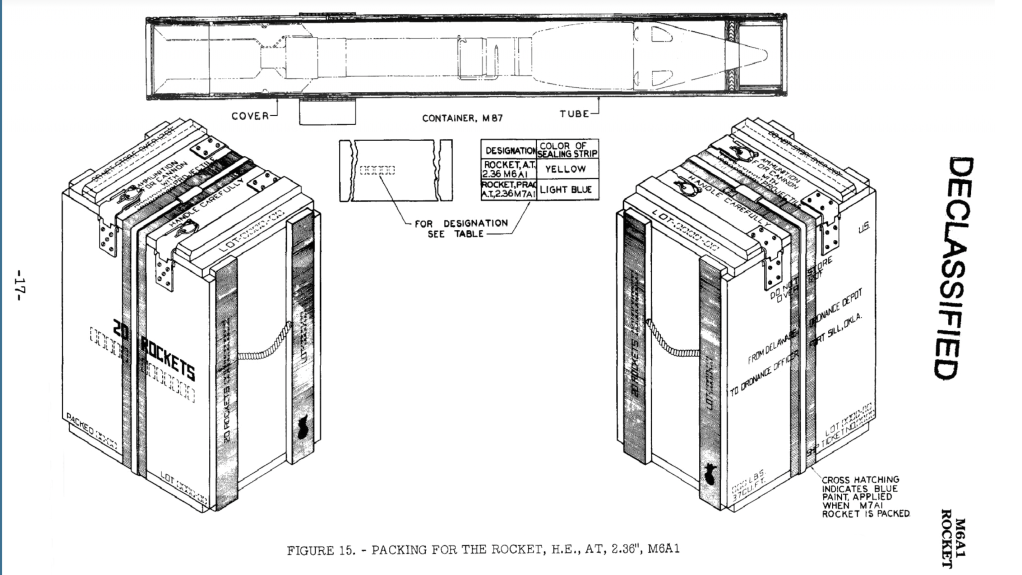
Diagram showing the transport packing and transit cannister tube for the M6 Rocket, the tube could be used as a makeshift launch tube (US Army)

This improvised method of use was also demonstrated in a training film for the Rocket Launcher, a Bazooka team are seen digging a pit in a road and burying a rocket in its makeshift launcher just as laid down in the manual. The training film explains it best…

A still from the 1943 US Army training film for the Bazooka, demonstrating the setting up of an improvised rocket mine (US Army)

The 238th Combat Engineer battalion fought in the Battle of the Bulge and received a commendation from Major General Matthew B. Ridgeway, commander of XVIII Corps, for helping to establish a line of defence against the German offensive. The commendation read: 

“The work of the 238th Engineer Combat Battalion in the construction of the initial barrier in the vicinity of Manhay was outstanding and materially assisted the Corps in holding off the attack of the enemy in that area.”

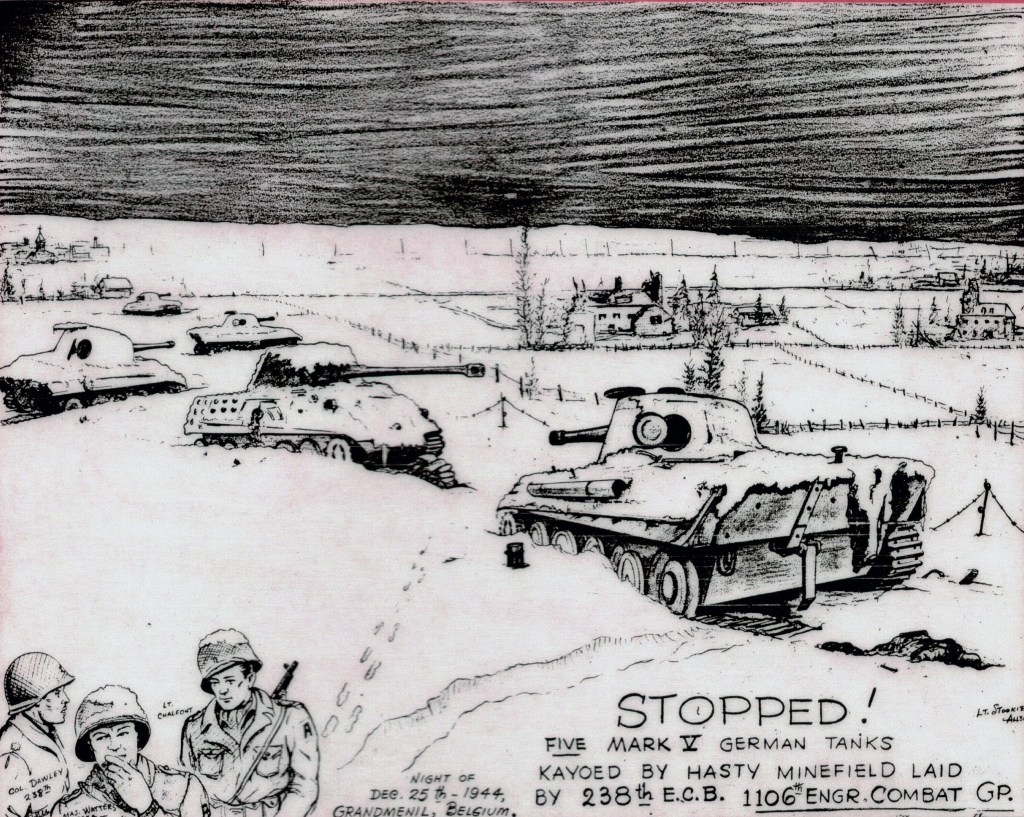
Illustration from a 238th Combat Engineer Battalion Association book showing knocked out German tanks around Grandmenil (238th Combat Engineer Battalion Association)

Whether this technique of improvising a mine from the rockets was used during the battle is unclear but I found the footage of the engineers demonstrating the set up fascinating. Its always interesting to see suggestions from manuals and training films put into action in the field so I was excited to come across this footage. 


If you enjoyed this video and article please consider supporting our work here. We have some great perks available for Patreon Supporters – including custom stickers and early access to videos! Thank you for your support!


Bibliography:

238th Combat Engineer Battalion Association (source)

The Ardennes: Battle of the Bulge, H.C. Cole, 1965, (source)

Footage:

The Anti-Tank Rocket M6” 1943 US Army Training Film; M1 & M1A1 Bazookas, War Department

Combat Bulletin No.39, War Department