
A new kind of Ukrainian drone-deployed anti-personnel mine has been seen behind Russian lines. On 4 November Russian telegram channel ‘Combat Engineer‘, a Russian sapper account, shared photographs of a small mine recovered ‘deep in the rear of the Luhansk People’s Republic’. The mine is one of a number found by the Separate Engineer-Sapper Battalion – Karbyshev, a Russian Volunteer Corps unit. The caption noted that the body is plastic, it uses a 13g explosive charge of PETN and has an overall weight of 43g. The body of the mine has the Ukrainian HFM-prefix and is coded HFM0040. The small anti-personnel blast-effect mine has an unusual shape, which combined with the green colour of its body, looks a little like an avocado.
The Karbyshev Battalion didn’t post about the mines until two days later. Their post included additional new photographs and a detailed caption. The caption explains the tactics used to deploy the mines. The Karbyshev sapper battalion stated that Ukrainian forces used reconnaissance drones to locate a Russian position and then seeded the area with, per Russian estimates, around 200 HFM0040 anti-personnel mines to interdict possible evacuation routes. The Ukrainians then attacked the position with ’15-17 strike drones’. Karbyshev Battalion concluded by saying that “the HFM0040 mine shows the influence of the PFM-1 (ПФМ-1) ‘petal/butterfly’ mines. The droplet-shaped design is intended to give the mine aerodynamic properties, and the body is made of silicone. Due to its elasticity, only individual mines detonate upon impact with a hard surface (asphalt, concrete, compacted soil), while most remain in place where they were dropped.”
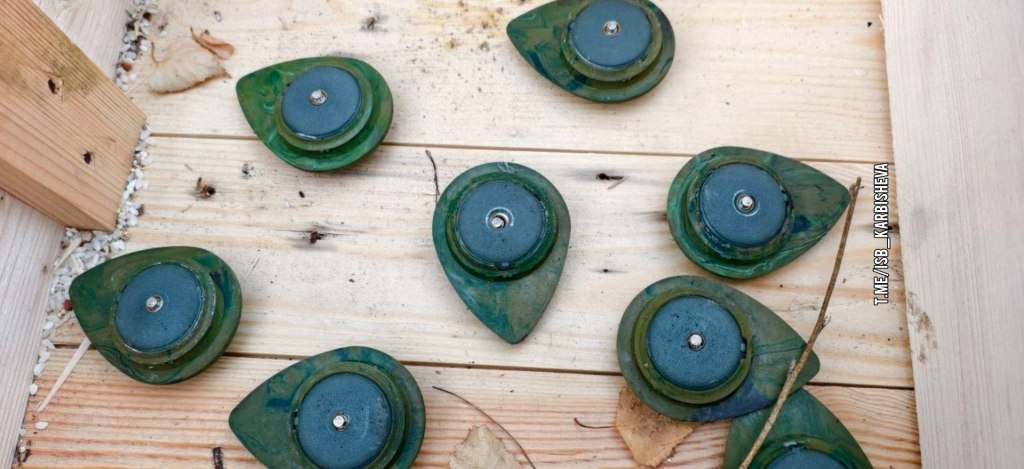
These recent sightings, however, are not the first. On 29th July, Two Majors, a large Russian telegram page, shared a pair of photographs showing 27 of the mines collected after they were dropped by drones overnight. Referring to the mines colloquially as “butterflies”, the caption notes “Approximately one hundred of these munitions were discovered after the nighttime raid” and urged people to be “extremely cautious. Watch where you are stepping, do not approach unfamiliar objects, and do not attempt to handle them yourself. Report any such findings immediately to the relevant authorities.”
In late October a number of Russian social media pages began sharing one of the images from July and suggesting the mines had been seen in the Ormsk oblast, in central Russia. This was quickly denied as fake news by the local government.
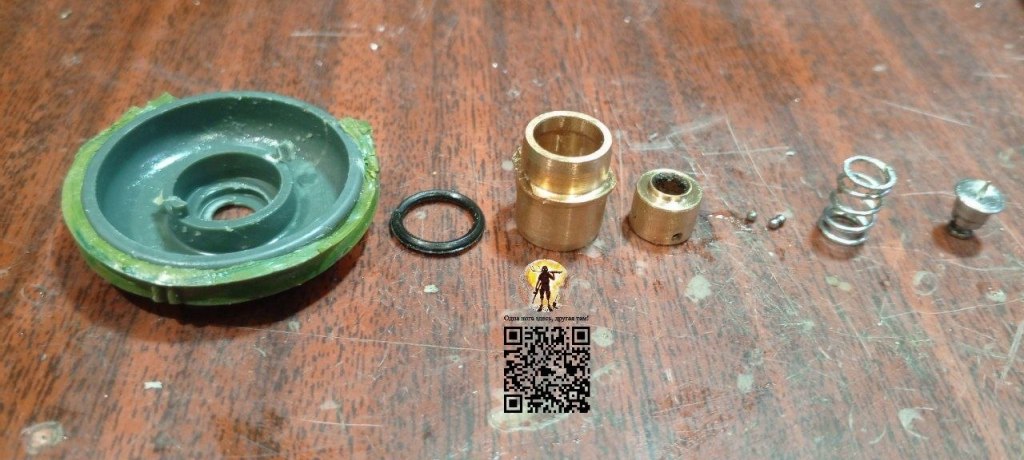
So how do these new mines work? EOD specialist Seán Moorhouse notes that the HFM0040 appears to have a cocked-striker inside a transverse fuze well and when the pressure plate is pushed down, it aligns a notch with the fuze well, thereby releasing the cocked-striker into the sensitive primer, initiating the blast. These components can be seen in the images shared in early November.
These aren’t the first drone-deployed anti-personnel mines we’ve seen utilised by the Ukrainians. Back in December 2024 we shaw a much simpler 3D-printed mine which utilised a screw as a striker to initiate detonation.
The HFM designation, design and the build quality of the mine suggests that the mines are produced at scale. These sorts of mine would be useful in interdicting Russian supply lines and, as described by the Russian sappers, in preventing the movement of troops in or out of areas of engagement.

Support Us: If you enjoyed this video and article, please consider supporting our work here. We have some great perks available for Patreon Supporters – including early access to custom stickers and early access to videos! Thank you for your support!
Discover more from The Armourers Bench
Subscribe to get the latest posts sent to your email.

