
In March the Canadian Armed Forces selected a new rifle to replace their venerable C7 and C8 rifles. The Canadian Modular Assault Rifle (CMAR) program has seen Canada make an initial order for 30,000 General Service (GS) variants of the new rifle. In selecting the CMAR the Canadian Armed Forces have wrestled with the fundamental question facing many major armies around the world as they come to replace their current generation of small arms – how do you defeat enemies with level IV body armor?

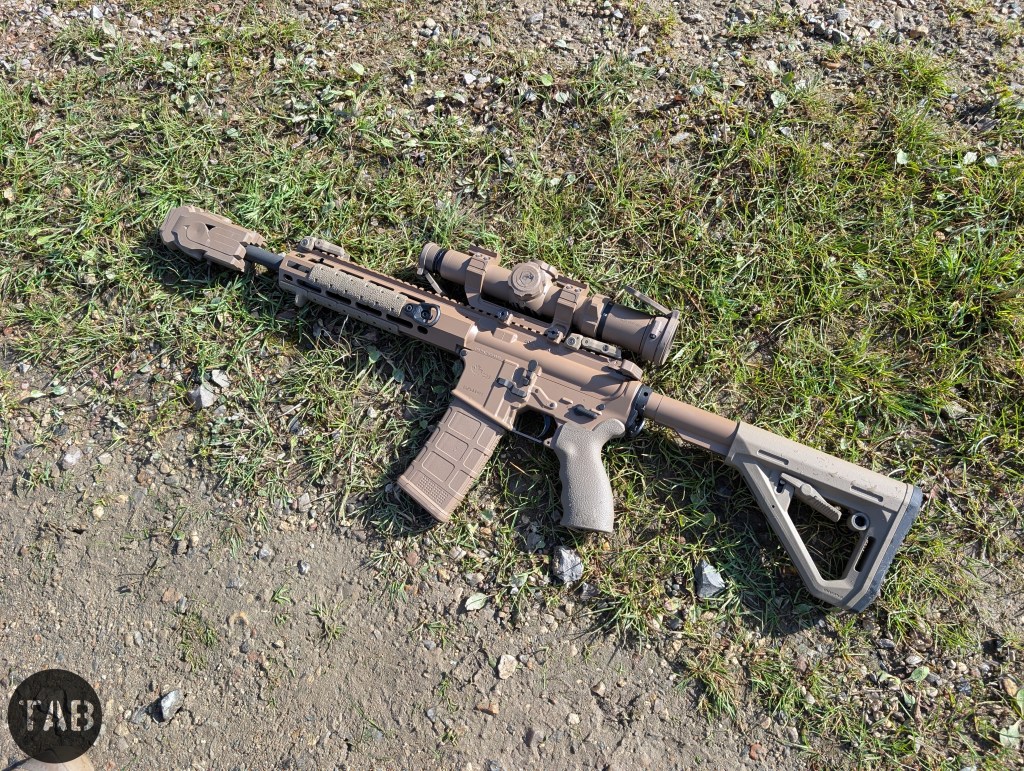
The US Army has opted for power and penetration with the Next Generation Squad Weapons program and the new 6.8x51mm round but not every military sees a larger, more powerful round as the answer. While the US Army has gone all-in on the 6.8mm family of ammunition for its close combat units, other nations – for various reasons – will be more cautious, not wanting to move away from the proven 5.56x45mm and 7.62x51mm standardised ammunition natures. After assessing a number of approaches the Canadian Armed Forces and Defence Research and Development Canada (DRDC) have chosen to stick with 5.56x45mm for their soldiers’ individual weapons. The C25 Canadian Modular Assault Rifle developed by Colt Canada in conjunction with the Canadian Armed Forces aims to improve the average Canadian soldiers’ capability to defeat enemies with modern body armor by giving them a modern, modular rifle which improves their practical accuracy.
Canada’s New Doctrine
With the new C25 rifle Canada aims to enable close combatants to strike unprotected or more vulnerable areas of their opponents’ bodies. Conventionally, troops are taught to aim for centre mass, a significant area that contains many vital organs. With the proliferation of modern body armour, which protects this area and reduces the effectiveness of 5.56mm ammunition, Canada believes targeting less well protected areas such as: the head, neck, lower abdomen, groin and legs is the modern soldier’s best option. To reliably hit these areas, which are harder to hit than centre mass, soldiers will need to be more precise with their shot placement – Colt Canada say the C25’s configuration has been developed with this in mind. However, for this new doctrine to be truly effective Canadian troops will probably need more time at the range.
How Does the C25 Improve Soldier Accuracy?
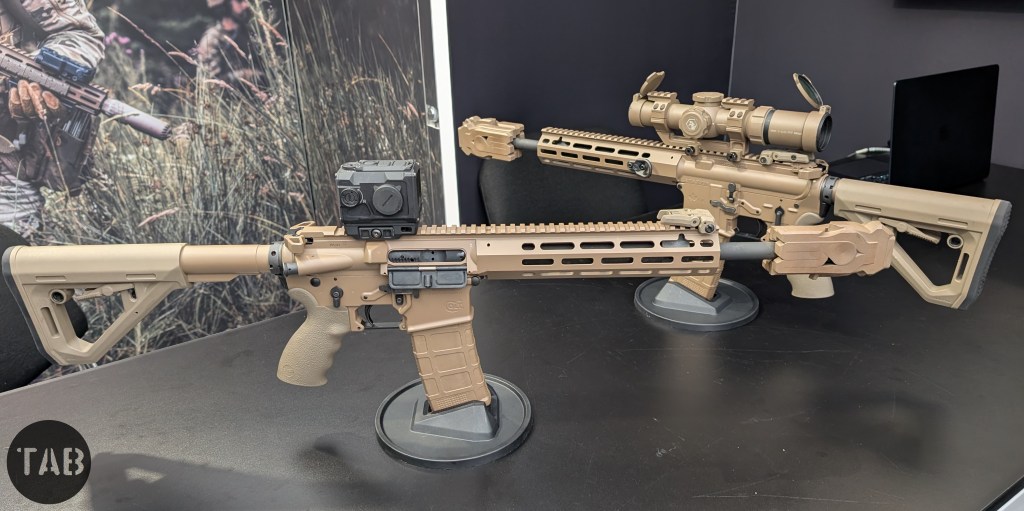
The C25 is an evolution of the Colt Canada C8A4 (known as the Modular Rail Rifle) so at its core the C25 uses the classic direct impingement system, or expansion gas bleed-off as Colt Canada describe it. The rifle’s length ranges between 32in (813mm) and 35.2in (895mm), depending on stock position, and weighs in at 7.61lbs (3.45 kg) unloaded and without optics and accessories, but with an MFMD mounted.
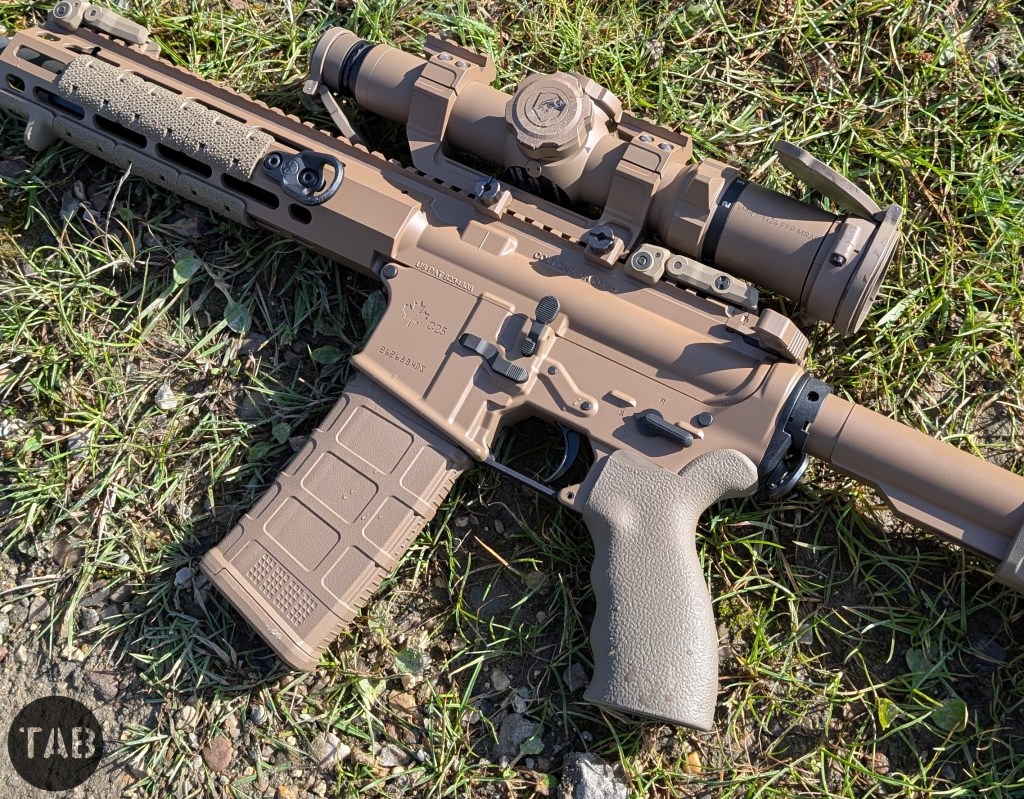
Increasing hit probability and the impact of rounds on target was the key consideration for Colt Canada when working with the Canadian Armed Forces. The C25 achieves this in a few ways: improvements to the rifle’s ergonomics (new MLOK handguard, a monolithic upper receiver and fully ambidextrous controls), a new two-stage trigger, a new 1-6X low power variable optic (LPVO) and a new muzzle device – the Millbrook Strategic Sciences MFMD or Multi-Function Muzzle Device. These features combine to improve the soldiers’ practical combat accuracy.
How do these features help improve practical accuracy?
The monolithic upper receiver provides improved rigidity and stability for the mounting of optics and enablers. The two-stage trigger provides more control under stress and greater precision, the new LPVO allows the user to aim more precisely at various ranges and the MFMD helps reduce perceived recoil with a smoother impulse as well as reducing flash and blast at the muzzle.
At the Range with the C25
In Copenhagen, I had the opportunity to get behind the C25 for the first time. Putting around 100 rounds of Sellier & Bellot SS109 through a C25 with Colt Optics’ 1-6x Low Power Variable Optic.
In terms of points of contact with the weapon, the 5-slot MLOK forend, mounting to the monolithic upper receiver, minimises flex and offers plenty of room for mounting enablers like lights and lasers. The C25 has the very ergonomic ERGO 2 pistol grip and Magpul DT carbine buttstock as standard and a full suite of ambidextrous controls.

The C25 also benefits from a new two-stage trigger which Colt Canada says is intended to ensure a more sensitive, clearly perceptible and predictable trigger pull with each shot. The trigger had smooth first stage take-up, with the second stage breaking predictably, followed by a short reset. The rifles have a 13.7in (348 mm), 1:7 twist, cold hammer-forged chrome-moly vanadium steel barrel with improved geometry to reduce disturbance during the travel of the projectile. The C25 is optimised for Canada’s current SS109 (C77 Ball) but Colt Canada are exploring other 5.56x45mm loadings.
Colt Canada noted that C25 has been optimised to be effective out to 300m, though with the Colt Optics’ 1-6x LPVO I can see a skilled rifleman easily reaching out further. The barrel is tipped with a directly threaded MFMD, which will be standard across the whole C25 fleet – making Canada the first country to equip its all of its service rifles with a suppressor as standard. There has been a lot of hype around the MFMD so I was excited to give one a try.
The MFMD’s flow-through design is driven by fluid dynamics which leads to its very unconventional profile. Colt Canada noted that they had tested the MFMD, which is 3D printed from inconel, extensively putting 10,000 rounds through it. Canada reportedly trialled 14 suppressors from various manufacturers before selecting the MFMD.
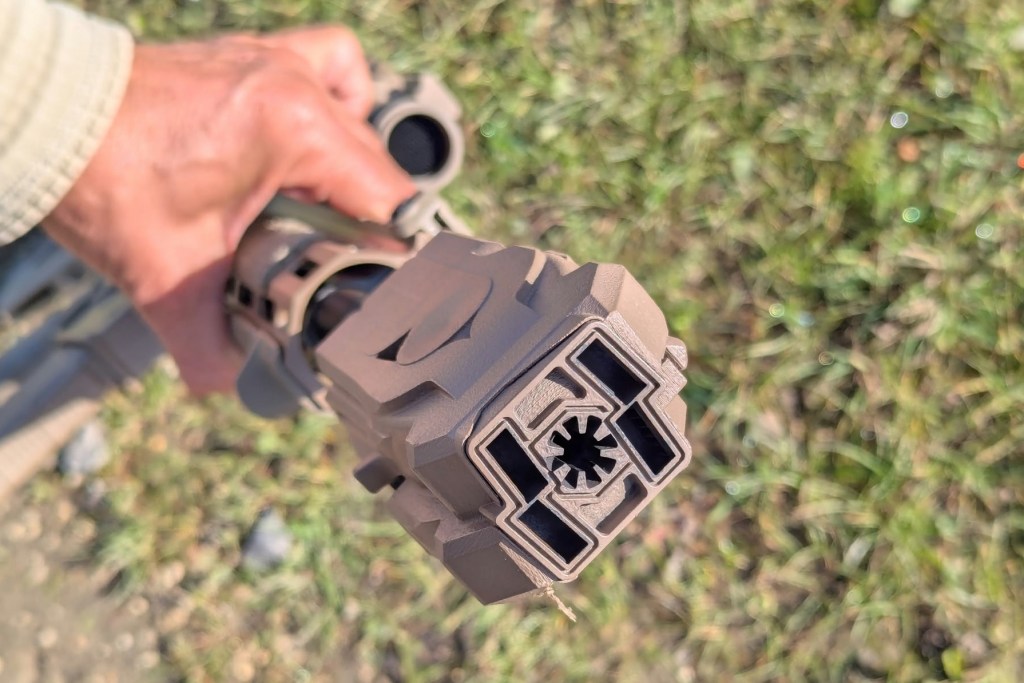
As a left-handed shooter I found the MFMD’s flow-through design minimised gas pushed out the rear of the upper receiver and into my face and I was impressed by the MFMD’s sound signature mitigation. The base module of the MFMD is designed to work as an all-in-one flash hider, muzzle brake and suppressor. It can be augmented with an additional module, the SD, which offers further suppression but the Canadian Armed Forces have opted for just the base MFMD. Despite this the base muzzle device still suppresses the C25 to around 140dB, this was certainly noticeable on the firing line.
The new carbine comes in the increasingly ubiquitous flat dark earth finish, marking the end of the unique green furniture (pistol grip, stock and hand guards) of the C7 and C8 family of Canadian weapons. I’m a fan of the classic Canadian furniture colours, optimised for the plains and woodland, so I’m sad to see it replaced by FDE. Sadly, the new muzzle device also means no bayonet mounting.
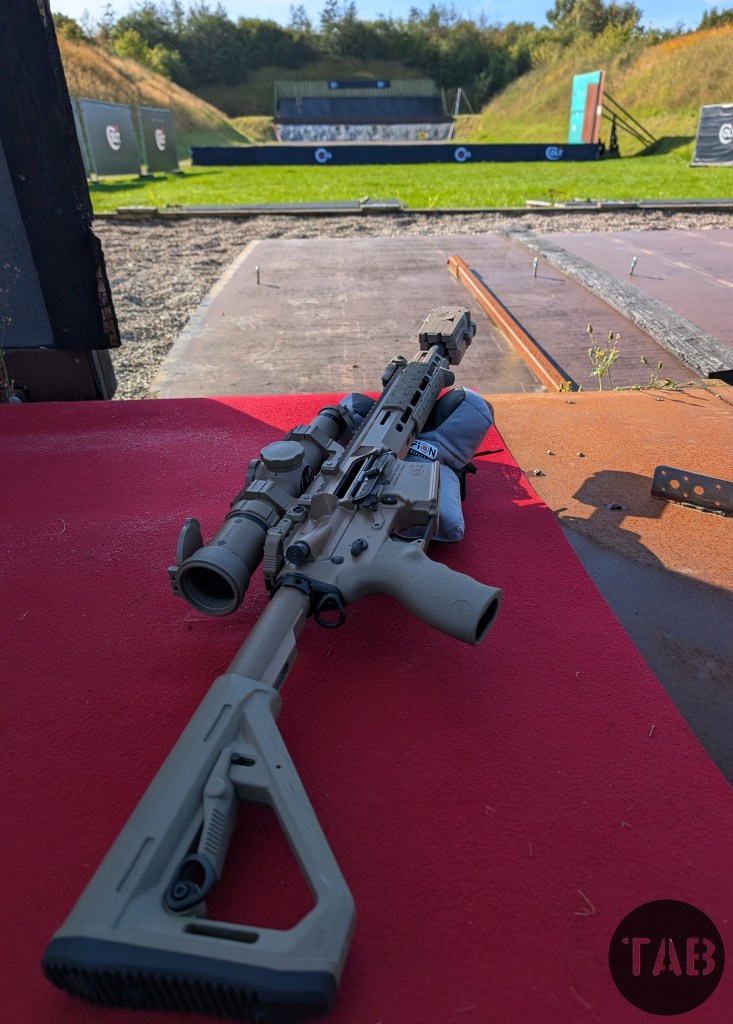
All in all, the C25 left the impression of a capable weapon: robust, accurate and ergonomic. While we didn’t shoot groups on paper engaging plates and a crossing target at 100m supported and unsupported was pretty easy. The new MFMD has a practical effect, and the rifle as a package seems well placed to fulfil Canada’s pragmatic new doctrine.
As the UK’s Project Grayburn begins to ramp up rifles like the C25 are going to be key competitors in the upcoming UK rifle programme.
Special thanks to my friend and colleague Amael Kotlarski for filming some of the range footage used in this article’s video.

Support Us: If you enjoyed this video and article, please consider supporting our work here. We have some great perks available for Patreon Supporters – including early access to custom stickers and early access to videos! Thank you for your support!
Discover more from The Armourers Bench
Subscribe to get the latest posts sent to your email.

