
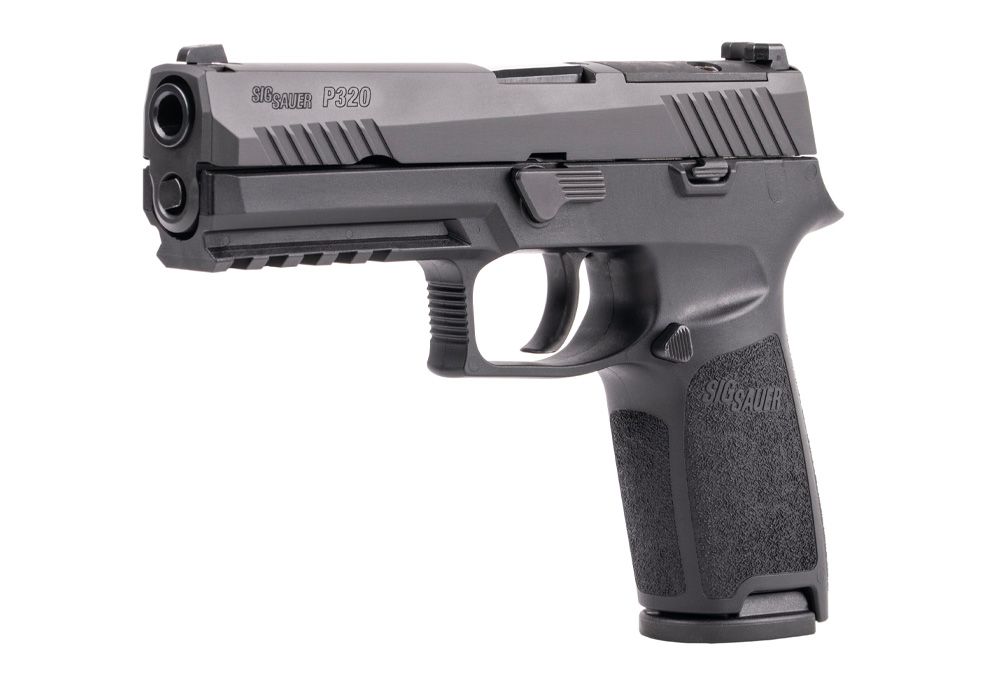
On Thursday (4 December) Armasuisse, Switzerland’s Federal Office for Defence Procurement, announced the selection of the SIG Sauer P320 to replace the venerable P75 (SIG Sauer P220), which has been in service since 1975. So I thought it was a good time to break down all of the major militaries that have adopted the SIG Sauer P320 over the last 10 years.
The SIG P320 is a modular, striker-fired pistol that uses the typical short-recoil, tilting barrel action, with a serialised trigger group available in varying grip-frame sizes. It evolved from the hammer-fired SIG Sauer P250 and entered production in 2014.
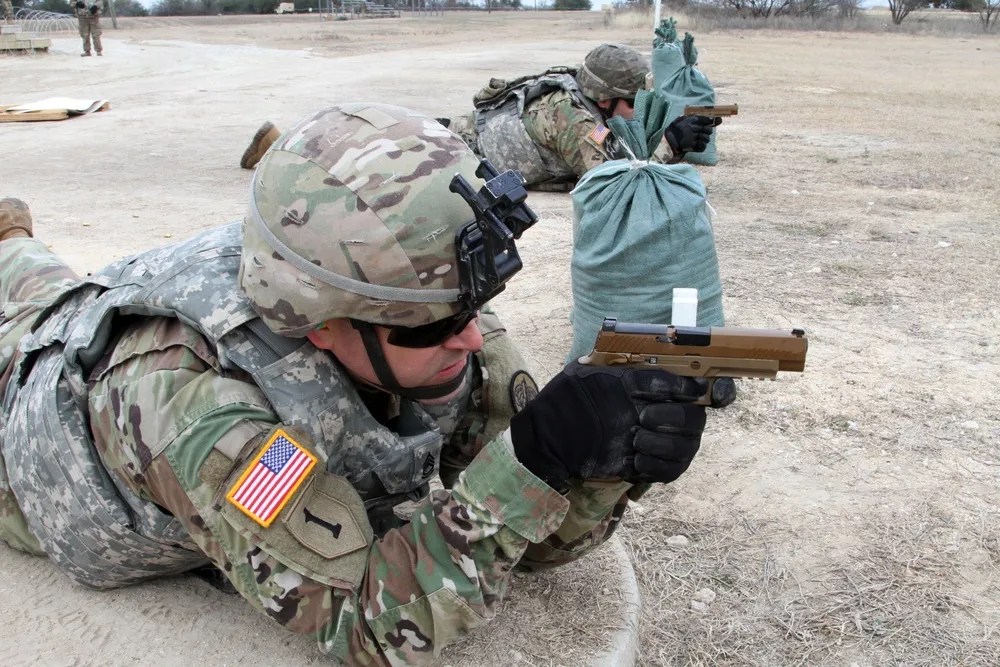
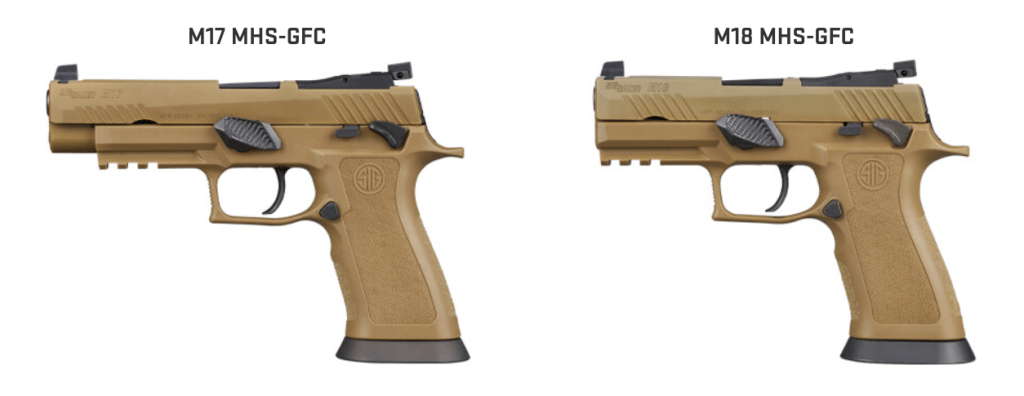
In September 2015, the United States Army and United States Air Force released a Request for Proposals for a new service pistol. This launched the Modular Handgun System program seeking to replace the Beretta M9 which entered service in 1990. The P320 faced off against a broad field of competitors including: the Beretta APX, CZ P-07, FN FNS, Smith & Wesson M&P M2.0, Glock 17 MHS and the STI Detonics STX. Down-selection and further testing took place in 2016, before the winner was announced in January 2017. The 101st Airborne were the first unit to be issued the new MX17 and compact XM18 pistols, and fielding continued into the 2020s. The M17 and M18 have a frame mounted safety and their slides are optics ready. The USAF and US Navy procured the smaller M18, with its 3.9in barrel. The USMC also eventually selected the M18 to replace the M9, M9A1, M45A1 and M007 (Glock 19) in September 2020.
Almost 10 years after the US Army launched the Modular Handgun System program, it was announced that the MHS General Forces Configuration had been approved. The MHS GFC introduces new parts and accessories for the M17 and M18. This system allows units and soldiers to customise their sidearms to a greater degree. The new parts and accessories include new grip frames, flared magazine wells, gas pedal take-down levers, slide-mounted or stand-alone Romeo M17 Pistol Red Dot Sights and special barrels. The GFC introduces elements seen in the popular X-Carry variants.
In April 2018, the Danish armed forces became the second military to select the P320. The Danish Ministry of Defense selected the P320 X-Carry variant of the pistol. The Danish Army pistol trials began in 2017 and the P320 X-Carry beat competition from the Glock 17 Gen 5, Beretta APX and Canik TP 9 SF to replace Denmark’s P/49 (SIG P210) pistols. The Danish pistols have the enhanced X-Carry polymer grip frame, a flat trigger, an extended beaver tail, an extended removable magwell, an optics-ready slide, and a deep trigger guard undercut. The pistols do not have a frame-mounted manual safety. At the time of the adoption, Major Tom Elvius-Brisson, Chief of Weaponry Branch, Danish Defense Acquisition and Logistics Organization, said: “By far SIG SAUER’s P320 X-Carry outperformed the competition throughout our rigorous and stringent testing process… the pistol is the modern firearm we were looking for to support our soldiers. The P320 X-Carry has a larger magazine capacity, comes reflex red-dot ready for sighting, and has the ability to incorporate a suppressor – all extremely important features to our soldiers for their sidearm today.” It’s unconfirmed just how many pistols Denmark procured, likely under 10,000, and fielding of the Sig Sauer P320 was anticipated to have been completed by the end of 2019.
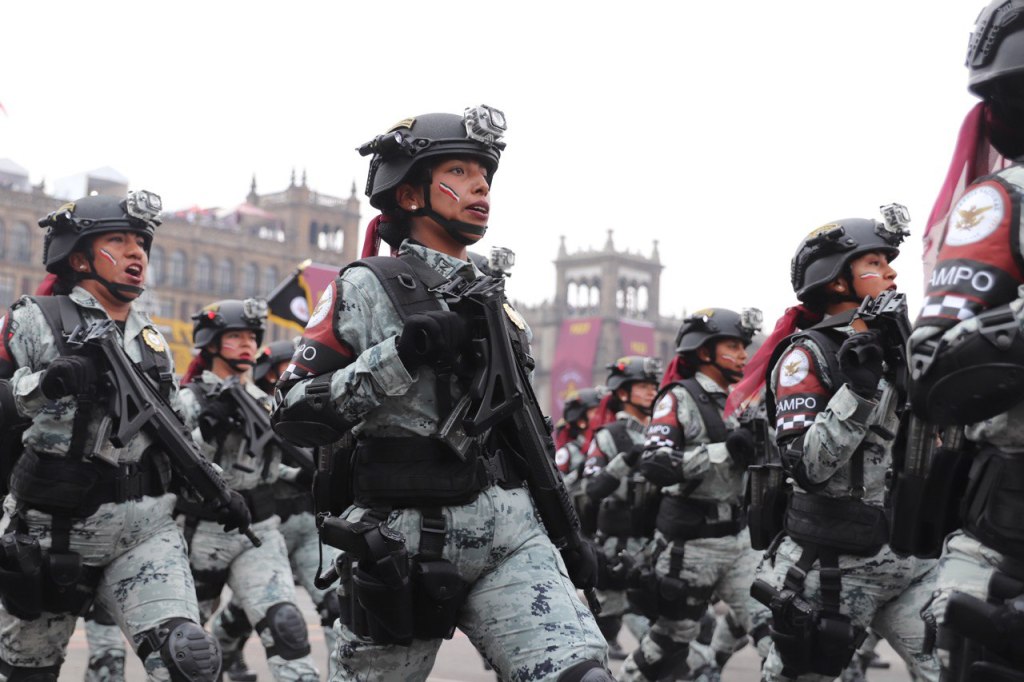
One of the less widely reported adoptions of the P320 came in 2019 when Mexico’s National Guard reportedly acquired 50,000 P320s. Some sources suggest that the pistol is also used by elements of the Mexican military. The pistols were procured in 2019 and appear listed in the National Guard’s 2021 Annual Activity Report. They can also be regularly seen as standard issue equipment in imagery shared by the Mexican government. Some photos of the pistols show the slides engraved with ‘SDN’ for Secretaría de la Defensa Nacional, Mexico’s defence department. The pistols otherwise appear to be stock, full-size duty model P320s in black with no manual safety present.
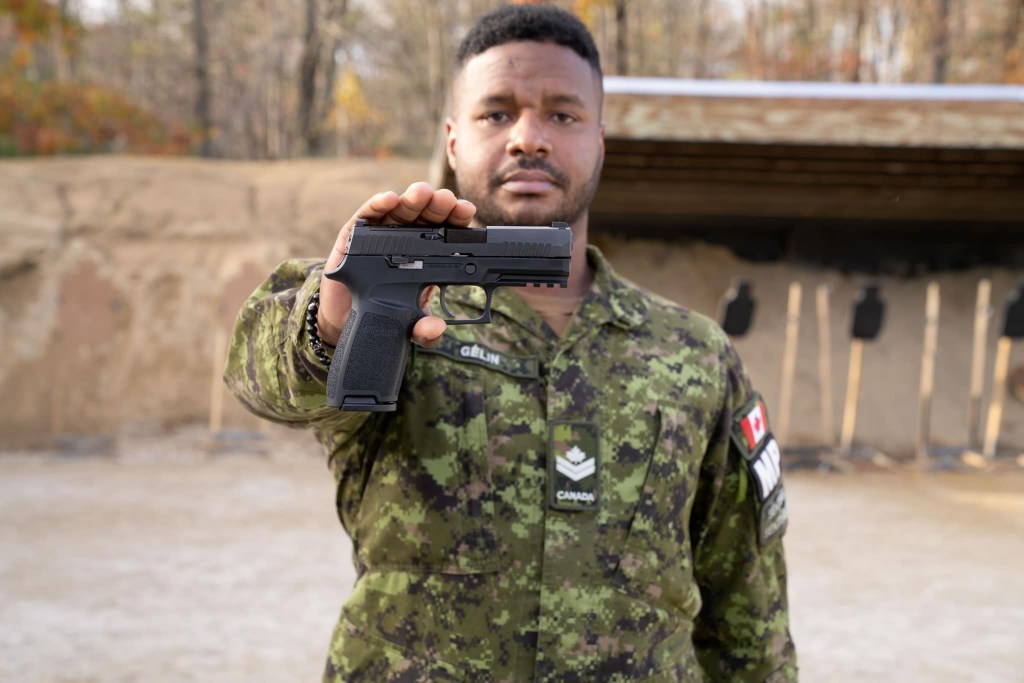
Canada became the next nation to select the P320, replacing their 80 year old Inglis-made Browning Hi-Powers. Opting for a full-size pistol with a 4.7in barrel, the pistol differs from the M17-pattern pistol in that it lacks a frame-mounted manual safety, and its rear sight is fixed on the slide, with the optics-mounting place located separately just ahead of it. It also has unique Canadian engravings on the slide, and both slide and frame are completely cerakoted in an FDE colour. The Canadian Armed Forces adopted the P320 as the C22, with an initial order for 7,000 pistols for the Canadian Army announced in October 2022. At the time of the announcement, Anita Anand, Minister of National Defence, said: “The Government of Canada is committed to providing the Canadian Armed Forces with the equipment they need when they need it. Replacing the Browning 9mm with the C22 full-frame modular pistol (Sig Sauer P320) will help ensure the continued operational readiness and effectiveness of all our members.”
There is an additional option for a further 9,500 pistols to support Royal Canadian Air Force, Royal Canadian Navy and Military Police requirements. Canada’s transition to the C22 began in June 2023, when it was also confirmed that the Canadian Government was also in the process of procuring an additional 2,272 pistol and holster systems for the Canadian Army, 1,550 for the Royal Canadian Navy and 2,478 for the Royal Canadian Air Force. In December 2023, the Canadian Armed Forces also announced that they would start issuing the carry-size C24 pistol in early 2024.
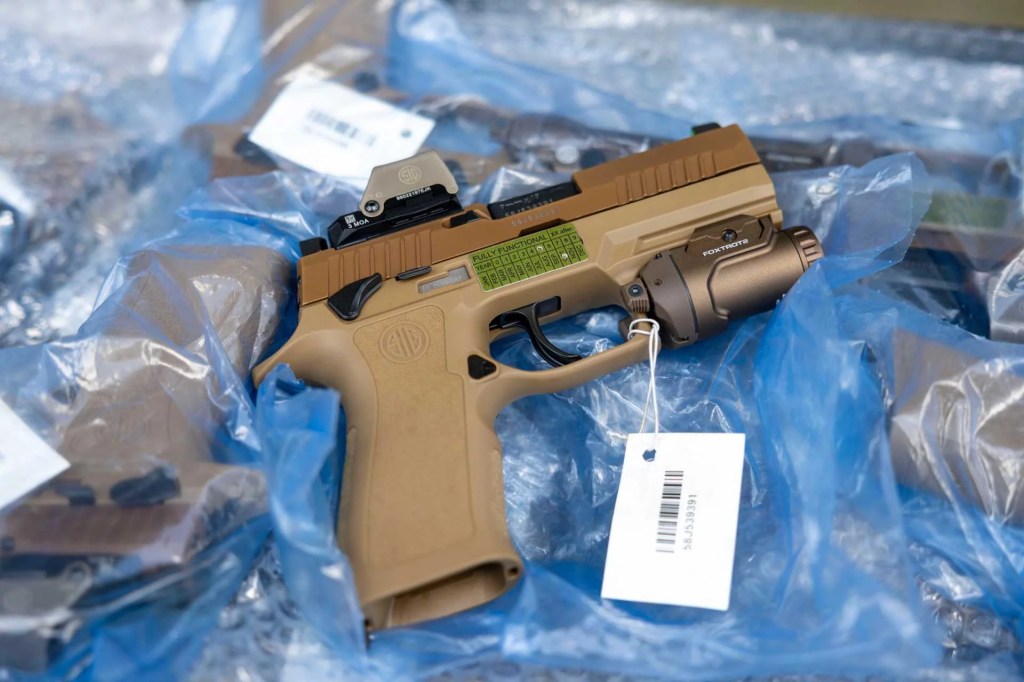
At the beginning of October 2022, the Australian Department of Defence announced that under its Lethality System Project LAND 159, a raft of new small arms were selected for the Australian Defence Force’s dismounted combatants. The P320 was chosen to replace Australia’s Browning Hi-Power Mk3s. The X-Carry Pro was selected as the platform for the Sidearm Weapon System requirement. The Australian pistol has a manual safety, suppressor height sights and a 3.9” barrel. It comes mounted with a SIG Romeo 2 (half shroud) reflex sight and Foxtrot 2 white light illuminator (which itself is designated the F10). In September 2024, this package was designated the F9. Unlike the X-Carry selected by the Danish, the X-Carry Pro chosen by Australia has its rear sight mounted on the slide rather than the optics-cut plate. Elements of the ADF’s 7th Brigade became some of the first Australian units to begin training with the pistols in August 2025.
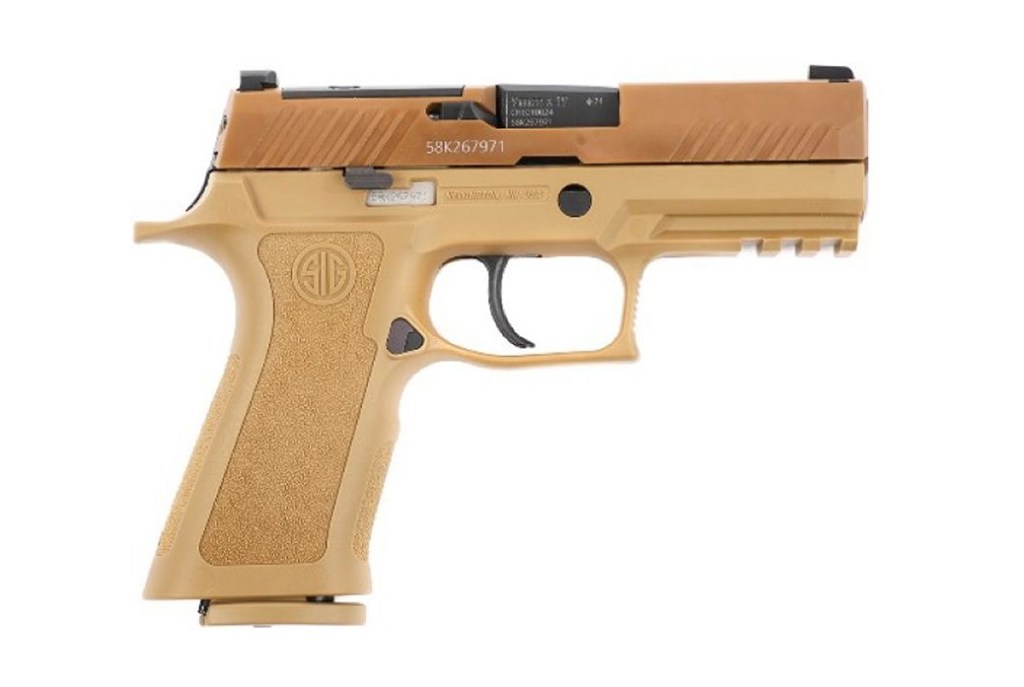
As mentioned at the start of the video, Most recently, the Swiss Army has selected the P320 X-Carry Pro to replace the P75 (SIG Sauer P220). The Swiss sought a pistol with modern ergonomics, modularity and a 30 year service life. The tender for a new pistol was launched in 2024, from the pistols submitted five were selected for evaluation and three were down-selected. After further testing the P320 beat out competition from the Glock 45 Gen 5 and Heckler & Koch’s SFP9. Intriguingly, Armasuisse, the Swiss Federal Office for Defence Procurement, noted that initially only the Glock 45 met all the mandatory criteria and was classified as suitable for service. The SIG, however, was selected following a cost-benefit analysis and Armasuisse notes that SIG Sauer are contractually obliged to resolve any issues and establish production of the pistols locally in Switzerland. The Swiss have set aside “a mid-range double-digit million amount” for the procurement of 140,000 SIG Sauer P320s, with the initial lot numbering 50,000 pistols. The image shared by the Swiss Army showed an FDE pistol while a subsequent photo shared by SIG Sauer Switzerland showed one with a black slide and a green frame with a Swiss Cross on the grip.
Despite controversies surrounding the pistol, and SIG Sauer’s ongoing response, the P320 continues to win major military contracts around the world. SIG have optimised their approach: partnering on a number of occasions with credible local companies and offering a capable but, perhaps most importantly, affordable sidearm, as such at the time of writing the P320 is involved in a number of ongoing and upcoming pistol trials.
Special thanks to Greg Knowles for assistance.
Support Us: If you enjoyed this video and article please consider supporting our work here. We have some great perks available for Patreon Supporters – including exclusive videos, custom stickers and early access to videos! Thank you for your support!



 The Armourers Bench