
Over the past 12 months various Russian units have been developing and deploying their own home-made, makeshift ground kamikazes. These have been made out of commercially available ‘hoverboards’, hoverboard is a bit of a misnomer but its easier than saying two-wheeled, balancing board. In Russian they’re known as гироскутеры or ‘gyroscooters’.
Russian military workshops in various sectors have developed remote-controlled ground drones; in military terms, these are a very basic sort of unmanned ground vehicle. Russian forces have deployed them to carry a variety of payloads, including: smoke generators, supplies, remotely detonated explosive devices and even mine rollers.
In the simplest terms, the workshops constructing the Hoverboard UGVs typically take two commercially available self-balancing hoverboards and bolt them together. They retrofit a remote control receiver and connections to interact with the hoverboard’s motors.
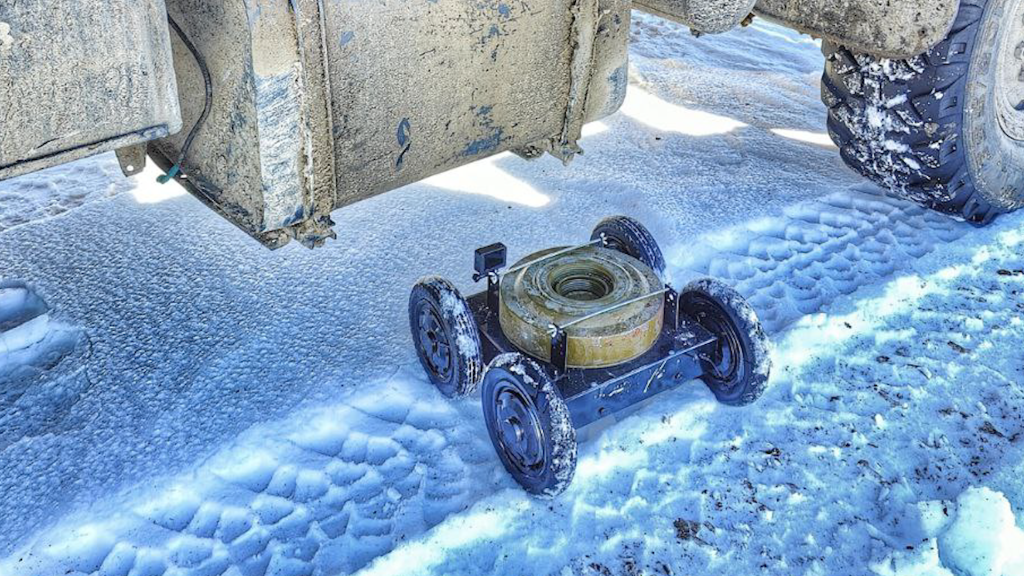
Experimentation with unmanned ground vehicles by both sides has been ongoing since 2022 though it has been largely outpaced by developments in aerial drones the UGVs have found their niches and continued to evolve. One of the earliest videos of a UGV which likely utilised hoverboard components I was able to find dates to mid-March 2023, when a Ukrainian team deployed a UGV loaded with a MON-90 and additional explosives in the Bakhmut area. Similarly, at the same time Russian units were also developing small kamikaze UGVs such as the ∆V-04, a one-way UGV which delivers a TM-62 (or similar) to a target. Developed by the Russian Avtobot group the drone appears to utilise hoverboard components.
On 7 May, a small Russian Telegram page, Stavropol Fighter, posted a workshop video showing what the caption describes as: “a combat radio-controlled vehicle (BRM-1)” which has a range of up to 1km and can be used in a variety of roles including casualty evacuation, one-way munition and the launching of anti-personnel mines. The post also called for donations of components including: “Old scooters, gyro scooters, video cameras, transceivers, etc.”
A couple of months later in July, the same channel showed another UGV similar to the BRM-1 seen in May, equipped with six RPGs (though no control system is visible) and its own little anti-drone (cope) cage. It was also seen in another photo posted on the 27 July. A day later they also shared a video showing the construction of a casualty evacuation UGV based on a pair of Hoverboards.
In September, another video surface which shows a pair of hoverboards with their casings removed, connected by a pair of metal braces and a board of wood which the unit’ s batteries and a control box have been mounted. In the video a Russian individual explains it can be used to carry mines up to an approximate range of 5km.
While developments no doubt continued the next reference to the use of hoverboards I came across was a video posted at the end of February 2024, calling for the donation of old, unwanted hoverboards with the caption noting [machine translated] “It doesn’t have to be new! Old, broken, unnecessary, lying in the closet! This will help our team and our country bring the victory closer!”
On 11 May, the Russian Telegram page, Two Majors, also made a request for old hoverboards, with the video showing a number of hoverboards adapted in various ways, one had an outrigger with caster wheels fitted, while another much more sophisticated UGV has combined three hoverboards together and added tracks. The caption for the video read [machine translated]: “do you have an old hoverboard gathering dust somewhere and want to help the Army? Send it to us! All gyroscooters will be regularly sent to the Front, and there, on site, they will be converted into self-propelled units. Several weeks later the channel shared a video of donated hoverboards arriving and being unloaded.
At the start of June, Russian media outlet Sputnik shared a video showing a small logistics UGV carrying a payload of mortar rounds. The drone appears to be utilising components from hoverboards. The video concludes with a drone feed video showing the UGV being used as a kamikaze, detonating on a treeline position.
On 6 June, Russian media outlet Izvestia reported on a small logistics UGV made to carry ammunition and supplies to forward positions. The video shows a small UGV is based on the components of a pair of hoverboards but has larger wheels, a cargo space and new control receivers. The UGV was built by members of the 110th Separate Guards Motor Rifle Brigade of the then-1st Donetsk Army Corps.
On 15 June, Two Majors posted a short video showcasing the testing of what they jokingly call a ‘combat cockroach’ showing it travelling over rough ground – interestingly, it appears to be somewhat centrally articulated allowing the axles to traverse uneven ground. The caption notes that it can carry “up to 100 kg” over around 2km but some refinement is still needed. The video shows the drone with a UDSh smoke generator mounted, these share the same dimensions as TM-62 anti-tank mines.
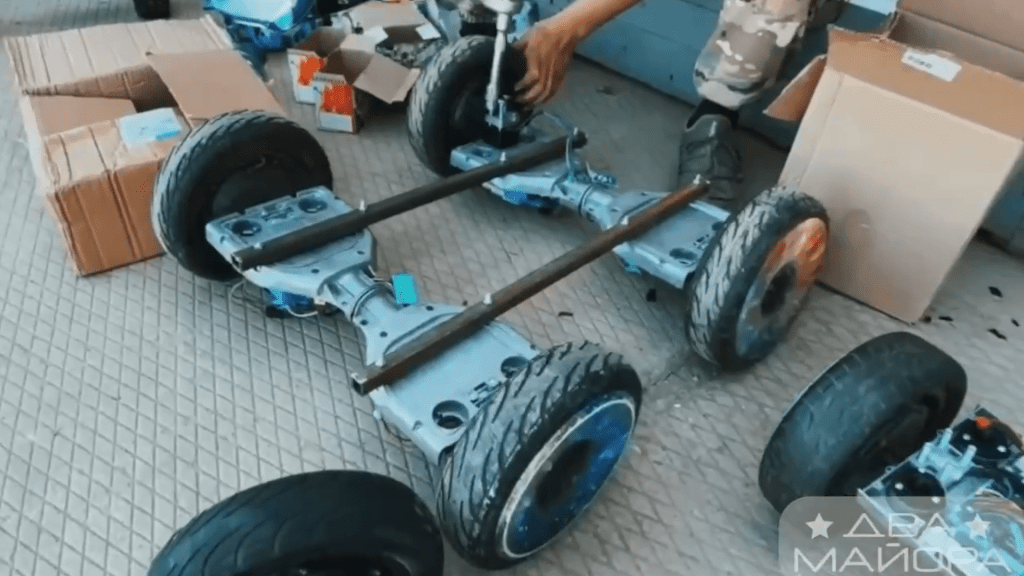
On 22 June, the same Telegram channel shared a video showing the disassembly and modification of donated hoverboards. The video shows Russian technicians removing casings, rewiring the boards and testing connections and motors.
A day later, on 23 June, the channel shared another video of a completed hoverboard drone with a raised cargo bed with a UDSh smoke generator mounted. The video shows the UGV travelling down a track and then the UDSh being remotely ignited. This use case is interesting as it could be used to screen other hoverboard UGVs with explosive payloads or supplies, or cover an infantry assault.
In early July, another video, shared by Two Majors shows a batch of five completed and painted Hoverboard UGVs ready for use as kamikaze drones. During the same video we get a rare look inside a larger tracked UGV and we can see that they also use hoverboard components. The Two Majors groups’ website also added a page about the Kamikaze Hoverboards. On 7 July, they shared a video of the drones being painted using foliage to create a camouflage pattern.
Towards the end of July, the channel shared two more videos showing a more complete picture of how the Kamikaze Hoverboards are built, showing the construction, the testing and the test detonation of one of the drones. In the videos we see the hoverboards being disassembled, their wiring being accessed and the addition of connecting struts added between the two hoverboards. The test footage then shows a drone covering rough ground and going along a road before seemingly detonating next to a vehicles.
On 9 August, the group shared a video of a delivery of more donated Hoverboards with the caption stating [machine translated]: “Gyro scooters continue to arrive for kamikaze cars from all over Russia. We pick them up from the pick-up point in large batches and immediately take them to production. More than one such batch has already arrived for assembly.” The same day they confirmed that the first Hoverboard drones had reached combat units.
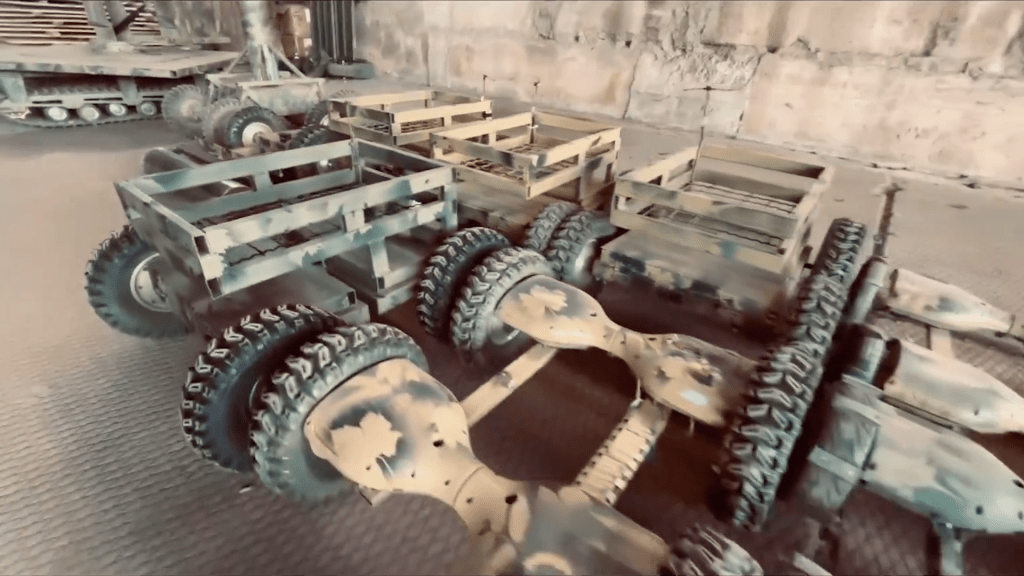
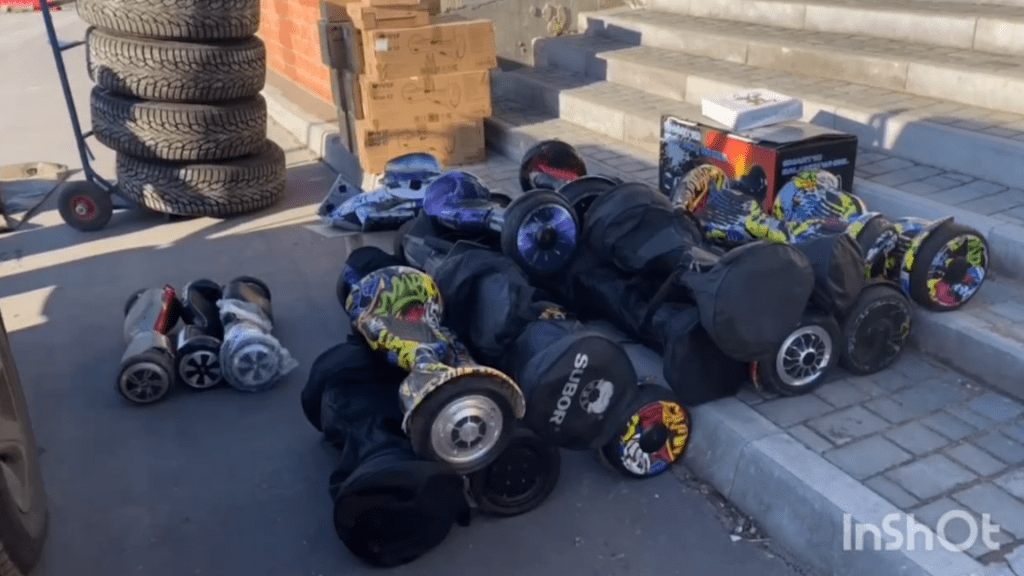
A video posted on the 11 August by the Archangel Legion Foundation nicely illustrates the variety of different models of Hoverboards which have been donated and procured for conversion. On 10 October, Two Majors shared a 1 minute 48 second long video showing the Hoverboard Kamikazes in action with a series of drone videos showing the UGVs travelling to targets and detonating. A day later, on 11 October, the ‘Reliable Rear’ Foundation shared a video showing a drone travel towards a treeline before detonating. The caption notes that the drone has been used for demining and that they have constructed six of the drones from 17 donated hoverboards. This illustrates that there are numerous Russian organisations and workshops constructing the Hoverboard drones.
In a 17 October post, Two Majors noted that the 33rd Separate Rear Logistics Battalion in the Sobinsky District of Vladimir Oblast had been actively collecting Hoverboards with the accompanying video showing at least 21 hoverboards of various models.
Later in October, Two Majors unveiled a new development for the Hoverboard UGVs, a mine-clearing variant designed to clear anti-personnel mines using a small roller mounted ahead of the UGV. At the very end of the month, the channel shared a video of a Hoverboard Kamikaze with an incendiary payload deployed against what the post claims is a Ukrainian position.
The following month the channel shared further footage of what is suggested to be a combat deployment of the Hoverboard UGVs in the one-way munition role. The UGVs appear to have been deployed by Russia’s 64th Separate Guards Motor Rifle Brigade with the footage showing two kamikaze drone detonations. In both clips the UGVs’ progress is followed by a video feed from an overhead drone, it is seen travelling across open ground towards a treeline before detonating.
On 11 October, testing footage of a pair of small UGV was shared by the Russian telegram channel FPV_vyZOV. The clip showed two small tracked UGVs being tested in some shallow water. The video’s caption notes that the majority of the components for the drone originated in Russia but that motors and components from Hoverboards were acquired from China. The drone is reportedly able to carry up to 100kg of payload.
It appears that the hoverboards have also enabled the continued development of more robust, specialised UGVs such as a surveillance UGV which is reportedly based on the technology and parts of hoverboards but has a new chassis. This was seen in a video shared by the Two Majors channel on the 12 October, the detailed 2 minute video gives a good look at the UGV from multiple angles, showing the UGV and its sensor mast up close. The drone does not use the actual bodies and motor-wheels of the Hoverboards directly, instead it uses components from the boards, it also features a telescoping mast which can be raised and lowered.
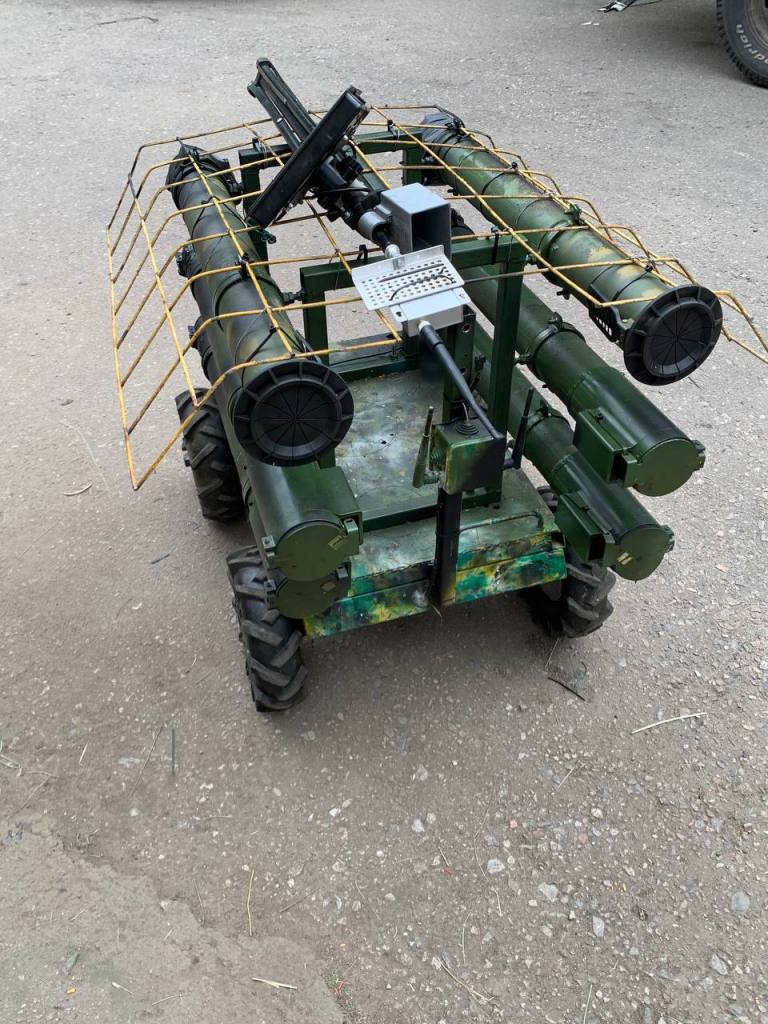
On the 8 November, Two Majors shared video showing the manufacture of the drones, showing piles of components and Hoverboards being modified with new wheels, motors and augmentations to their wiring. The video ends by showing several different variations of UGV all based on the hoverboards. These include UGVs with cargo beds, UGVs designed to carry mines and explosive devices, a mine-clearing variant and a UGV with a sensor mast for reconnaissance.
In a video thanking people for their Hoverboard donations, posted on 22 November, the same collection of Hoverboard UGVs is seen. The video gives us a longer look at the different variants developed by Two Majors. The variants include the reconnaissance UGV, a couple of UGVs with a mine roller for demining, five cargo-carrying variants and four capable of carrying anti-tank mines or smoke generators.
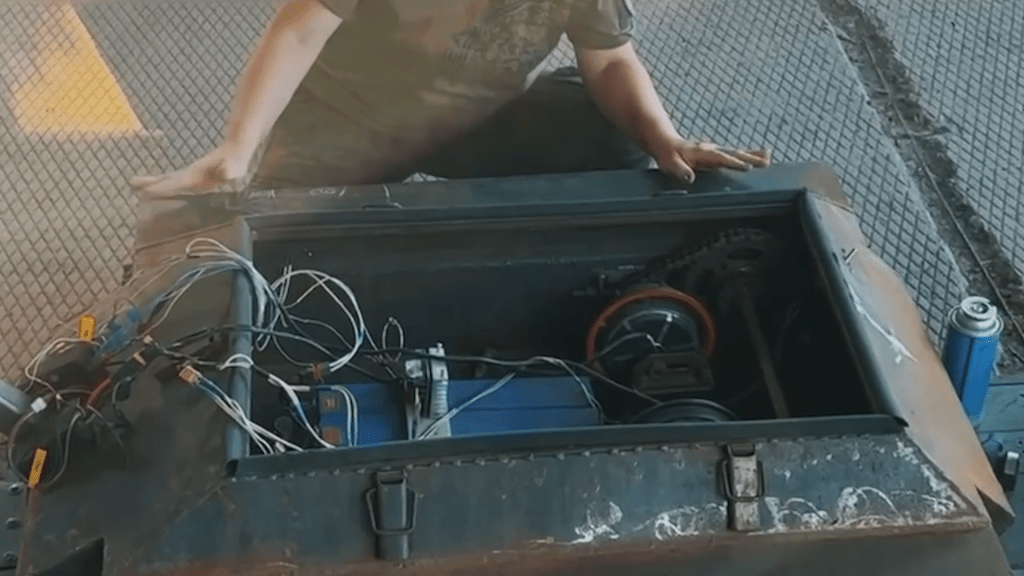
A photograph and a short clip posted to the WagNer Сапëр Telegram channel on 10 February 2025, showed the assembly and testing of another Hoverboard UGV. In the imagery, we can see the UGV without its top cover with its battery, motors and circuits exposed.
A week or so later another Russian channel shared a video showing the collection of donated hoverboards ready for conversion. This indicates that Russian efforts to produce these home-made UGVs are ongoing in a number of regions, personnel are seen loading three hoverboards onto the back of a truck.
On 6 March, Ukrainian journalist Yuri Butusov shared a video from men of the Russian 177th Marine Regiment which showed a logistics variant of the Hoverboard UGV with cargo bed. This is another example of a UGV which uses hoverboard components on a custom built chassis rather than simply bolting several units together. Text in the video appeals for more scooters, in any condition, for use as parts to build more of the cargo UGVs.
In late April a video of Russian troops laughing as a combatant on a hoverboard pushes a two-wheeled cart full of supplies was shared. The fact that the hoverboard appears to have been attached to the cart suggests that this configuration may have found some practical use.
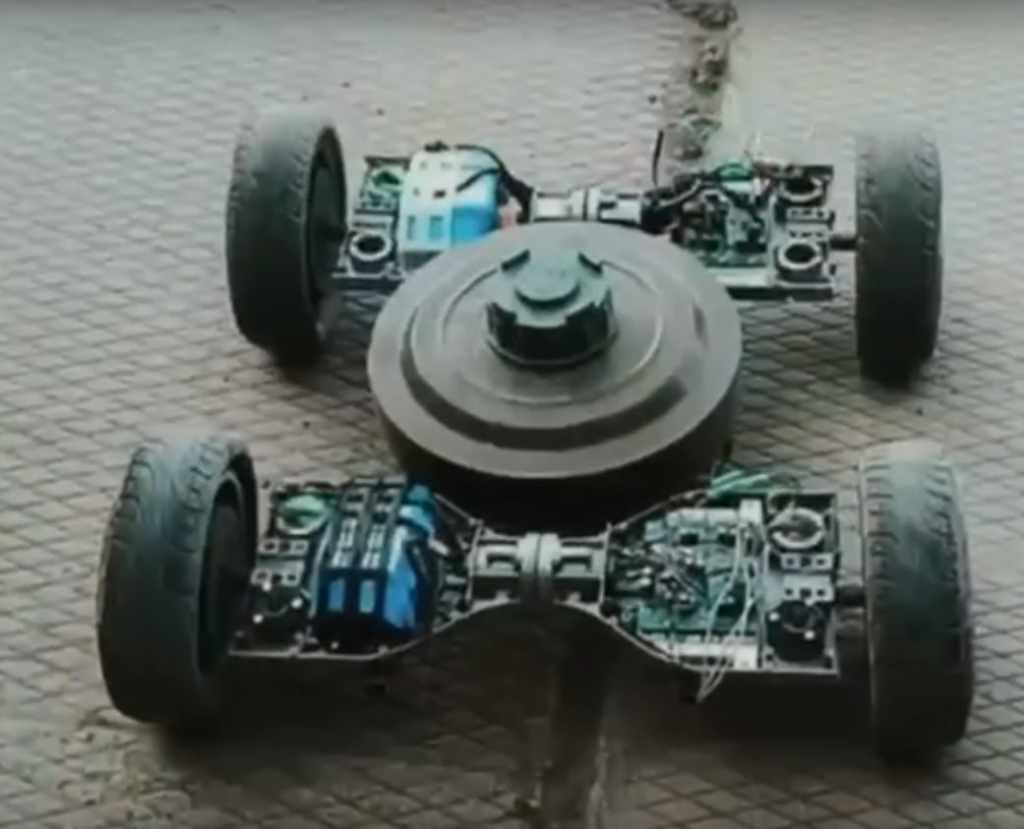
Into May 2025, videos of Hoverboard UGVs continued to be shared on Russian social media channels. On 1 May, a montage of combat footage showing the detonation of a series of the UGVs was shared. While the blasts are substantial, there is no battle damage assessment footage shared to examine the UGVs’ effect downrange despite this the UGVs offer a safer method of delivering substantial explosive payloads to enemy positions without exposing troops. The start of the montage shows a pair of hoverboards bolted together with a TM-62 anti-tank mine as payload. Depending on the variant TM-62s mine are packed with 7.5kg (17lbs) of explosive and is normally centrally fuzed by a mechanical MVCh-62 pressure fuze. It is a High-Explosive Blast (HE-Blast) mine typically with a TNT filling. In this case they are likely command detonated electrically.
Small unmanned ground vehicles are proliferating on both sides, be it the hoverboard-based drones or other small wheeled or tracked UGVs. There appears to be more than a handful of Ukrainian versions of the Hoverboard UGVs too, several are listed on Ukraine’s new Brave1 Market site. The Bombetel-M is an explosive-carrying UGV which uses a hoverboard with a third wheel attached for stability. It replaces the board’s tyres with metal wheels for improved traction and can carry a TM-62 mine. While Kamikaze UGVs like the Smiley (Smailik) and the Trimmer (Тримінер) clearly utilise hoverboard parts its also likely that other Ukrainian UGVs also utilise elements from hoverboards as they are a readily available source of key components. Small llogistics UGVs like the Horse-S, Cockroach 1K and Carpenter also appear to use hoverboard parts.
More recently on 5 May, a Russian telegram channel, VictoryDrones, shared additional photos hoverboard-based kamikaze drones showing a UGV mounte with a TM-62 mine. The caption notes that these drones have good “stability due to gyroscopes and low cost, which allows them to be used en masse.” The caption also suggests that the “drones can move across rough terrain on the front lines faster than any other ground drones.”
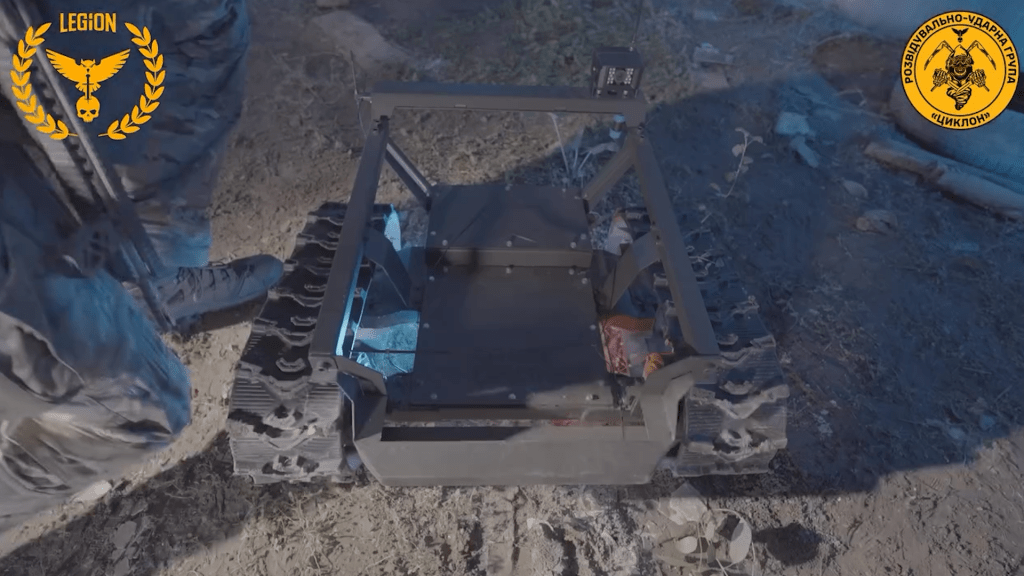
Intriguingly, at the end of June, the HUR’s [Main Directorate of Intelligence] branch of the International Legion announced the production and deployment of a new small UGV called “LEGIT”. The small tracked UGV clearly utilises hoverboard components with the video’s caption explaining that it was co-developed by operators and engineers from the HUR Legion’s Cyclone unmanned systems team in collaboration with specialists. The video shows the LEGIT drone being used to pull cargo in a towed trailer, another is drone being loaded with an explosive payload and driven up to a building and detonated. Finally, the most interesting variant is armed with a pair of Bulgarian Bullspike RPGs on an articulated mount which can be raised and lowered. The video concludes showing the RPG-UGV test firing at a building.

This survey is by no means exhaustive but I have spent over a year tracking the development and proliferation of these UGVs as they represent some of the most basic but useful ground drones developed during the war.
Support Us: If you enjoyed this video and article please consider supporting our work here. We have some great perks available for Patreon Supporters – including early access to custom stickers and early access to videos! You can also find us on the History of Weapons & War app. Thank you for your support!
Discover more from The Armourers Bench
Subscribe to get the latest posts sent to your email.
 The Armourers Bench
2 thoughts on “Russia’s Secret Weapon: Hoverboards”