
A recent video posted by a Russian Telegram channel ‘KOPCAP’ showcased the latest evolution of the homemade rifle-calibre buckshot rounds, a demonstration of 12.7x108mm anti-drone rounds. Back in early December 2024, TAB published an article examining the emerging trend of using ball bearings held inside heat-shrink tubing. The concept was used and developed by both Russian and subsequently Ukrainian personnel. By the Spring of 2025, the concept had evolved into the use of 3D-printed sabots to hold the ball bearings.
The KOPCAP Telegram channel appears to be associated with a volunteer group focused on anti-drone solutions. On 9 August, KOPCAP published a video demonstrating 12.7mm anti-drone rounds being fired from an NSV heavy machine gun. A close-up shows four 12.7x108mm rounds with 3D-printed sabots containing projectiles.
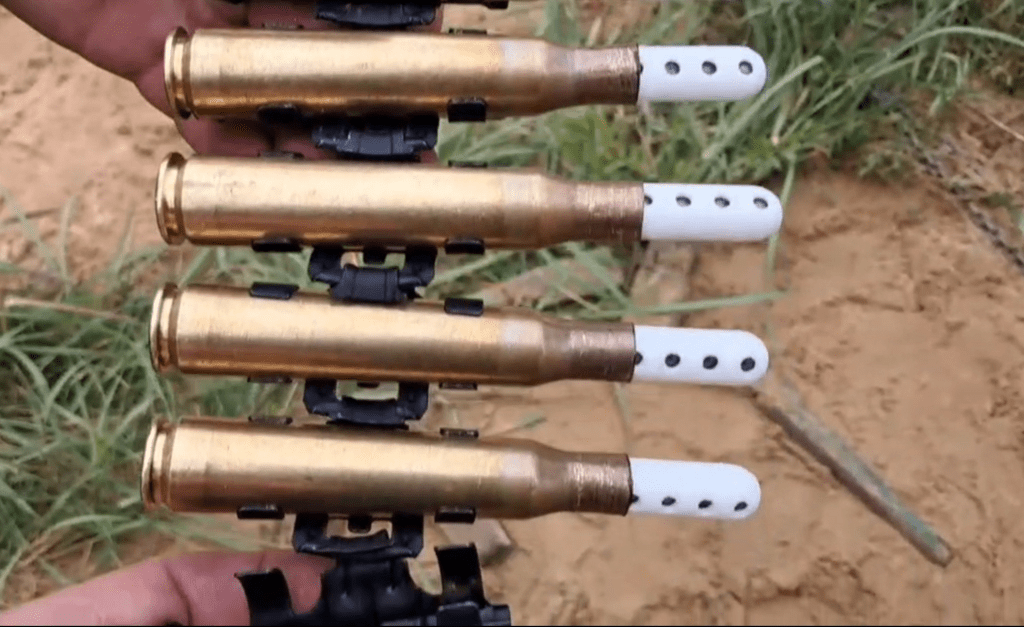
The video’s caption states the projectile sabots are printed using fused filament fabrication, likely with a plastic like PLA. Assembly of the rounds is likely similar to the earlier 5.45x39mm and 7.62x39mm improvised anti-drone rounds. The cartridge’s conventional projectile is pulled and replaced with a 3D-printed sabot containing the projectiles. According to responses from the designers each sabot contains 6 or 7 steel balls of 8.5mm to 9.5mm diameter – slightly larger than 00 Buck.
It’s likely that the sabot disintegrates inside the barrel this likely leaves a residue in the weapon’s rifling and depending on the the material the pellets are made from they could also damage the barrel as they bounce down the barrel before leaving the muzzle.

From the video it appears that five of the rounds were fired during the demonstration at a target which the caption describes as 200 meters downrange. From a possible 30 or 35 projectiles, five are shown to have struck the target – a roughly 1×3 meter board. Giving a roughly 1 in 6 hit rate. The NSV’s tripod does not appear to have been properly weighed down for the demonstration which will likely have contributed to some inaccuracy. It’s also difficult to confirm if the range stated in the video caption is accurate though it does appear that the target is perhaps closer than claimed.
While medium-sized Ukrainian kamikaze drones (one-way munitions) are currently engaged in a campaign of strikes against Russian logistics targets, the development of this locally-produced 12.7mm anti-drone projectile makes more sense, given its limited range and hit probability, for use against smaller drones. The doctrine of use for the round and the ammunition’s effectiveness remains to be seen, and it’s currently unclear if the sabot design is now available; I’ve so far only been able to find a single post highlighting it.
Update – 3/9/26:
A Russian team, PMC SW, posted a video showing the manufacture and testing of some of the KOPCAP 12.7 anti-drone rounds. The caption explained: “We tested the “Antidrone” 12.7mm. We still need to fine-tune the bullet’s trajectory height, the product’s diameter. Now, the designers will create prototypes based on these issues, and we’ll test them for accuracy, precision, and range.”
Support Us: If you enjoyed this video and article please consider supporting our work here. We have some great perks available for Patreon Supporters – including early access to custom stickers and early access to videos! Thank you for your support!
 The Armourers Bench